

537
have progressed towards commercial application [241]. ETG process follows nearly
the same mechanistic pathway that is proposed for MTG process, and accordingly
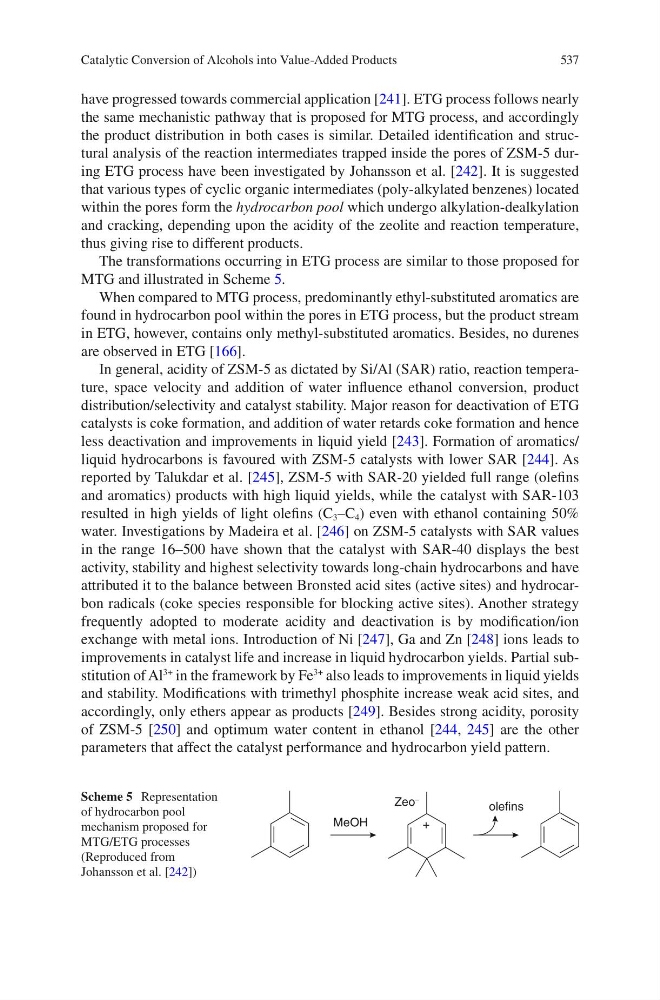
the product distribution in both cases is similar. Detailed identification and structural analysis of the reaction intermediates trapped inside the pores of ZSM-5 during ETG process have been investigated by Johansson et al. [242]. It is suggested
that various types of cyclic organic intermediates (poly-alkylated benzenes) located
within the pores form the hydrocarbon pool which undergo alkylation-dealkylation
and cracking, depending upon the acidity of the zeolite and reaction temperature,
thus giving rise to different products.
The transformations occurring in ETG process are similar to those proposed for
MTG and illustrated in Scheme 5.
When compared to MTG process, predominantly ethyl-substituted aromatics are
found in hydrocarbon pool within the pores in ETG process, but the product stream
in ETG, however, contains only methyl-substituted aromatics. Besides, no durenes
are observed in ETG [166].
In general, acidity of ZSM-5 as dictated by Si/Al (SAR) ratio, reaction temperature, space velocity and addition of water influence ethanol conversion, product
distribution/selectivity and catalyst stability. Major reason for deactivation of ETG
catalysts is coke formation, and addition of water retards coke formation and hence
less deactivation and improvements in liquid yield [243]. Formation of aromatics/
liquid hydrocarbons is favoured with ZSM-5 catalysts with lower SAR [244]. As
reported by Talukdar et al. [245], ZSM-5 with SAR-20 yielded full range (olefins
and aromatics) products with high liquid yields, while the catalyst with SAR-103
resulted in high yields of light olefins (C 3 –C 4 ) even with ethanol containing 50%
water. Investigations by Madeira et al. [246] on ZSM-5 catalysts with SAR values
in the range 16–500 have shown that the catalyst with SAR-40 displays the best
activity, stability and highest selectivity towards long-chain hydrocarbons and have
attributed it to the balance between Bronsted acid sites (active sites) and hydrocarbon radicals (coke species responsible for blocking active sites). Another strategy
frequently adopted to moderate acidity and deactivation is by modification/ion
exchange with metal ions. Introduction of Ni [247], Ga and Zn [248] ions leads to
improvements in catalyst life and increase in liquid hydrocarbon yields. Partial substitution of Al
3+
in the framework by Fe
3+
also leads to improvements in liquid yields
and stability. Modifications with trimethyl phosphite increase weak acid sites, and
accordingly, only ethers appear as products [249]. Besides strong acidity, porosity
of ZSM-5 [250] and optimum water content in ethanol [244, 245] are the other
parameters that affect the catalyst performance and hydrocarbon yield pattern.
MeOH
+
olefins
Zeo
–
Scheme 5 Representation
of hydrocarbon pool
mechanism proposed for
MTG/ETG processes
(Reproduced from
Johansson et al. [242])
Catalytic Conversion of Alcohols into Value-Added Products