

531
2
2
3
2
2
2
2
CH CH OH CH CH CH CH
H O
→
=
−
=
+
+
(4)
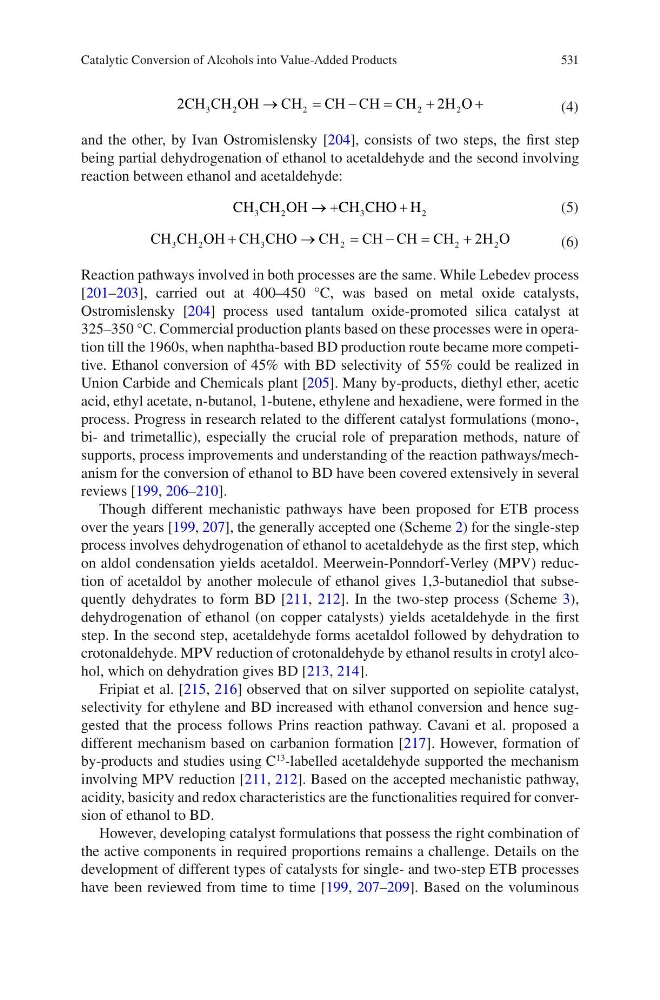
and the other, by Ivan Ostromislensky [204], consists of two steps, the first step
being partial dehydrogenation of ethanol to acetaldehyde and the second involving
reaction between ethanol and acetaldehyde:
CH CH OH
CH CHO H
3
2
3
2
→ +
+
(5)
CH CH OH CH CHO CH CH CH CH
H O
3
2
3
2
2
2
2
+
→
=
−
=
+
(6)
Reaction pathways involved in both processes are the same. While Lebedev process
[201–203], carried out at 400–450 °C, was based on metal oxide catalysts,
Ostromislensky [204] process used tantalum oxide-promoted silica catalyst at
325–350 °C. Commercial production plants based on these processes were in operation till the 1960s, when naphtha-based BD production route became more competitive. Ethanol conversion of 45% with BD selectivity of 55% could be realized in
Union Carbide and Chemicals plant [205]. Many by-products, diethyl ether, acetic
acid, ethyl acetate, n-butanol, 1-butene, ethylene and hexadiene, were formed in the
process. Progress in research related to the different catalyst formulations (mono-,
bi- and trimetallic), especially the crucial role of preparation methods, nature of
supports, process improvements and understanding of the reaction pathways/mechanism for the conversion of ethanol to BD have been covered extensively in several
reviews [199, 206–210].
Though different mechanistic pathways have been proposed for ETB process
over the years [199, 207], the generally accepted one (Scheme 2) for the single-step
process involves dehydrogenation of ethanol to acetaldehyde as the first step, which
on aldol condensation yields acetaldol. Meerwein-Ponndorf-Verley (MPV) reduction of acetaldol by another molecule of ethanol gives 1,3-butanediol that subsequently dehydrates to form BD [211, 212]. In the two-step process (Scheme 3),
dehydrogenation of ethanol (on copper catalysts) yields acetaldehyde in the first
step. In the second step, acetaldehyde forms acetaldol followed by dehydration to
crotonaldehyde. MPV reduction of crotonaldehyde by ethanol results in crotyl alcohol, which on dehydration gives BD [213, 214].
Fripiat et al. [215, 216] observed that on silver supported on sepiolite catalyst,
selectivity for ethylene and BD increased with ethanol conversion and hence suggested that the process follows Prins reaction pathway. Cavani et al. proposed a
different mechanism based on carbanion formation [217]. However, formation of
by-products and studies using C
13
-labelled acetaldehyde supported the mechanism
involving MPV reduction [211, 212]. Based on the accepted mechanistic pathway,
acidity, basicity and redox characteristics are the functionalities required for conversion of ethanol to BD.
However, developing catalyst formulations that possess the right combination of
the active components in required proportions remains a challenge. Details on the
development of different types of catalysts for single- and two-step ETB processes
have been reviewed from time to time [199, 207–209]. Based on the voluminous
Catalytic Conversion of Alcohols into Value-Added Products
2
2
3
2
2
2
2
CH CH OH CH CH CH CH
H O
→
=
−
=
+
+
(4)
and the other, by Ivan Ostromislensky [204], consists of two steps, the first step
being partial dehydrogenation of ethanol to acetaldehyde and the second involving
reaction between ethanol and acetaldehyde:
CH CH OH
CH CHO H
3
2
3
2
→ +
+
(5)
CH CH OH CH CHO CH CH CH CH
H O
3
2
3
2
2
2
2
+
→
=
−
=
+
(6)
Reaction pathways involved in both processes are the same. While Lebedev process
[201–203], carried out at 400–450 °C, was based on metal oxide catalysts,
Ostromislensky [204] process used tantalum oxide-promoted silica catalyst at
325–350 °C. Commercial production plants based on these processes were in operation till the 1960s, when naphtha-based BD production route became more competitive. Ethanol conversion of 45% with BD selectivity of 55% could be realized in
Union Carbide and Chemicals plant [205]. Many by-products, diethyl ether, acetic
acid, ethyl acetate, n-butanol, 1-butene, ethylene and hexadiene, were formed in the
process. Progress in research related to the different catalyst formulations (mono-,
bi- and trimetallic), especially the crucial role of preparation methods, nature of
supports, process improvements and understanding of the reaction pathways/mechanism for the conversion of ethanol to BD have been covered extensively in several
reviews [199, 206–210].
Though different mechanistic pathways have been proposed for ETB process
over the years [199, 207], the generally accepted one (Scheme 2) for the single-step
process involves dehydrogenation of ethanol to acetaldehyde as the first step, which
on aldol condensation yields acetaldol. Meerwein-Ponndorf-Verley (MPV) reduction of acetaldol by another molecule of ethanol gives 1,3-butanediol that subsequently dehydrates to form BD [211, 212]. In the two-step process (Scheme 3),
dehydrogenation of ethanol (on copper catalysts) yields acetaldehyde in the first
step. In the second step, acetaldehyde forms acetaldol followed by dehydration to
crotonaldehyde. MPV reduction of crotonaldehyde by ethanol results in crotyl alcohol, which on dehydration gives BD [213, 214].
Fripiat et al. [215, 216] observed that on silver supported on sepiolite catalyst,
selectivity for ethylene and BD increased with ethanol conversion and hence suggested that the process follows Prins reaction pathway. Cavani et al. proposed a
different mechanism based on carbanion formation [217]. However, formation of
by-products and studies using C
13
-labelled acetaldehyde supported the mechanism
involving MPV reduction [211, 212]. Based on the accepted mechanistic pathway,
acidity, basicity and redox characteristics are the functionalities required for conversion of ethanol to BD.
However, developing catalyst formulations that possess the right combination of
the active components in required proportions remains a challenge. Details on the
development of different types of catalysts for single- and two-step ETB processes
have been reviewed from time to time [199, 207–209]. Based on the voluminous
Catalytic Conversion of Alcohols into Value-Added Products