

529
process thus follows a cascade reaction pathway, involving dehydrogenation, condensation, dehydration and decomposition reactions, taking place in a sequential
manner, yielding isobutene with >80% selectivity in a single step, along with valuable hydrogen as by-product. Overall reaction is expressed as:
3
2
6
3
2
2
4 8
2
2
CH CH OH H O i C H
CO
H
+
→ −
+
+
(3)
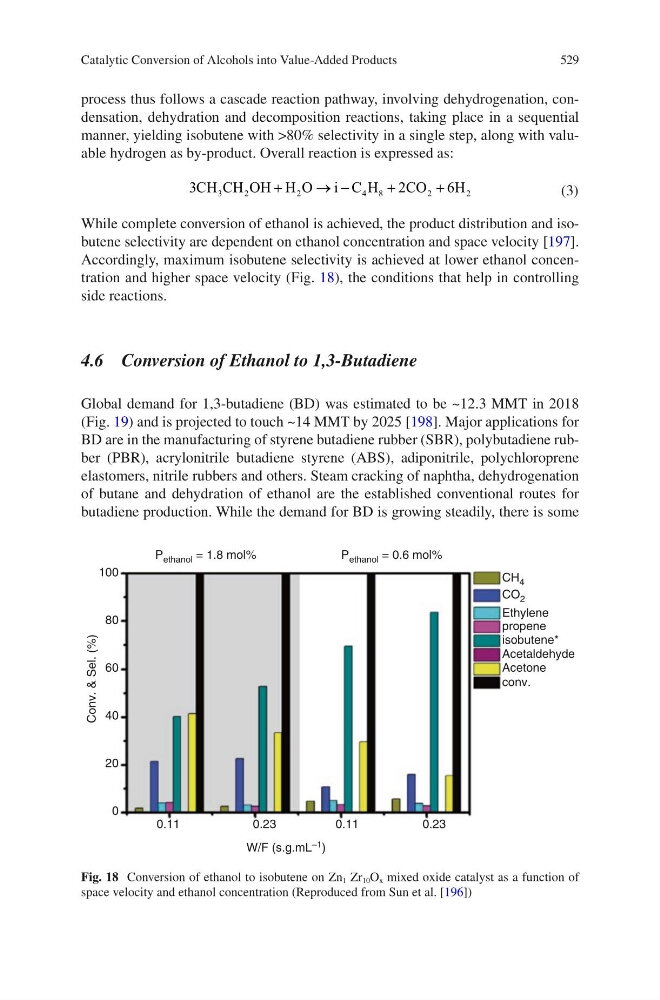
While complete conversion of ethanol is achieved, the product distribution and isobutene selectivity are dependent on ethanol concentration and space velocity [197].
Accordingly, maximum isobutene selectivity is achieved at lower ethanol concentration and higher space velocity (Fig. 18), the conditions that help in controlling
side reactions.
4.6 Conversion of Ethanol to 1,3-Butadiene
Global demand for 1,3-butadiene (BD) was estimated to be ~12.3 MMT in 2018
(Fig. 19) and is projected to touch ~14 MMT by 2025 [198]. Major applications for
BD are in the manufacturing of styrene butadiene rubber (SBR), polybutadiene rubber (PBR), acrylonitrile butadiene styrene (ABS), adiponitrile, polychloroprene
elastomers, nitrile rubbers and others. Steam cracking of naphtha, dehydrogenation
of butane and dehydration of ethanol are the established conventional routes for
butadiene production. While the demand for BD is growing steadily, there is some
100
P ethanol = 1.8 mol%
P ethanol = 0.6 mol%
80
60
40
Conv. & Sel. (%)
20
0
0.11
0.23
W/F (s.g.mL –1 )
0.11
0.23
CH 4
CO 2
Ethylene
propene
isobutene*
Acetaldehyde
Acetone
conv.
Fig. 18 Conversion of ethanol to isobutene on Zn 1 Zr 10 O x mixed oxide catalyst as a function of
space velocity and ethanol concentration (Reproduced from Sun et al. [196])
Catalytic Conversion of Alcohols into Value-Added Products