

518
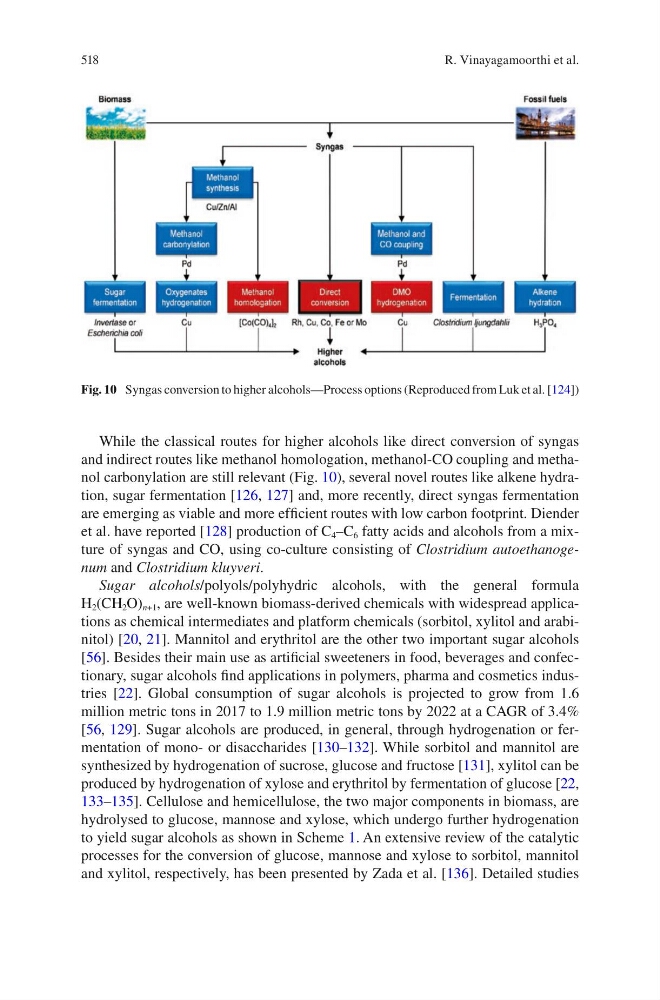
While the classical routes for higher alcohols like direct conversion of syngas
and indirect routes like methanol homologation, methanol-CO coupling and methanol carbonylation are still relevant (Fig. 10), several novel routes like alkene hydration, sugar fermentation [126, 127] and, more recently, direct syngas fermentation
are emerging as viable and more efficient routes with low carbon footprint. Diender
et al. have reported [128] production of C 4 –C 6 fatty acids and alcohols from a mixture of syngas and CO, using co-culture consisting of Clostridium autoethanogenum and Clostridium kluyveri.
Sugar alcohols/polyols/polyhydric alcohols, with the general formula
H 2 (CH 2 O) n+1 , are well-known biomass-derived chemicals with widespread applications as chemical intermediates and platform chemicals (sorbitol, xylitol and arabinitol) [20, 21]. Mannitol and erythritol are the other two important sugar alcohols
[56]. Besides their main use as artificial sweeteners in food, beverages and confectionary, sugar alcohols find applications in polymers, pharma and cosmetics industries [22]. Global consumption of sugar alcohols is projected to grow from 1.6
million metric tons in 2017 to 1.9 million metric tons by 2022 at a CAGR of 3.4%
[56, 129]. Sugar alcohols are produced, in general, through hydrogenation or fermentation of mono- or disaccharides [130–132]. While sorbitol and mannitol are
synthesized by hydrogenation of sucrose, glucose and fructose [131], xylitol can be
produced by hydrogenation of xylose and erythritol by fermentation of glucose [22,
133–135]. Cellulose and hemicellulose, the two major components in biomass, are
hydrolysed to glucose, mannose and xylose, which undergo further hydrogenation
to yield sugar alcohols as shown in Scheme 1. An extensive review of the catalytic
processes for the conversion of glucose, mannose and xylose to sorbitol, mannitol
and xylitol, respectively, has been presented by Zada et al. [136]. Detailed studies
Fig. 10 Syngas conversion to higher alcohols—Process options (Reproduced from Luk et al. [124])
R. Vinayagamoorthi et al.