

513
[59]. 1-Propanol finds applications [57] as a solvent, antimicrobial agent and chemical intermediates for the production of value-added products.
There are two different routes for the manufacture of isopropanol, (1) indirect
hydration of propylene with H 2 SO 4 via a mixture of mono- and di-isopropyl sulphate esters and (2) direct hydration of propylene over an acidic heterogeneous
catalyst [56]. Its applications include use as a solvent in inks and surfactants, as a
chemical intermediate and as a cleaning fluid [57]. Microbial processes for isopropanol production, including Clostridium beijerinckii, engineered E. coli and engineered Clostridium acetobutylicum [60, 61], have been reported.
C 4 alcohols, namely, 1-butanol (n-butanol), 2-butanol (secondary butanol),
2-methyl propanol (isobutanol) and 2-methyl 2-propanol (tertiary butyl alcohol),
are highly versatile in terms of applications as solvents, in manufacturing of chemical intermediates and as fuel additives. Details on the manufacturing of 1-butanol,
2-butanol and 2-methyl propanol by conventional chemical as well as microbial
routes and typical applications have been described by Kunz et al. [56]. 2-Methyl
2-propanol (tertiary butyl alcohol) is produced by hydration of isobutylene [62]. Its
reaction with methanol/ethanol results in methyl tertiary butyl ether (MTBE)/ethyl
tertiary butyl ether (ETBE), useful as octane booster and oxygenate for blending
with gasoline. Tertiary butyl hydroperoxide (TBHP) is another useful chemical
intermediate.
Amongst C 4 alcohols, 1-butanol has the unique distinction of being highly useful
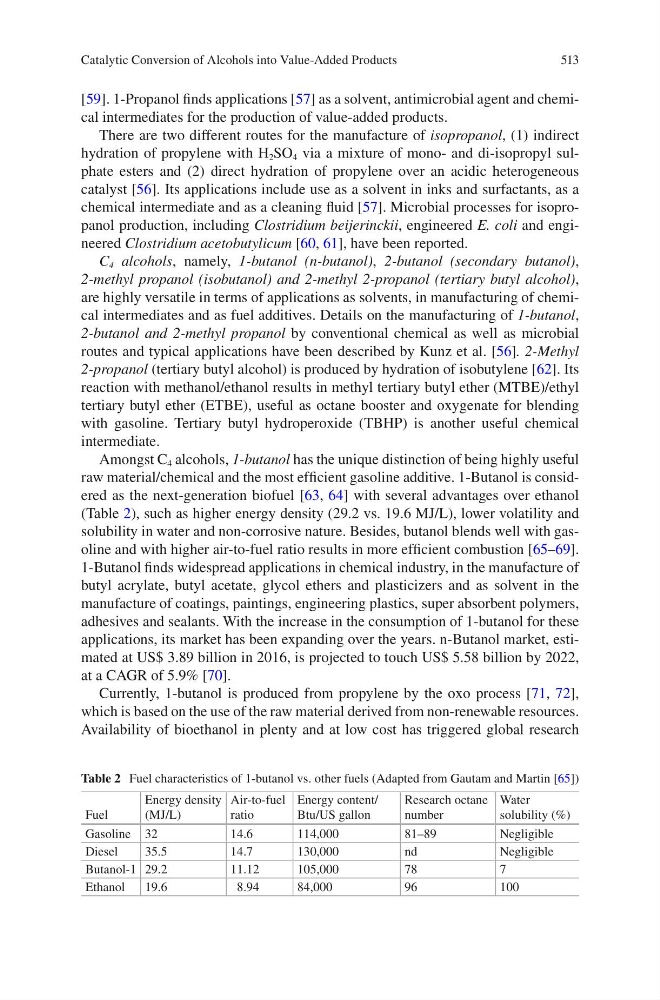
raw material/chemical and the most efficient gasoline additive. 1-Butanol is considered as the next-generation biofuel [63, 64] with several advantages over ethanol
(Table 2), such as higher energy density (29.2 vs. 19.6 MJ/L), lower volatility and
solubility in water and non-corrosive nature. Besides, butanol blends well with gasoline and with higher air-to-fuel ratio results in more efficient combustion [65–69].
1-Butanol finds widespread applications in chemical industry, in the manufacture of
butyl acrylate, butyl acetate, glycol ethers and plasticizers and as solvent in the
manufacture of coatings, paintings, engineering plastics, super absorbent polymers,
adhesives and sealants. With the increase in the consumption of 1-butanol for these
applications, its market has been expanding over the years. n-Butanol market, estimated at US$ 3.89 billion in 2016, is projected to touch US$ 5.58 billion by 2022,
at a CAGR of 5.9% [70].
Currently, 1-butanol is produced from propylene by the oxo process [71, 72],
which is based on the use of the raw material derived from non-renewable resources.
Availability of bioethanol in plenty and at low cost has triggered global research
Table 2 Fuel characteristics of 1-butanol vs. other fuels (Adapted from Gautam and Martin [65])
Fuel
Energy density
(MJ/L)
Air-to-fuel
ratio
Energy content/
Btu/US gallon
Research octane
number
Water
solubility (%)
Gasoline 32
14.6
114,000
81–89
Negligible
Diesel
35.5
14.7
130,000
nd
Negligible
Butanol-1 29.2
11.12
105,000
78
7
Ethanol
19.6
8.94
84,000
96
100
Catalytic Conversion of Alcohols into Value-Added Products