

506
1 Introduction
In the journey towards clean energy and environmental sustainability, identification
of biomass as an alternate, renewable and sustainable resource and the advent of
biomass conversion processes for the production of fuels and chemicals are the two
important milestones [1–5]. Abundant availability of various types of biomass [6–8]
and the development of a series of biomass conversion processes, through homogeneous, heterogeneous and enzymatic catalytic routes, have opened up a new avenue
of research, full of challenges and enormous opportunities [9–12]. Through sustained research efforts, spread over more than three decades, a well-defined road
map in this vital area has been drawn up. Emergence of the concept of biorefinery
[13–15], akin to the petroleum refining/petrochemical plants based on fossil
resources [16, 17], was the first step in this direction. As the nodal entity, biorefinery
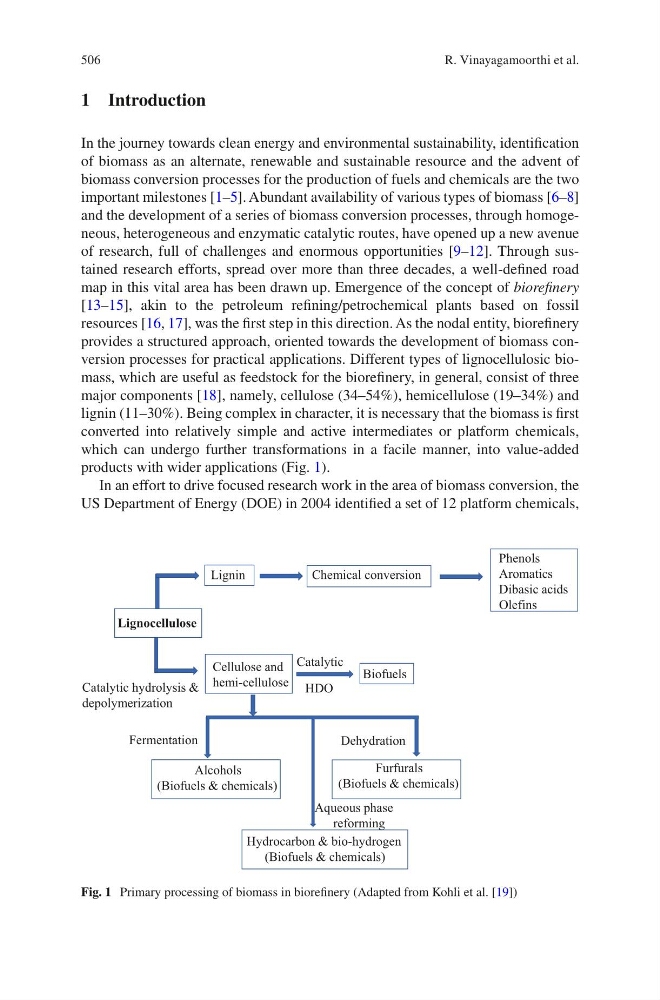
provides a structured approach, oriented towards the development of biomass conversion processes for practical applications. Different types of lignocellulosic biomass, which are useful as feedstock for the biorefinery, in general, consist of three
major components [18], namely, cellulose (34–54%), hemicellulose (19–34%) and
lignin (11–30%). Being complex in character, it is necessary that the biomass is first
converted into relatively simple and active intermediates or platform chemicals,
which can undergo further transformations in a facile manner, into value-added
products with wider applications (Fig. 1).
In an effort to drive focused research work in the area of biomass conversion, the
US Department of Energy (DOE) in 2004 identified a set of 12 platform chemicals,
Lignocellulose
Lignin
Biofuels
Cellulose and
hemi-cellulose
Catalytic hydrolysis &
depolymerization
Catalytic
Chemical conversion
Phenols
Aromatics
Dibasic acids
Olefins
HDO
Fermentation
Dehydration
Aqueous phase
reforming
Alcohols
(Biofuels & chemicals)
Furfurals
(Biofuels & chemicals)
Hydrocarbon & bio-hydrogen
(Biofuels & chemicals)
Fig. 1 Primary processing of biomass in biorefinery (Adapted from Kohli et al. [19])
R. Vinayagamoorthi et al.