

493
reverse reaction; likewise, higher concentration ruins its activity through saturation.
Therefore, it is necessary to maintain an optimum glycerol and acetone molar ratio.
Apart from this, reaction time also plays crucial role in glycerol acetalization reaction. Prolonged reaction time can reduce glycerol conversion through the hydrolysis
of five-membered or six-membered ring [194]. Thus, reaction time must be optimized depending on the catalyst.
7 Prospect and Conclusion
The usage of petroleum chemicals and fuels continues to create pollution hazard
which has a huge impact on the environment. Recently emerging researches for
more sustainable alternatives are interestingly growing very fast, and even commercialization of some processes has already taken place. In recent times a large number of countries in the world have already adopted biodiesel as fuel or fuel additive.
The prime by-product in this biodiesel production is glycerol which is growing at a
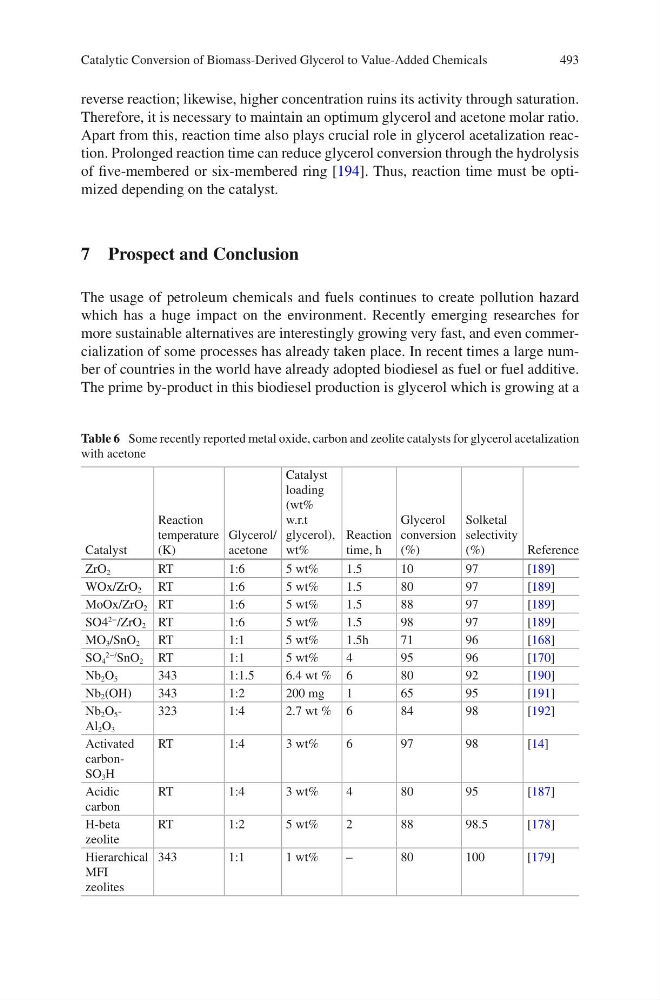
Table 6 Some recently reported metal oxide, carbon and zeolite catalysts for glycerol acetalization
with acetone
Catalyst
Reaction
temperature
(K)
Glycerol/
acetone
Catalyst
loading
(wt%
w.r.t
glycerol),
wt%
Reaction
time, h
Glycerol
conversion
(%)
Solketal
selectivity
(%)
Reference
ZrO 2
RT
1:6
5 wt%
1.5
10
97
[189]
WOx/ZrO 2 RT
1:6
5 wt%
1.5
80
97
[189]
MoOx/ZrO 2 RT
1:6
5 wt%
1.5
88
97
[189]
SO4
2−
/ZrO 2 RT
1:6
5 wt%
1.5
98
97
[189]
MO 3 /SnO 2 RT
1:1
5 wt%
1.5h
71
96
[168]
SO 4
2−/ SnO 2 RT
1:1
5 wt%
4
95
96
[170]
Nb 2 O 5
343
1:1.5
6.4 wt % 6
80
92
[190]
Nb 2 (OH)
343
1:2
200 mg
1
65
95
[191]
Nb 2 O 5 -
Al 2 O 3
323
1:4
2.7 wt % 6
84
98
[192]
Activated
carbonSO 3 H
RT
1:4
3 wt%
6
97
98
[14]
Acidic
carbon
RT
1:4
3 wt%
4
80
95
[187]
H-beta
zeolite
RT
1:2
5 wt%
2
88
98.5
[178]
Hierarchical
MFI
zeolites
343
1:1
1 wt%
–
80
100
[179]
Catalytic Conversion of Biomass-Derived Glycerol to Value-Added Chemicals
reverse reaction; likewise, higher concentration ruins its activity through saturation.
Therefore, it is necessary to maintain an optimum glycerol and acetone molar ratio.
Apart from this, reaction time also plays crucial role in glycerol acetalization reaction. Prolonged reaction time can reduce glycerol conversion through the hydrolysis
of five-membered or six-membered ring [194]. Thus, reaction time must be optimized depending on the catalyst.
7 Prospect and Conclusion
The usage of petroleum chemicals and fuels continues to create pollution hazard
which has a huge impact on the environment. Recently emerging researches for
more sustainable alternatives are interestingly growing very fast, and even commercialization of some processes has already taken place. In recent times a large number of countries in the world have already adopted biodiesel as fuel or fuel additive.
The prime by-product in this biodiesel production is glycerol which is growing at a
Table 6 Some recently reported metal oxide, carbon and zeolite catalysts for glycerol acetalization
with acetone
Catalyst
Reaction
temperature
(K)
Glycerol/
acetone
Catalyst
loading
(wt%
w.r.t
glycerol),
wt%
Reaction
time, h
Glycerol
conversion
(%)
Solketal
selectivity
(%)
Reference
ZrO 2
RT
1:6
5 wt%
1.5
10
97
[189]
WOx/ZrO 2 RT
1:6
5 wt%
1.5
80
97
[189]
MoOx/ZrO 2 RT
1:6
5 wt%
1.5
88
97
[189]
SO4
2−
/ZrO 2 RT
1:6
5 wt%
1.5
98
97
[189]
MO 3 /SnO 2 RT
1:1
5 wt%
1.5h
71
96
[168]
SO 4
2−/ SnO 2 RT
1:1
5 wt%
4
95
96
[170]
Nb 2 O 5
343
1:1.5
6.4 wt % 6
80
92
[190]
Nb 2 (OH)
343
1:2
200 mg
1
65
95
[191]
Nb 2 O 5 -
Al 2 O 3
323
1:4
2.7 wt % 6
84
98
[192]
Activated
carbonSO 3 H
RT
1:4
3 wt%
6
97
98
[14]
Acidic
carbon
RT
1:4
3 wt%
4
80
95
[187]
H-beta
zeolite
RT
1:2
5 wt%
2
88
98.5
[178]
Hierarchical
MFI
zeolites
343
1:1
1 wt%
–
80
100
[179]
Catalytic Conversion of Biomass-Derived Glycerol to Value-Added Chemicals