

475
the Sn-catalysts [100, 101]. Addition of methanol as an alcoholic solvent helped to
improve the yield from 7% to 35%. The findings of thermodynamic estimations
indicated that this reaction is thermodynamically limited, which also explains the
reported low yields of the reaction. An alternate synthetic procedure was suggested
by Ochoa-Gomez et al. Among the three steps in this procedure, first, CO 2 capture
takes place which will act as carbonation source and then glycerol to 3-chloro-1,2
propanediol synthesis followed by converting it into glycerol carbonate with the
carbonation source [102]. They also synthesized glycerol carbonate in another successive study where along with 3-chloro-1,2-propanediol and carbon dioxide, triethylamine was used both as solvent and CO 2 fixing and activating agent, where
they could achieve glycerol carbonate yield of 90% [103]. Another work of direct
carboxylation was reported by Aresta et al. [100, 104] where transition metal alkoxides (Sn-catalysts) were used. Among different Sn-based catalysts, n-Bu 2 Sn(OMe) 2
was found to be superior in catalytic activity. All the above findings certainly indicate that there is still lot of room for modification to produce glycerol carbonate
from glycerol and CO 2 more effectively and energy efficiently.
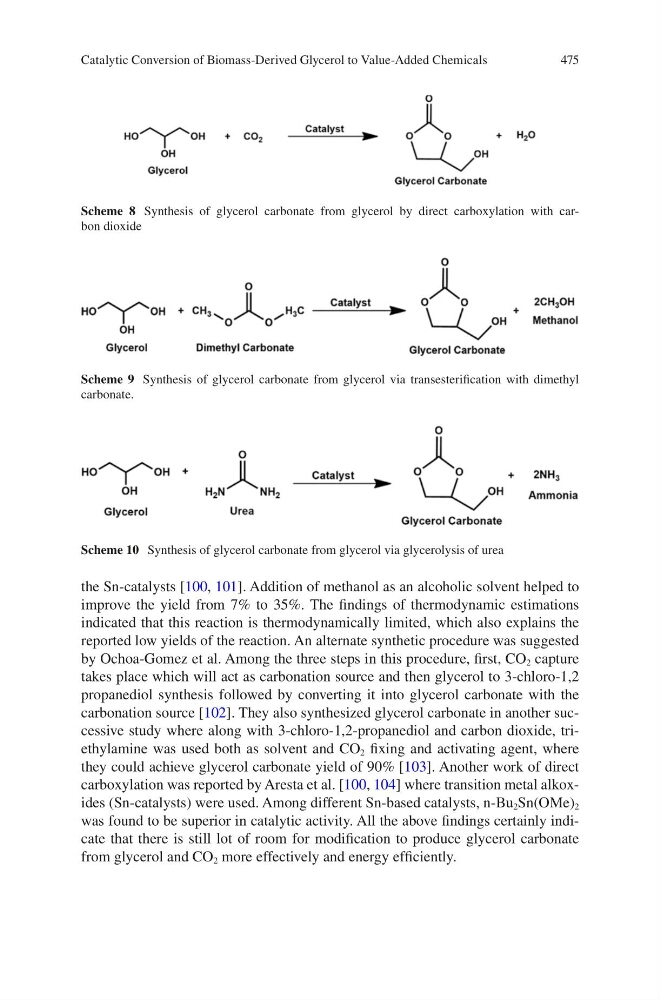
Scheme 8 Synthesis of glycerol carbonate from glycerol by direct carboxylation with carbon dioxide
Scheme 9 Synthesis of glycerol carbonate from glycerol via transesterification with dimethyl
carbonate.
Scheme 10 Synthesis of glycerol carbonate from glycerol via glycerolysis of urea
Catalytic Conversion of Biomass-Derived Glycerol to Value-Added Chemicals
the Sn-catalysts [100, 101]. Addition of methanol as an alcoholic solvent helped to
improve the yield from 7% to 35%. The findings of thermodynamic estimations
indicated that this reaction is thermodynamically limited, which also explains the
reported low yields of the reaction. An alternate synthetic procedure was suggested
by Ochoa-Gomez et al. Among the three steps in this procedure, first, CO 2 capture
takes place which will act as carbonation source and then glycerol to 3-chloro-1,2
propanediol synthesis followed by converting it into glycerol carbonate with the
carbonation source [102]. They also synthesized glycerol carbonate in another successive study where along with 3-chloro-1,2-propanediol and carbon dioxide, triethylamine was used both as solvent and CO 2 fixing and activating agent, where
they could achieve glycerol carbonate yield of 90% [103]. Another work of direct
carboxylation was reported by Aresta et al. [100, 104] where transition metal alkoxides (Sn-catalysts) were used. Among different Sn-based catalysts, n-Bu 2 Sn(OMe) 2
was found to be superior in catalytic activity. All the above findings certainly indicate that there is still lot of room for modification to produce glycerol carbonate
from glycerol and CO 2 more effectively and energy efficiently.
Scheme 8 Synthesis of glycerol carbonate from glycerol by direct carboxylation with carbon dioxide
Scheme 9 Synthesis of glycerol carbonate from glycerol via transesterification with dimethyl
carbonate.
Scheme 10 Synthesis of glycerol carbonate from glycerol via glycerolysis of urea
Catalytic Conversion of Biomass-Derived Glycerol to Value-Added Chemicals