

473
3.4 Effects of Physicochemical Properties of the Catalyst
on Acrolein Yield
The two main properties of the catalyst which significantly affect glycerol dehydration to acrolein are the acidic property and the textural property. The general consideration is that Brønsted acidic sites facilitate acrolein formation. Chai et al. [97]
studied an array of catalysts with different acid strengths for the glycerol dehydration reaction. According to their observation, catalysts with very strong acid sites
achieved lower acrolein yields (40–50%) due to severe deposition of coke, while
catalysts with strong acid sites found to be most effective in terms of acrolein yield
(60–70%). On the other hand, catalysts having moderate or weak acid sites could
attain low acrolein yield due to their low selectivity (30%). This simply indicates
that catalysts with very strong acidity lead to serious deposition of coke. The textural properties of the catalyst are also associated with formation of coke which
eventually leads to deactivation. In an investigation by Sato’s group, they prepared
heteropolyacid supported on SiO 2 with different pore sizes of 3, 6, and 10 nm [61].
It was observed that the catalyst with largest pore size demonstrated durable catalytic performance, whereas the silica with small pore size results in fast deactivation. The observation was supported by Atia et al. [23] where they did the same type
of study with Al 2 O 3 -supported heteropolyacids. It was concluded that open and
interconnected mesopores in catalyst are more stable than closed and small mesopores which tend to deactivate early due to the heavy production and transfer limitations of coke formed in the pores.
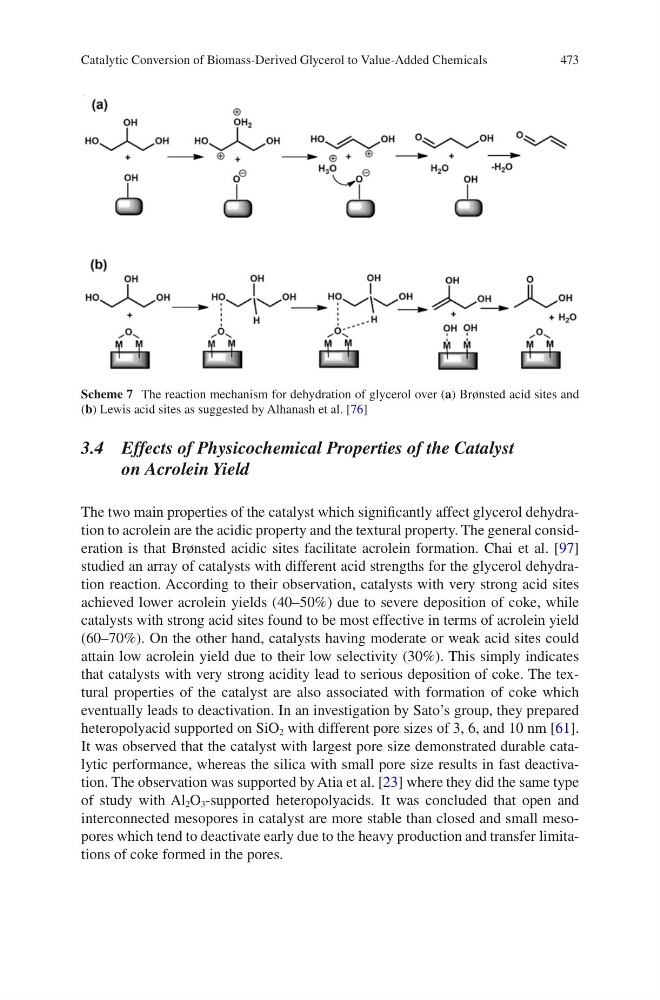
Scheme 7 The reaction mechanism for dehydration of glycerol over (a) Brønsted acid sites and
(b) Lewis acid sites as suggested by Alhanash et al. [76]
Catalytic Conversion of Biomass-Derived Glycerol to Value-Added Chemicals
3.4 Effects of Physicochemical Properties of the Catalyst
on Acrolein Yield
The two main properties of the catalyst which significantly affect glycerol dehydration to acrolein are the acidic property and the textural property. The general consideration is that Brønsted acidic sites facilitate acrolein formation. Chai et al. [97]
studied an array of catalysts with different acid strengths for the glycerol dehydration reaction. According to their observation, catalysts with very strong acid sites
achieved lower acrolein yields (40–50%) due to severe deposition of coke, while
catalysts with strong acid sites found to be most effective in terms of acrolein yield
(60–70%). On the other hand, catalysts having moderate or weak acid sites could
attain low acrolein yield due to their low selectivity (30%). This simply indicates
that catalysts with very strong acidity lead to serious deposition of coke. The textural properties of the catalyst are also associated with formation of coke which
eventually leads to deactivation. In an investigation by Sato’s group, they prepared
heteropolyacid supported on SiO 2 with different pore sizes of 3, 6, and 10 nm [61].
It was observed that the catalyst with largest pore size demonstrated durable catalytic performance, whereas the silica with small pore size results in fast deactivation. The observation was supported by Atia et al. [23] where they did the same type
of study with Al 2 O 3 -supported heteropolyacids. It was concluded that open and
interconnected mesopores in catalyst are more stable than closed and small mesopores which tend to deactivate early due to the heavy production and transfer limitations of coke formed in the pores.
Scheme 7 The reaction mechanism for dehydration of glycerol over (a) Brønsted acid sites and
(b) Lewis acid sites as suggested by Alhanash et al. [76]
Catalytic Conversion of Biomass-Derived Glycerol to Value-Added Chemicals