

445
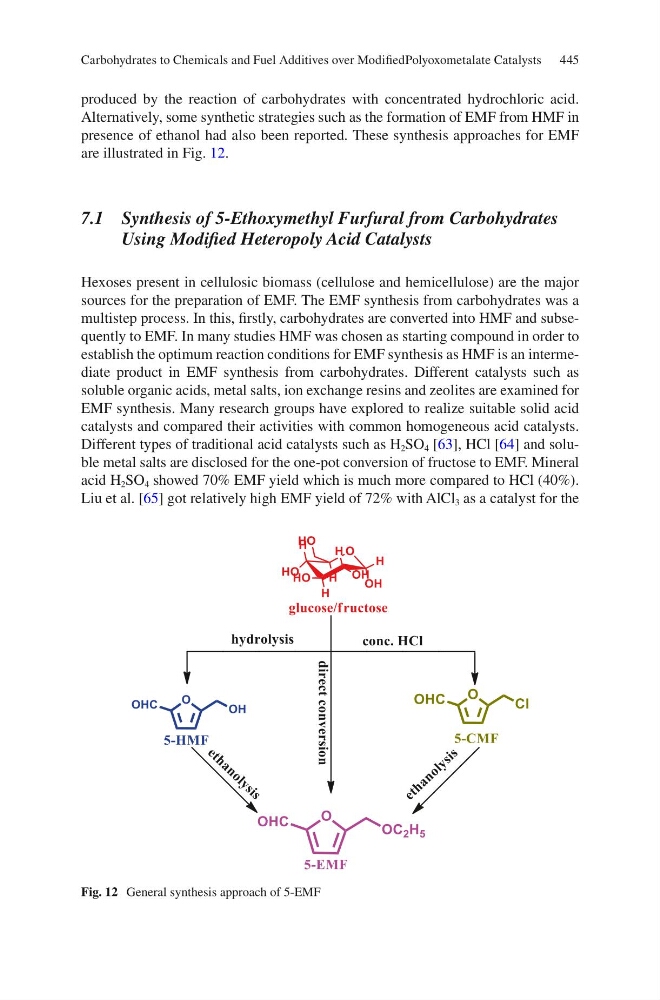
produced by the reaction of carbohydrates with concentrated hydrochloric acid.
Alternatively, some synthetic strategies such as the formation of EMF from HMF in
presence of ethanol had also been reported. These synthesis approaches for EMF
are illustrated in Fig. 12.
7.1 Synthesis of 5-Ethoxymethyl Furfural from Carbohydrates
Using Modified Heteropoly Acid Catalysts
Hexoses present in cellulosic biomass (cellulose and hemicellulose) are the major
sources for the preparation of EMF. The EMF synthesis from carbohydrates was a
multistep process. In this, firstly, carbohydrates are converted into HMF and subsequently to EMF. In many studies HMF was chosen as starting compound in order to
establish the optimum reaction conditions for EMF synthesis as HMF is an intermediate product in EMF synthesis from carbohydrates. Different catalysts such as
soluble organic acids, metal salts, ion exchange resins and zeolites are examined for
EMF synthesis. Many research groups have explored to realize suitable solid acid
catalysts and compared their activities with common homogeneous acid catalysts.
Different types of traditional acid catalysts such as H 2 SO 4 [63], HCl [64] and soluble metal salts are disclosed for the one-pot conversion of fructose to EMF. Mineral
acid H 2 SO 4 showed 70% EMF yield which is much more compared to HCl (40%).
Liu et al. [65] got relatively high EMF yield of 72% with AlCl 3 as a catalyst for the
Fig. 12 General synthesis approach of 5-EMF
Carbohydrates to Chemicals and Fuel Additives over ModifiedPolyoxometalate Catalysts
produced by the reaction of carbohydrates with concentrated hydrochloric acid.
Alternatively, some synthetic strategies such as the formation of EMF from HMF in
presence of ethanol had also been reported. These synthesis approaches for EMF
are illustrated in Fig. 12.
7.1 Synthesis of 5-Ethoxymethyl Furfural from Carbohydrates
Using Modified Heteropoly Acid Catalysts
Hexoses present in cellulosic biomass (cellulose and hemicellulose) are the major
sources for the preparation of EMF. The EMF synthesis from carbohydrates was a
multistep process. In this, firstly, carbohydrates are converted into HMF and subsequently to EMF. In many studies HMF was chosen as starting compound in order to
establish the optimum reaction conditions for EMF synthesis as HMF is an intermediate product in EMF synthesis from carbohydrates. Different catalysts such as
soluble organic acids, metal salts, ion exchange resins and zeolites are examined for
EMF synthesis. Many research groups have explored to realize suitable solid acid
catalysts and compared their activities with common homogeneous acid catalysts.
Different types of traditional acid catalysts such as H 2 SO 4 [63], HCl [64] and soluble metal salts are disclosed for the one-pot conversion of fructose to EMF. Mineral
acid H 2 SO 4 showed 70% EMF yield which is much more compared to HCl (40%).
Liu et al. [65] got relatively high EMF yield of 72% with AlCl 3 as a catalyst for the
Fig. 12 General synthesis approach of 5-EMF
Carbohydrates to Chemicals and Fuel Additives over ModifiedPolyoxometalate Catalysts