

440
reactions involving polar molecules as reactants or products. Furthermore, the thermal stability of pure heteropoly acids is very low and cannot be used in vapourphase reactions. In order to overcome these shortcomings and extend their catalytic
applications in a wide range, these materials have to be modified.
HPAs can be modified in the following ways:
1. By exchange of HPA protons with various metal cations
2. By supporting them on suitable solid supports
1. Metal-Exchanged Keggin Heteropoly Acids
HPAs can be modified by replacing the protons partially or fully with metal
ions in secondary structure without altering the primary structure. Metalexchanged Keggin HPAs, indicated by formula M
1 X H Y-X M
2
M
3 12 O 40 , where
M
1
= Cs
+
, Rb
+
, etc., M
2
= P or Si, M
3
= W or Mo, x = 2.5 and y = 3 or 4 if M
2
is
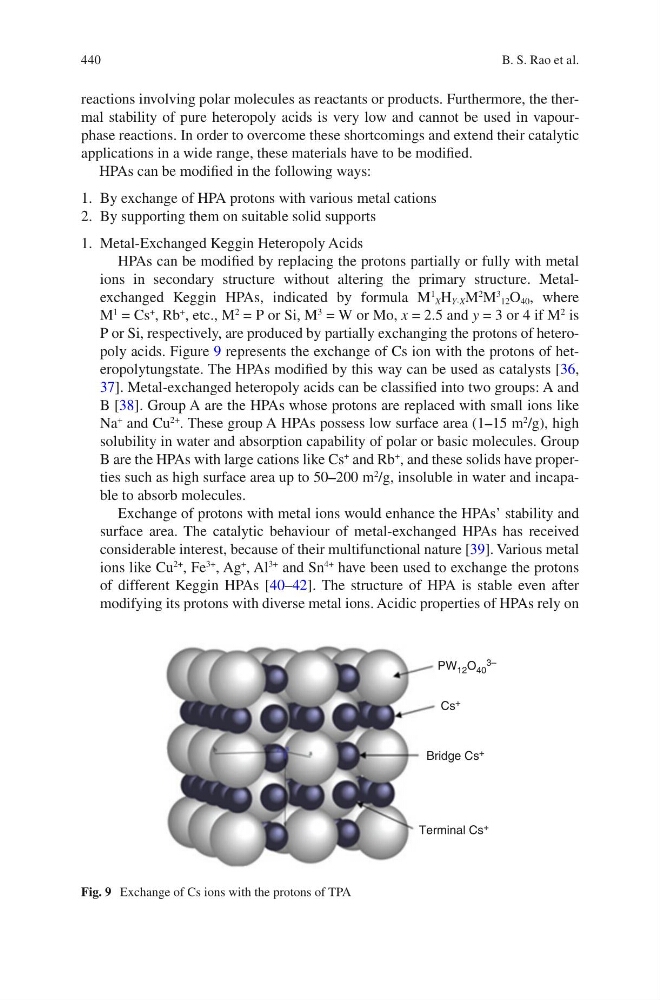
P or Si, respectively, are produced by partially exchanging the protons of heteropoly acids. Figure 9 represents the exchange of Cs ion with the protons of heteropolytungstate. The HPAs modified by this way can be used as catalysts [36,
37]. Metal-exchanged heteropoly acids can be classified into two groups: A and
B [38]. Group A are the HPAs whose protons are replaced with small ions like
Na
+
and Cu
2+
. These group A HPAs possess low surface area (1–15 m
2
/g), high
solubility in water and absorption capability of polar or basic molecules. Group
B are the HPAs with large cations like Cs
+
and Rb
+
, and these solids have properties such as high surface area up to 50–200 m
2
/g, insoluble in water and incapable to absorb molecules.
Exchange of protons with metal ions would enhance the HPAs’ stability and
surface area. The catalytic behaviour of metal-exchanged HPAs has received
considerable interest, because of their multifunctional nature [39]. Various metal
ions like Cu
2+
, Fe
3+
, Ag
+
, Al
3+
and Sn
4+
have been used to exchange the protons
of different Keggin HPAs [40–42]. The structure of HPA is stable even after
modifying its protons with diverse metal ions. Acidic properties of HPAs rely on
PW 12 O 40
3–
Cs +
Bridge Cs +
Terminal Cs +
Fig. 9 Exchange of Cs ions with the protons of TPA
B. S. Rao et al.
reactions involving polar molecules as reactants or products. Furthermore, the thermal stability of pure heteropoly acids is very low and cannot be used in vapourphase reactions. In order to overcome these shortcomings and extend their catalytic
applications in a wide range, these materials have to be modified.
HPAs can be modified in the following ways:
1. By exchange of HPA protons with various metal cations
2. By supporting them on suitable solid supports
1. Metal-Exchanged Keggin Heteropoly Acids
HPAs can be modified by replacing the protons partially or fully with metal
ions in secondary structure without altering the primary structure. Metalexchanged Keggin HPAs, indicated by formula M
1 X H Y-X M
2
M
3 12 O 40 , where
M
1
= Cs
+
, Rb
+
, etc., M
2
= P or Si, M
3
= W or Mo, x = 2.5 and y = 3 or 4 if M
2
is
P or Si, respectively, are produced by partially exchanging the protons of heteropoly acids. Figure 9 represents the exchange of Cs ion with the protons of heteropolytungstate. The HPAs modified by this way can be used as catalysts [36,
37]. Metal-exchanged heteropoly acids can be classified into two groups: A and
B [38]. Group A are the HPAs whose protons are replaced with small ions like
Na
+
and Cu
2+
. These group A HPAs possess low surface area (1–15 m
2
/g), high
solubility in water and absorption capability of polar or basic molecules. Group
B are the HPAs with large cations like Cs
+
and Rb
+
, and these solids have properties such as high surface area up to 50–200 m
2
/g, insoluble in water and incapable to absorb molecules.
Exchange of protons with metal ions would enhance the HPAs’ stability and
surface area. The catalytic behaviour of metal-exchanged HPAs has received
considerable interest, because of their multifunctional nature [39]. Various metal
ions like Cu
2+
, Fe
3+
, Ag
+
, Al
3+
and Sn
4+
have been used to exchange the protons
of different Keggin HPAs [40–42]. The structure of HPA is stable even after
modifying its protons with diverse metal ions. Acidic properties of HPAs rely on
PW 12 O 40
3–
Cs +
Bridge Cs +
Terminal Cs +
Fig. 9 Exchange of Cs ions with the protons of TPA
B. S. Rao et al.