

359
ligand concept were first reported in 1991. They are three-dimensional porous
hybrid materials made up of organic units (multidentate hydrophobic linkers) and
metal ions (metal-ions-oxo clusters) [78–80]. These organic structures have the
potential for manipulation, through varying the metal ions, their counter-anions,
organic linkers, and mixed organic linkers and through the control of the architectures and functionalization of the pores [81, 82]. Various combinations of organic
unit and metal ion-oxo-cluster generates a library of MOFs. High variability and
possibility of modifications are two salient features of MOFs which enables one to
design tailor-made MOFs for desired end-use applications [72, 73, 79]. In the last
decade, the design and synthesis of such supramolecular assemblies have attracted
considerable attention due to their potential applications as smart optoelectronics,
magnetic, heterogeneous catalysis, sensors, and gas storage and in separation, due
to their inherently high surface areas, uniform and tuneable pore sizes, and ample
possibilities for functionalization [80, 83–87]. MOFs may be produced to act as
highly selective molecular sieves, sensors, or catalysts. Incorporation of guest species generates sensing capabilities of MOFs. The guest species can be removed and
reintroduced reversibly without collapse of the framework [88].
Catalysis is often regarded as a desirable attribute of MOFs. Kim and coworkers
[85] studied the enantiopure Zn-based MOFs involving coordination linkages with
pyridinium functional groups and demonstrated catalytic activity in transesterification reaction.
An esterification reaction can also be well executed using Brønsted acidity of
MOFs, which is attributed to the functional groups present in them. Because of
improved mass transport and structure tunability, these materials have tremendous
possibilities from the point of view of designing a highly active heterogeneous catalyst for targeted applications [89]. UiO-66 MOF whose nominal composition is
Zr 6 O 4 (OH) 4 (BDC) 6 (BDC = 1,4-benezene dicarboxylate). This MOF is made of
12-coordinated Zr 6 O 4 (OH) 4 metal clusters (Zr6 nodes linked with benzene dicarboxylate linkers). [90–92]. From catalysis perspective, favorable porosity and
O
O
O
O
O
+
H 2 O
levulinic acid
n-butyl levulinate
n-butanol
Zeolite
OH
HO
+
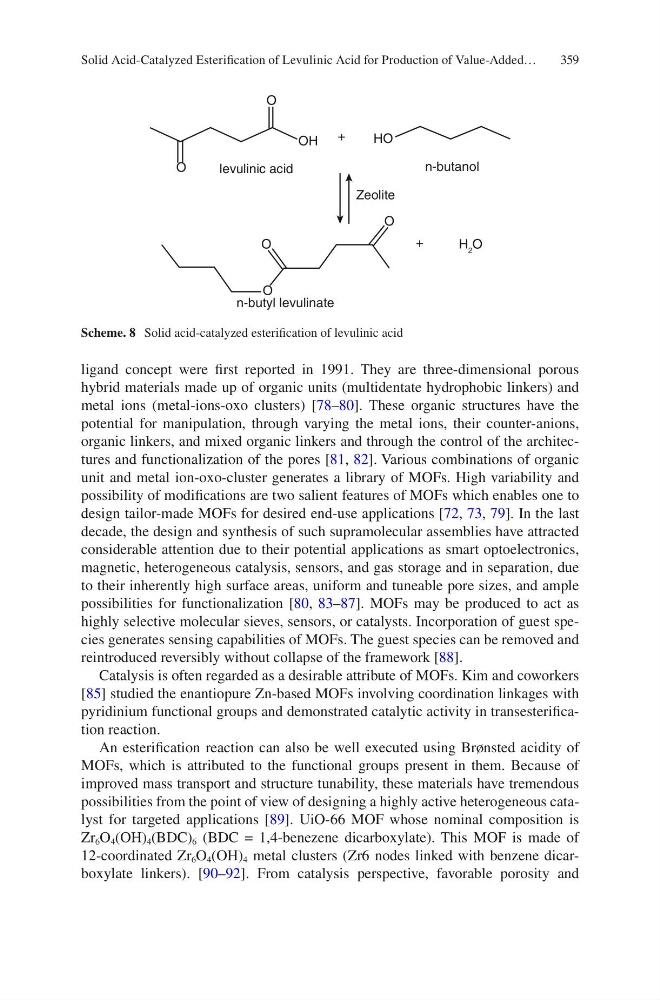
Scheme. 8 Solid acid-catalyzed esterification of levulinic acid
Solid Acid-Catalyzed Esterification of Levulinic Acid for Production of Value-Added…
ligand concept were first reported in 1991. They are three-dimensional porous
hybrid materials made up of organic units (multidentate hydrophobic linkers) and
metal ions (metal-ions-oxo clusters) [78–80]. These organic structures have the
potential for manipulation, through varying the metal ions, their counter-anions,
organic linkers, and mixed organic linkers and through the control of the architectures and functionalization of the pores [81, 82]. Various combinations of organic
unit and metal ion-oxo-cluster generates a library of MOFs. High variability and
possibility of modifications are two salient features of MOFs which enables one to
design tailor-made MOFs for desired end-use applications [72, 73, 79]. In the last
decade, the design and synthesis of such supramolecular assemblies have attracted
considerable attention due to their potential applications as smart optoelectronics,
magnetic, heterogeneous catalysis, sensors, and gas storage and in separation, due
to their inherently high surface areas, uniform and tuneable pore sizes, and ample
possibilities for functionalization [80, 83–87]. MOFs may be produced to act as
highly selective molecular sieves, sensors, or catalysts. Incorporation of guest species generates sensing capabilities of MOFs. The guest species can be removed and
reintroduced reversibly without collapse of the framework [88].
Catalysis is often regarded as a desirable attribute of MOFs. Kim and coworkers
[85] studied the enantiopure Zn-based MOFs involving coordination linkages with
pyridinium functional groups and demonstrated catalytic activity in transesterification reaction.
An esterification reaction can also be well executed using Brønsted acidity of
MOFs, which is attributed to the functional groups present in them. Because of
improved mass transport and structure tunability, these materials have tremendous
possibilities from the point of view of designing a highly active heterogeneous catalyst for targeted applications [89]. UiO-66 MOF whose nominal composition is
Zr 6 O 4 (OH) 4 (BDC) 6 (BDC = 1,4-benezene dicarboxylate). This MOF is made of
12-coordinated Zr 6 O 4 (OH) 4 metal clusters (Zr6 nodes linked with benzene dicarboxylate linkers). [90–92]. From catalysis perspective, favorable porosity and
O
O
O
O
O
+
H 2 O
levulinic acid
n-butyl levulinate
n-butanol
Zeolite
OH
HO
+
Scheme. 8 Solid acid-catalyzed esterification of levulinic acid
Solid Acid-Catalyzed Esterification of Levulinic Acid for Production of Value-Added…