

352
3.3 Synthesis of Valeric Biofuels from LA
As shown above, GVL and LA as well can be converted to other useful value-added
products. Similar to 1,4-PDO and 2-MTHF, GVL and, ultimately, LA can be converted into liquid hydrocarbon fuels like alkanes by applying selective catalytic
pathways. The reaction path goes away in two different steps, in which the first step
involves the ring opening reaction of GVL and generation of pentanoic acid. While
in the second step, the reaction of pentanoic acid with dicarboxylic acid leads to the
formation of butenes. Butenes can be further applied as a precursor for the synthesis
of C8 alkanes.
Lange et al. [37] have introduced valeric biofuels, which are the new derivatives
of LA and are fully compatible as transportation fuels. In the report, GVL is first
converted into pentanoic acid over Pt/ZSM-5 as the bifunctional metal acid catalyst.
By the use of Pt-based bifunctional catalyst, a yield of up to 90% of pentanoic acid
is achieved. Further, pentanoic acid is converted to valerate ester by esterification
reaction in the presence of solid acid catalyst and alcohols. Zaccheria et al. have
reported the simple one-step process for the production of pentylvalerate from GVL
using Cu-supported SiO 2 -ZrO 2 catalyst [38] (Scheme 5).
O
O
OH
Levulinic acid
O
OH
OH
O
O
GVL
O
OH
O
O
H 2
OH
OH
1,4-Pentanediol
CH +
OH
O
2-Methyltetrahydrofuran
-H
+
-H 2 O
+H
+
H 2
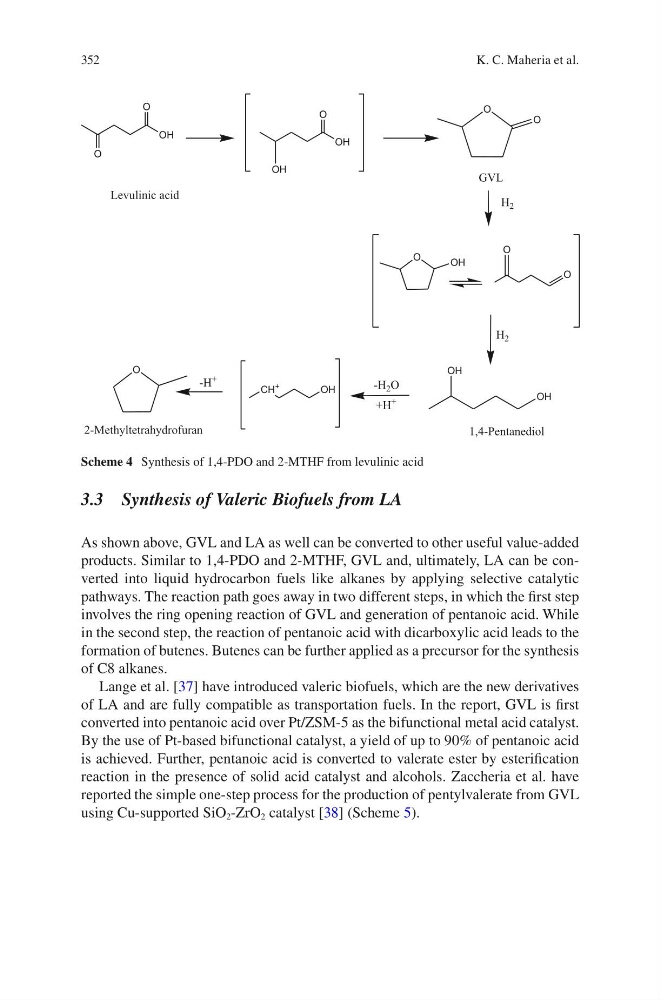
Scheme 4 Synthesis of 1,4-PDO and 2-MTHF from levulinic acid
K. C. Maheria et al.
3.3 Synthesis of Valeric Biofuels from LA
As shown above, GVL and LA as well can be converted to other useful value-added
products. Similar to 1,4-PDO and 2-MTHF, GVL and, ultimately, LA can be converted into liquid hydrocarbon fuels like alkanes by applying selective catalytic
pathways. The reaction path goes away in two different steps, in which the first step
involves the ring opening reaction of GVL and generation of pentanoic acid. While
in the second step, the reaction of pentanoic acid with dicarboxylic acid leads to the
formation of butenes. Butenes can be further applied as a precursor for the synthesis
of C8 alkanes.
Lange et al. [37] have introduced valeric biofuels, which are the new derivatives
of LA and are fully compatible as transportation fuels. In the report, GVL is first
converted into pentanoic acid over Pt/ZSM-5 as the bifunctional metal acid catalyst.
By the use of Pt-based bifunctional catalyst, a yield of up to 90% of pentanoic acid
is achieved. Further, pentanoic acid is converted to valerate ester by esterification
reaction in the presence of solid acid catalyst and alcohols. Zaccheria et al. have
reported the simple one-step process for the production of pentylvalerate from GVL
using Cu-supported SiO 2 -ZrO 2 catalyst [38] (Scheme 5).
O
O
OH
Levulinic acid
O
OH
OH
O
O
GVL
O
OH
O
O
H 2
OH
OH
1,4-Pentanediol
CH +
OH
O
2-Methyltetrahydrofuran
-H
+
-H 2 O
+H
+
H 2
Scheme 4 Synthesis of 1,4-PDO and 2-MTHF from levulinic acid
K. C. Maheria et al.