

350
3.1 Synthesis of GVL from LA
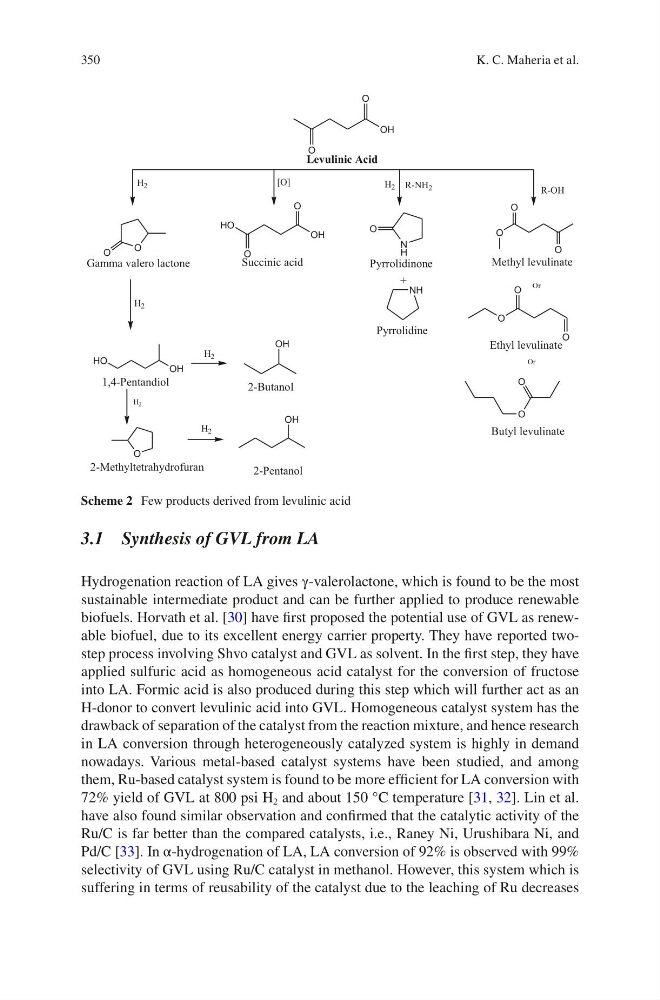
Hydrogenation reaction of LA gives γ-valerolactone, which is found to be the most
sustainable intermediate product and can be further applied to produce renewable
biofuels. Horvath et al. [30] have first proposed the potential use of GVL as renewable biofuel, due to its excellent energy carrier property. They have reported twostep process involving Shvo catalyst and GVL as solvent. In the first step, they have
applied sulfuric acid as homogeneous acid catalyst for the conversion of fructose
into LA. Formic acid is also produced during this step which will further act as an
H-donor to convert levulinic acid into GVL. Homogeneous catalyst system has the
drawback of separation of the catalyst from the reaction mixture, and hence research
in LA conversion through heterogeneously catalyzed system is highly in demand
nowadays. Various metal-based catalyst systems have been studied, and among
them, Ru-based catalyst system is found to be more efficient for LA conversion with
72% yield of GVL at 800 psi H 2 and about 150 °C temperature [31, 32]. Lin et al.
have also found similar observation and confirmed that the catalytic activity of the
Ru/C is far better than the compared catalysts, i.e., Raney Ni, Urushibara Ni, and
Pd/C [33]. In α-hydrogenation of LA, LA conversion of 92% is observed with 99%
selectivity of GVL using Ru/C catalyst in methanol. However, this system which is
suffering in terms of reusability of the catalyst due to the leaching of Ru decreases
O
O
OH
Levulinic Acid
O
OH
O
HO
Succinic acid
O
O
Gamma valero lactone
HO
OH
1,4-Pentandiol
O
2-Methyltetrahydrofuran
N
H
O
Pyrrolidinone
NH
Pyrrolidine
O
O
O
Methyl levulinate
O
O
Butyl levulinate
OH
2-Butanol
OH
2-Pentanol
[O]
H 2
H 2 R-NH 2
R-OH
H 2
H 2
H 2
H 2
O
O
O
Ethyl levulinate
+
Or
Or
Scheme 2 Few products derived from levulinic acid
K. C. Maheria et al.
3.1 Synthesis of GVL from LA
Hydrogenation reaction of LA gives γ-valerolactone, which is found to be the most
sustainable intermediate product and can be further applied to produce renewable
biofuels. Horvath et al. [30] have first proposed the potential use of GVL as renewable biofuel, due to its excellent energy carrier property. They have reported twostep process involving Shvo catalyst and GVL as solvent. In the first step, they have
applied sulfuric acid as homogeneous acid catalyst for the conversion of fructose
into LA. Formic acid is also produced during this step which will further act as an
H-donor to convert levulinic acid into GVL. Homogeneous catalyst system has the
drawback of separation of the catalyst from the reaction mixture, and hence research
in LA conversion through heterogeneously catalyzed system is highly in demand
nowadays. Various metal-based catalyst systems have been studied, and among
them, Ru-based catalyst system is found to be more efficient for LA conversion with
72% yield of GVL at 800 psi H 2 and about 150 °C temperature [31, 32]. Lin et al.
have also found similar observation and confirmed that the catalytic activity of the
Ru/C is far better than the compared catalysts, i.e., Raney Ni, Urushibara Ni, and
Pd/C [33]. In α-hydrogenation of LA, LA conversion of 92% is observed with 99%
selectivity of GVL using Ru/C catalyst in methanol. However, this system which is
suffering in terms of reusability of the catalyst due to the leaching of Ru decreases
O
O
OH
Levulinic Acid
O
OH
O
HO
Succinic acid
O
O
Gamma valero lactone
HO
OH
1,4-Pentandiol
O
2-Methyltetrahydrofuran
N
H
O
Pyrrolidinone
NH
Pyrrolidine
O
O
O
Methyl levulinate
O
O
Butyl levulinate
OH
2-Butanol
OH
2-Pentanol
[O]
H 2
H 2 R-NH 2
R-OH
H 2
H 2
H 2
H 2
O
O
O
Ethyl levulinate
+
Or
Or
Scheme 2 Few products derived from levulinic acid
K. C. Maheria et al.