

348
intermediates [14]. Cellulose and hemicellulose, two major constituents of biomass,
belong to a class of polymers which are carbohydrate-based and can be hydrolyzed
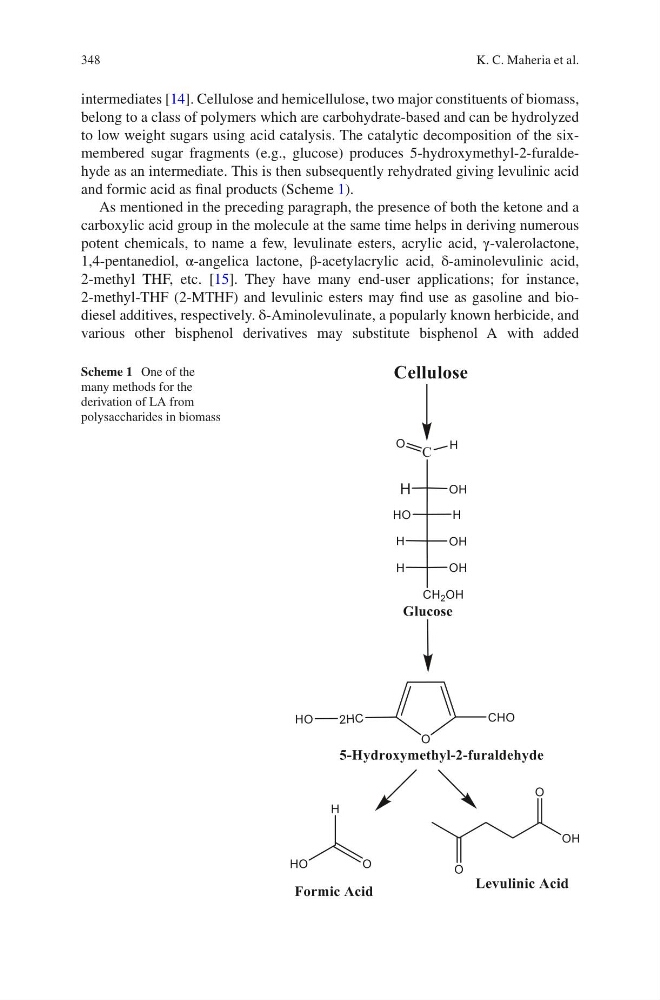
to low weight sugars using acid catalysis. The catalytic decomposition of the sixmembered sugar fragments (e.g., glucose) produces 5-hydroxymethyl-2-furaldehyde as an intermediate. This is then subsequently rehydrated giving levulinic acid
and formic acid as final products (Scheme 1).
As mentioned in the preceding paragraph, the presence of both the ketone and a
carboxylic acid group in the molecule at the same time helps in deriving numerous
potent chemicals, to name a few, levulinate esters, acrylic acid, γ-valerolactone,
1,4-pentanediol, α-angelica lactone, β-acetylacrylic acid, δ-aminolevulinic acid,
2-methyl THF, etc. [15]. They have many end-user applications; for instance,
2-methyl-THF (2-MTHF) and levulinic esters may find use as gasoline and biodiesel additives, respectively. δ-Aminolevulinate, a popularly known herbicide, and
various other bisphenol derivatives may substitute bisphenol A with added
Scheme 1 One of the
many methods for the
derivation of LA from
polysaccharides in biomass
K. C. Maheria et al.
intermediates [14]. Cellulose and hemicellulose, two major constituents of biomass,
belong to a class of polymers which are carbohydrate-based and can be hydrolyzed
to low weight sugars using acid catalysis. The catalytic decomposition of the sixmembered sugar fragments (e.g., glucose) produces 5-hydroxymethyl-2-furaldehyde as an intermediate. This is then subsequently rehydrated giving levulinic acid
and formic acid as final products (Scheme 1).
As mentioned in the preceding paragraph, the presence of both the ketone and a
carboxylic acid group in the molecule at the same time helps in deriving numerous
potent chemicals, to name a few, levulinate esters, acrylic acid, γ-valerolactone,
1,4-pentanediol, α-angelica lactone, β-acetylacrylic acid, δ-aminolevulinic acid,
2-methyl THF, etc. [15]. They have many end-user applications; for instance,
2-methyl-THF (2-MTHF) and levulinic esters may find use as gasoline and biodiesel additives, respectively. δ-Aminolevulinate, a popularly known herbicide, and
various other bisphenol derivatives may substitute bisphenol A with added
Scheme 1 One of the
many methods for the
derivation of LA from
polysaccharides in biomass
K. C. Maheria et al.