

306
reduction for preparation of Ru(0) from ruthenium precursor. Prior reduction of
catalysts mostly consumes more energy and sometimes may even be higher than the
input energy used for the reaction.
Cu-supported MgAl-LDH catalyst (prepared from colloidal deposition method)
was reported by Asiri research group for hydrocyclization of LA to Gvl under
vapour phase using fixed-bed reactor [74]. At optimized conditions, i.e. 260 °C,
10 bar H 2 , and 30 mL/min H 2 flow rate, the 3% Cu/MgAl-LDH catalyst (0.5 g)
showed 87.5% conversion of LA (WHSV = 0.456/h) with 95% selectivity of Gvl
(Table 1, entry 32). Three per cent Cu loading enhances the overall acidity of the
material which initiates the intramolecular esterification of γ-hydroxy pentanoic
acid to obtain Gvl. Increasing the temperature to >260 °C decreased the selectivity
of Gvl because of the onset of competing reactions such as the dehydration of LA
to angelica lactone and ring opening of obtained Gvl into valeric acid. The spent
Cu/MgAl-LDH catalyst shows decrease in activity towards the reaction and is associated with Cu particle size increment (5.3 nm from 2 nm) due to agglomeration as
well as decrease in the surface area and acidity.
2.2.2 Arylated-γ-Lactones from Levulinic Acid and Aromatics
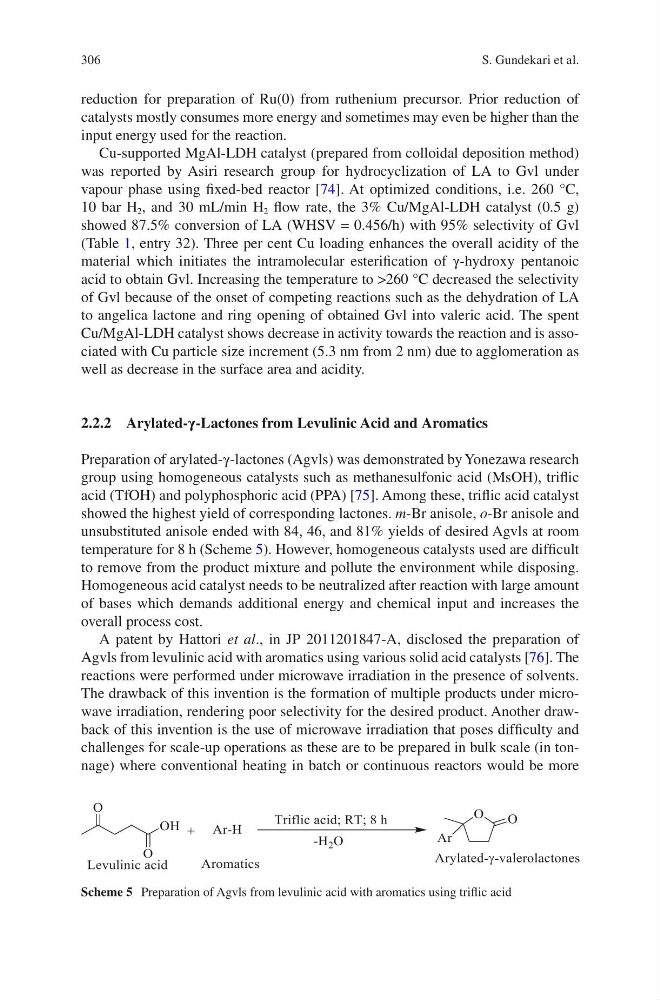
Preparation of arylated-γ-lactones (Agvls) was demonstrated by Yonezawa research
group using homogeneous catalysts such as methanesulfonic acid (MsOH), triflic
acid (TfOH) and polyphosphoric acid (PPA) [75]. Among these, triflic acid catalyst
showed the highest yield of corresponding lactones. m-Br anisole, o-Br anisole and
unsubstituted anisole ended with 84, 46, and 81% yields of desired Agvls at room
temperature for 8 h (Scheme 5). However, homogeneous catalysts used are difficult
to remove from the product mixture and pollute the environment while disposing.
Homogeneous acid catalyst needs to be neutralized after reaction with large amount
of bases which demands additional energy and chemical input and increases the
overall process cost.
A patent by Hattori et al., in JP 2011201847-A, disclosed the preparation of
Agvls from levulinic acid with aromatics using various solid acid catalysts [76]. The
reactions were performed under microwave irradiation in the presence of solvents.
The drawback of this invention is the formation of multiple products under microwave irradiation, rendering poor selectivity for the desired product. Another drawback of this invention is the use of microwave irradiation that poses difficulty and
challenges for scale-up operations as these are to be prepared in bulk scale (in tonnage) where conventional heating in batch or continuous reactors would be more
Scheme 5 Preparation of Agvls from levulinic acid with aromatics using triflic acid
S. Gundekari et al.
reduction for preparation of Ru(0) from ruthenium precursor. Prior reduction of
catalysts mostly consumes more energy and sometimes may even be higher than the
input energy used for the reaction.
Cu-supported MgAl-LDH catalyst (prepared from colloidal deposition method)
was reported by Asiri research group for hydrocyclization of LA to Gvl under
vapour phase using fixed-bed reactor [74]. At optimized conditions, i.e. 260 °C,
10 bar H 2 , and 30 mL/min H 2 flow rate, the 3% Cu/MgAl-LDH catalyst (0.5 g)
showed 87.5% conversion of LA (WHSV = 0.456/h) with 95% selectivity of Gvl
(Table 1, entry 32). Three per cent Cu loading enhances the overall acidity of the
material which initiates the intramolecular esterification of γ-hydroxy pentanoic
acid to obtain Gvl. Increasing the temperature to >260 °C decreased the selectivity
of Gvl because of the onset of competing reactions such as the dehydration of LA
to angelica lactone and ring opening of obtained Gvl into valeric acid. The spent
Cu/MgAl-LDH catalyst shows decrease in activity towards the reaction and is associated with Cu particle size increment (5.3 nm from 2 nm) due to agglomeration as
well as decrease in the surface area and acidity.
2.2.2 Arylated-γ-Lactones from Levulinic Acid and Aromatics
Preparation of arylated-γ-lactones (Agvls) was demonstrated by Yonezawa research
group using homogeneous catalysts such as methanesulfonic acid (MsOH), triflic
acid (TfOH) and polyphosphoric acid (PPA) [75]. Among these, triflic acid catalyst
showed the highest yield of corresponding lactones. m-Br anisole, o-Br anisole and
unsubstituted anisole ended with 84, 46, and 81% yields of desired Agvls at room
temperature for 8 h (Scheme 5). However, homogeneous catalysts used are difficult
to remove from the product mixture and pollute the environment while disposing.
Homogeneous acid catalyst needs to be neutralized after reaction with large amount
of bases which demands additional energy and chemical input and increases the
overall process cost.
A patent by Hattori et al., in JP 2011201847-A, disclosed the preparation of
Agvls from levulinic acid with aromatics using various solid acid catalysts [76]. The
reactions were performed under microwave irradiation in the presence of solvents.
The drawback of this invention is the formation of multiple products under microwave irradiation, rendering poor selectivity for the desired product. Another drawback of this invention is the use of microwave irradiation that poses difficulty and
challenges for scale-up operations as these are to be prepared in bulk scale (in tonnage) where conventional heating in batch or continuous reactors would be more
Scheme 5 Preparation of Agvls from levulinic acid with aromatics using triflic acid
S. Gundekari et al.