

285
proceeded by the release of gases initially, and at 800 K, bio-oil production was
maximum. The major products observed in the cellulose pyrolysis simulation were
glycolaldehyde, levoglucosan, 2-hydroxy-propionaldehyde, hydroxyl-acetone,
H 2 O, CO, and CO 2 which was in good agreement with the experiments. The
maximum yield of levoglucosan was observed to be at lower temperatures, whereas
higher temperature favored glycolaldehyde. Using ReaxFF MD simulations for a
large lignin model having 15,920 atoms, Zheng et al. studied the reaction pathways
for different linkages in lignin pyrolysis. Cα/Cβ ether bond cracking was found to
be the dominant pathway for β-O-4, α-O-4, and α-O-4 and β-5 linkages. Whereas
γ-O-α and β-β linkage bond cracking of Cα-O ether bond and the RO of aryl
monomer were found to be equally important [87]. For the other β-1, β-2, β-5,
4-O-5, and 5-5 linkages, RO pathway dominated. At low temperature, Cα/Cβ ether
bond cracking was observed, whereas aryl RO took place at higher temperatures.
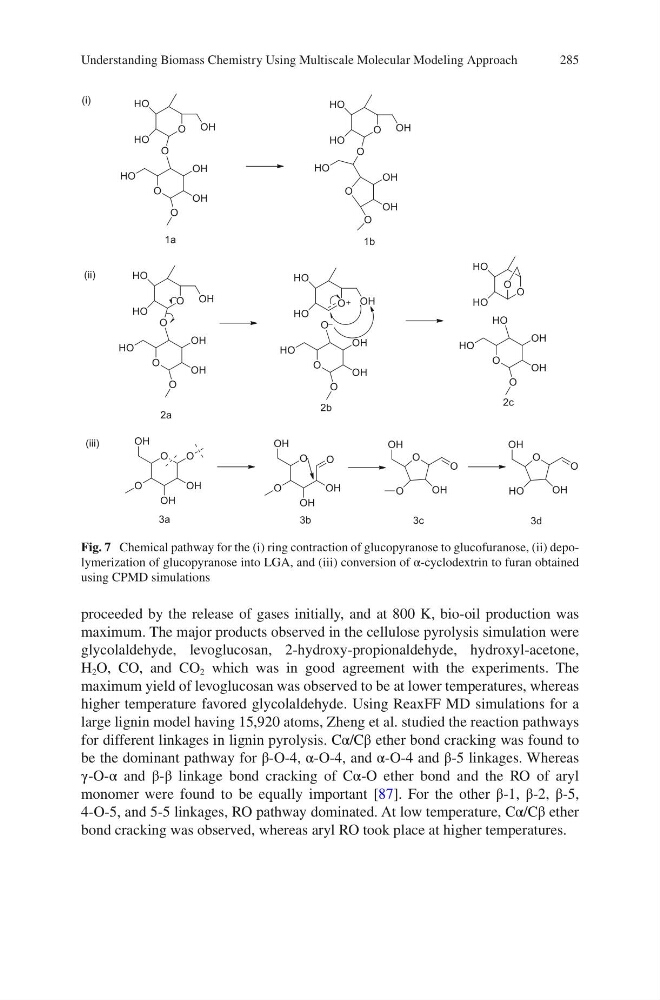
Fig. 7 Chemical pathway for the (i) ring contraction of glucopyranose to glucofuranose, (ii) depolymerization of glucopyranose into LGA, and (iii) conversion of α-cyclodextrin to furan obtained
using CPMD simulations
Understanding Biomass Chemistry Using Multiscale Molecular Modeling Approach
proceeded by the release of gases initially, and at 800 K, bio-oil production was
maximum. The major products observed in the cellulose pyrolysis simulation were
glycolaldehyde, levoglucosan, 2-hydroxy-propionaldehyde, hydroxyl-acetone,
H 2 O, CO, and CO 2 which was in good agreement with the experiments. The
maximum yield of levoglucosan was observed to be at lower temperatures, whereas
higher temperature favored glycolaldehyde. Using ReaxFF MD simulations for a
large lignin model having 15,920 atoms, Zheng et al. studied the reaction pathways
for different linkages in lignin pyrolysis. Cα/Cβ ether bond cracking was found to
be the dominant pathway for β-O-4, α-O-4, and α-O-4 and β-5 linkages. Whereas
γ-O-α and β-β linkage bond cracking of Cα-O ether bond and the RO of aryl
monomer were found to be equally important [87]. For the other β-1, β-2, β-5,
4-O-5, and 5-5 linkages, RO pathway dominated. At low temperature, Cα/Cβ ether
bond cracking was observed, whereas aryl RO took place at higher temperatures.
Fig. 7 Chemical pathway for the (i) ring contraction of glucopyranose to glucofuranose, (ii) depolymerization of glucopyranose into LGA, and (iii) conversion of α-cyclodextrin to furan obtained
using CPMD simulations
Understanding Biomass Chemistry Using Multiscale Molecular Modeling Approach