

283
out from cellulosic fraction as well as from each other. Also introduction of THF
leads to formation of random coil conformations instead of compact modules
observed in case of water [79].
However, classical MD simulations cannot be used to simulate the phenomena
(bond formation and breaking, charge distribution) associated with the changes in
electronic structures. As an alternative to study the dynamics during chemical
transformations, ab initio molecular dynamics (AIMD) simulations can be used.
AIMD simulations were used to understand the effect of polar aprotic solvents such
as GVL in the presence of salt containing Cl
−
ions on the acid-catalyzed dehydration
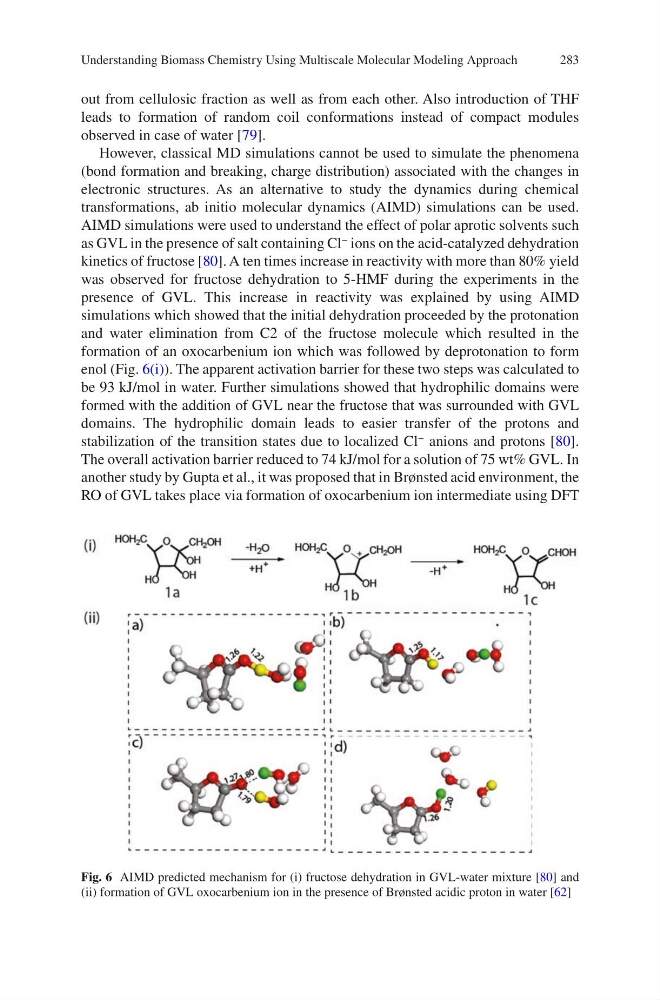
kinetics of fructose [80]. A ten times increase in reactivity with more than 80% yield
was observed for fructose dehydration to 5-HMF during the experiments in the
presence of GVL. This increase in reactivity was explained by using AIMD
simulations which showed that the initial dehydration proceeded by the protonation
and water elimination from C2 of the fructose molecule which resulted in the
formation of an oxocarbenium ion which was followed by deprotonation to form
enol (Fig. 6(i)). The apparent activation barrier for these two steps was calculated to
be 93 kJ/mol in water. Further simulations showed that hydrophilic domains were
formed with the addition of GVL near the fructose that was surrounded with GVL
domains. The hydrophilic domain leads to easier transfer of the protons and
stabilization of the transition states due to localized Cl
−
anions and protons [80].
The overall activation barrier reduced to 74 kJ/mol for a solution of 75 wt% GVL. In
another study by Gupta et al., it was proposed that in Brønsted acid environment, the
RO of GVL takes place via formation of oxocarbenium ion intermediate using DFT
Fig. 6 AIMD predicted mechanism for (i) fructose dehydration in GVL-water mixture [80] and
(ii) formation of GVL oxocarbenium ion in the presence of Brønsted acidic proton in water [62]
Understanding Biomass Chemistry Using Multiscale Molecular Modeling Approach
out from cellulosic fraction as well as from each other. Also introduction of THF
leads to formation of random coil conformations instead of compact modules
observed in case of water [79].
However, classical MD simulations cannot be used to simulate the phenomena
(bond formation and breaking, charge distribution) associated with the changes in
electronic structures. As an alternative to study the dynamics during chemical
transformations, ab initio molecular dynamics (AIMD) simulations can be used.
AIMD simulations were used to understand the effect of polar aprotic solvents such
as GVL in the presence of salt containing Cl
−
ions on the acid-catalyzed dehydration
kinetics of fructose [80]. A ten times increase in reactivity with more than 80% yield
was observed for fructose dehydration to 5-HMF during the experiments in the
presence of GVL. This increase in reactivity was explained by using AIMD
simulations which showed that the initial dehydration proceeded by the protonation
and water elimination from C2 of the fructose molecule which resulted in the
formation of an oxocarbenium ion which was followed by deprotonation to form
enol (Fig. 6(i)). The apparent activation barrier for these two steps was calculated to
be 93 kJ/mol in water. Further simulations showed that hydrophilic domains were
formed with the addition of GVL near the fructose that was surrounded with GVL
domains. The hydrophilic domain leads to easier transfer of the protons and
stabilization of the transition states due to localized Cl
−
anions and protons [80].
The overall activation barrier reduced to 74 kJ/mol for a solution of 75 wt% GVL. In
another study by Gupta et al., it was proposed that in Brønsted acid environment, the
RO of GVL takes place via formation of oxocarbenium ion intermediate using DFT
Fig. 6 AIMD predicted mechanism for (i) fructose dehydration in GVL-water mixture [80] and
(ii) formation of GVL oxocarbenium ion in the presence of Brønsted acidic proton in water [62]
Understanding Biomass Chemistry Using Multiscale Molecular Modeling Approach