

281
γ-carbenium ion on a Lewis acid catalyst with a reduced activation barrier of
E a = 13 kJ/mol [65]. Under Brønsted acid environment, the stability of oxocarbenium
ions determined RO rates in lactones [62].
On the other hand, polyketide biosynthesis route provides platform molecules
with variable no. of carbon atom in contrast to biomass-derived aqueous sugars
having C5–C6 atoms [66]. Shanks and co-workers demonstrated triacetic acid
lactone (TAL) as a potential platform produced via polyketide biosynthesized route
to produce value-added fuels and chemicals [63]. TAL underwent RO and
decarboxylation to produce CO 2 and 2,4-pentanedione with complete conversion
without any acid catalyst in the presence of water at a much lower temperature
(<100 °C) than that needed for GVL RO [63] (Fig. 5b). By utilizing DFT simulations,
it was observed that the RO takes place via nucleophilic addition of water on the
carbonyl group of the 2-pyrone molecule [6]. On partial hydrogenation and ketoenol tautomerization, TAL produced 3,6-dihydro-4-hydroxy-6-methylpyran-2-one
(DHHMP). DHHMP was observed to undergo RO and decarboxylation to produce
3-pentanone via retro-Diels-Alder (rDA) reaction mechanism (Fig. 5c). High
reactivity of DHHMP via rDA reaction was attributed to a double bond present at
C 4 –C 5 position. In another DFT study by our group, the substituent type present at
the C4 position and the nature of the solvent were observed to affect the RO barrier
[67]. 2-Pyrone containing electron-donating group at the C4 position exhibited
lower activation barriers in comparison to the one with electron-withdrawing
substituent. The reactivity of the 2-pyrones was correlated with the frontier
molecular orbital (FMO) theory where a linear relationship was proposed between
the FMO gap of the products formed and activation barrier [68]. In comparison to
nonpolar solvents, higher stabilization of transition state in polar solvents reduced
the RO activation barrier. In addition to it, Car-Parrinello molecular dynamics
(CPMD) simulations showed that the dynamic behavior of the solvent due to the
differential interaction of the solvent with the transition and the reactant state
reduced the barrier for the rDA reactions [69]. Similar to TAL, Alam et al. identified
6-amyl-alpha pyrone (6PP) as another platform molecule to produce food graded
flavoring agent and C15–C16 range fuel [64]. At 498 K, 6PP underwent RO and
O
a)
b)
c)
d)
O
O
O
O O
O O
O
O
O
O
O
O
O O
O O
O
O O
O
O
O
O
O
O
O
O
O
H +
H +
H +
H +
H +
H +
H +
H +
O –
O –
H +
O
O
O
O O
+
+
+
+H
OH
OH
OH
OH
OH OH
OH
OH
OH
OH
HDO
OH
OH
OH
OH +
OH +
H 3 C
H 2 O
H 3 C
H 3 C
–H
OH
HO
OH
–CO 2
–CO 2
–CO 2
H 2 O
H 2 O
H 2
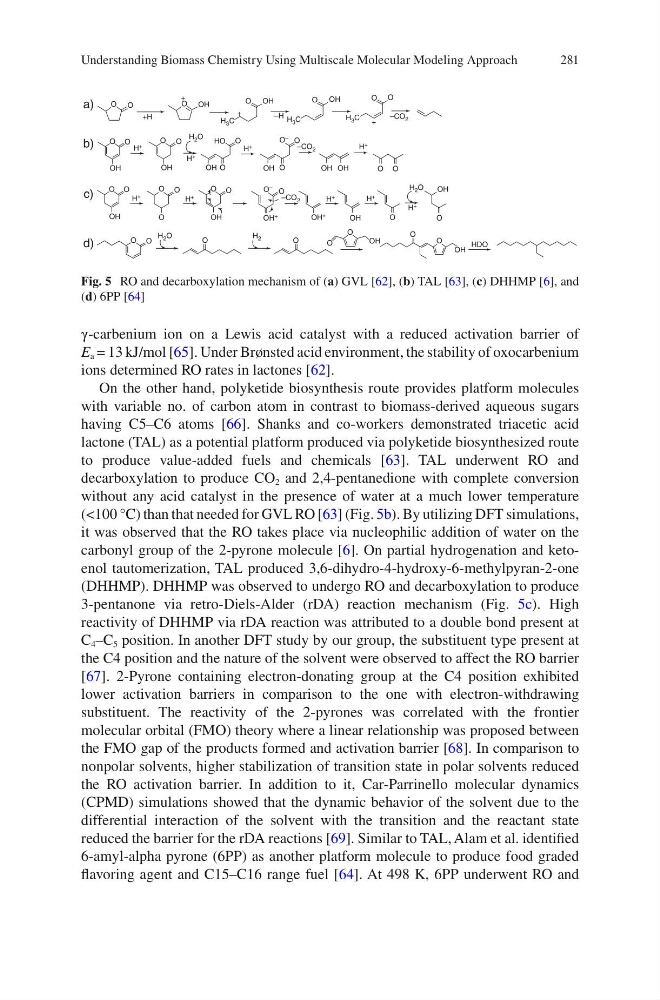
Fig. 5 RO and decarboxylation mechanism of (a) GVL [62], (b) TAL [63], (c) DHHMP [6], and
(d) 6PP [64]
Understanding Biomass Chemistry Using Multiscale Molecular Modeling Approach
γ-carbenium ion on a Lewis acid catalyst with a reduced activation barrier of
E a = 13 kJ/mol [65]. Under Brønsted acid environment, the stability of oxocarbenium
ions determined RO rates in lactones [62].
On the other hand, polyketide biosynthesis route provides platform molecules
with variable no. of carbon atom in contrast to biomass-derived aqueous sugars
having C5–C6 atoms [66]. Shanks and co-workers demonstrated triacetic acid
lactone (TAL) as a potential platform produced via polyketide biosynthesized route
to produce value-added fuels and chemicals [63]. TAL underwent RO and
decarboxylation to produce CO 2 and 2,4-pentanedione with complete conversion
without any acid catalyst in the presence of water at a much lower temperature
(<100 °C) than that needed for GVL RO [63] (Fig. 5b). By utilizing DFT simulations,
it was observed that the RO takes place via nucleophilic addition of water on the
carbonyl group of the 2-pyrone molecule [6]. On partial hydrogenation and ketoenol tautomerization, TAL produced 3,6-dihydro-4-hydroxy-6-methylpyran-2-one
(DHHMP). DHHMP was observed to undergo RO and decarboxylation to produce
3-pentanone via retro-Diels-Alder (rDA) reaction mechanism (Fig. 5c). High
reactivity of DHHMP via rDA reaction was attributed to a double bond present at
C 4 –C 5 position. In another DFT study by our group, the substituent type present at
the C4 position and the nature of the solvent were observed to affect the RO barrier
[67]. 2-Pyrone containing electron-donating group at the C4 position exhibited
lower activation barriers in comparison to the one with electron-withdrawing
substituent. The reactivity of the 2-pyrones was correlated with the frontier
molecular orbital (FMO) theory where a linear relationship was proposed between
the FMO gap of the products formed and activation barrier [68]. In comparison to
nonpolar solvents, higher stabilization of transition state in polar solvents reduced
the RO activation barrier. In addition to it, Car-Parrinello molecular dynamics
(CPMD) simulations showed that the dynamic behavior of the solvent due to the
differential interaction of the solvent with the transition and the reactant state
reduced the barrier for the rDA reactions [69]. Similar to TAL, Alam et al. identified
6-amyl-alpha pyrone (6PP) as another platform molecule to produce food graded
flavoring agent and C15–C16 range fuel [64]. At 498 K, 6PP underwent RO and
O
a)
b)
c)
d)
O
O
O
O O
O O
O
O
O
O
O
O
O O
O O
O
O O
O
O
O
O
O
O
O
O
O
H +
H +
H +
H +
H +
H +
H +
H +
O –
O –
H +
O
O
O
O O
+
+
+
+H
OH
OH
OH
OH
OH OH
OH
OH
OH
OH
HDO
OH
OH
OH
OH +
OH +
H 3 C
H 2 O
H 3 C
H 3 C
–H
OH
HO
OH
–CO 2
–CO 2
–CO 2
H 2 O
H 2 O
H 2
Fig. 5 RO and decarboxylation mechanism of (a) GVL [62], (b) TAL [63], (c) DHHMP [6], and
(d) 6PP [64]
Understanding Biomass Chemistry Using Multiscale Molecular Modeling Approach