

277
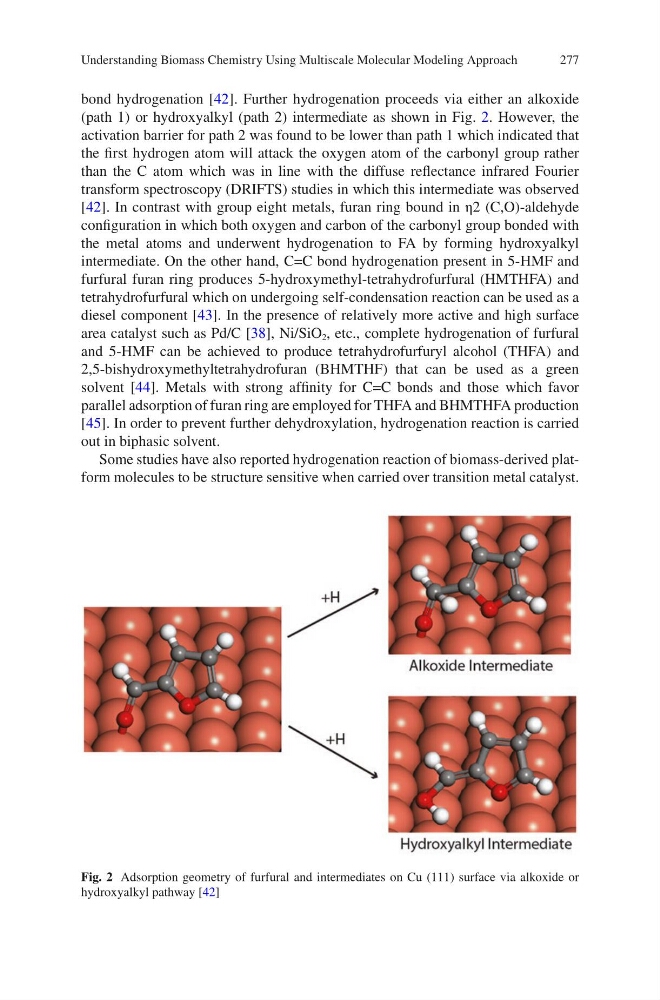
bond hydrogenation [42]. Further hydrogenation proceeds via either an alkoxide
(path 1) or hydroxyalkyl (path 2) intermediate as shown in Fig. 2. However, the
activation barrier for path 2 was found to be lower than path 1 which indicated that
the first hydrogen atom will attack the oxygen atom of the carbonyl group rather
than the C atom which was in line with the diffuse reflectance infrared Fourier
transform spectroscopy (DRIFTS) studies in which this intermediate was observed
[42]. In contrast with group eight metals, furan ring bound in η2 (C,O)-aldehyde
configuration in which both oxygen and carbon of the carbonyl group bonded with
the metal atoms and underwent hydrogenation to FA by forming hydroxyalkyl
intermediate. On the other hand, C=C bond hydrogenation present in 5-HMF and
furfural furan ring produces 5-hydroxymethyl-tetrahydrofurfural (HMTHFA) and
tetrahydrofurfural which on undergoing self-condensation reaction can be used as a
diesel component [43]. In the presence of relatively more active and high surface
area catalyst such as Pd/C [38], Ni/SiO 2 , etc., complete hydrogenation of furfural
and 5-HMF can be achieved to produce tetrahydrofurfuryl alcohol (THFA) and
2,5-bishydroxymethyltetrahydrofuran (BHMTHF) that can be used as a green
solvent [44]. Metals with strong affinity for C=C bonds and those which favor
parallel adsorption of furan ring are employed for THFA and BHMTHFA production
[45]. In order to prevent further dehydroxylation, hydrogenation reaction is carried
out in biphasic solvent.
Some studies have also reported hydrogenation reaction of biomass-derived platform molecules to be structure sensitive when carried over transition metal catalyst.
Fig. 2 Adsorption geometry of furfural and intermediates on Cu (111) surface via alkoxide or
hydroxyalkyl pathway [42]
Understanding Biomass Chemistry Using Multiscale Molecular Modeling Approach
bond hydrogenation [42]. Further hydrogenation proceeds via either an alkoxide
(path 1) or hydroxyalkyl (path 2) intermediate as shown in Fig. 2. However, the
activation barrier for path 2 was found to be lower than path 1 which indicated that
the first hydrogen atom will attack the oxygen atom of the carbonyl group rather
than the C atom which was in line with the diffuse reflectance infrared Fourier
transform spectroscopy (DRIFTS) studies in which this intermediate was observed
[42]. In contrast with group eight metals, furan ring bound in η2 (C,O)-aldehyde
configuration in which both oxygen and carbon of the carbonyl group bonded with
the metal atoms and underwent hydrogenation to FA by forming hydroxyalkyl
intermediate. On the other hand, C=C bond hydrogenation present in 5-HMF and
furfural furan ring produces 5-hydroxymethyl-tetrahydrofurfural (HMTHFA) and
tetrahydrofurfural which on undergoing self-condensation reaction can be used as a
diesel component [43]. In the presence of relatively more active and high surface
area catalyst such as Pd/C [38], Ni/SiO 2 , etc., complete hydrogenation of furfural
and 5-HMF can be achieved to produce tetrahydrofurfuryl alcohol (THFA) and
2,5-bishydroxymethyltetrahydrofuran (BHMTHF) that can be used as a green
solvent [44]. Metals with strong affinity for C=C bonds and those which favor
parallel adsorption of furan ring are employed for THFA and BHMTHFA production
[45]. In order to prevent further dehydroxylation, hydrogenation reaction is carried
out in biphasic solvent.
Some studies have also reported hydrogenation reaction of biomass-derived platform molecules to be structure sensitive when carried over transition metal catalyst.
Fig. 2 Adsorption geometry of furfural and intermediates on Cu (111) surface via alkoxide or
hydroxyalkyl pathway [42]
Understanding Biomass Chemistry Using Multiscale Molecular Modeling Approach