

275
either be directly dehydrated to produce 5-HMF [19] or is first isomerized to produce
fructose which upon dehydration produces 5-HMF. Out of these, the second route
has received considerable attention [20]. Lewis acid catalyst (e.g., Sn-BEA [21],
Ti-BEA [22], tungstite [23], etc.) has played a vital role in the isomerization of
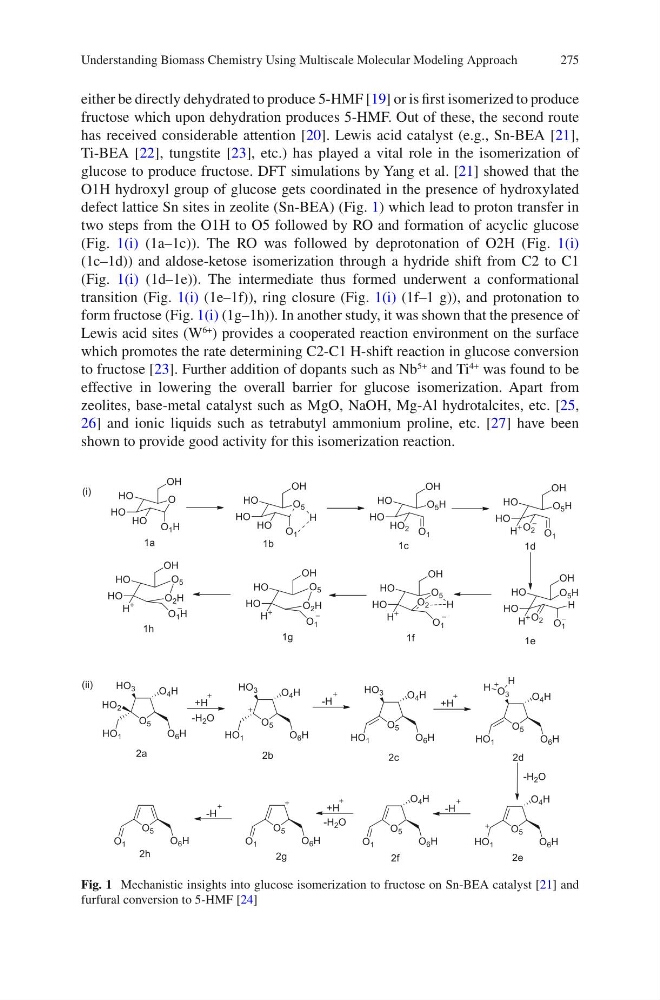
glucose to produce fructose. DFT simulations by Yang et al. [21] showed that the
O1H hydroxyl group of glucose gets coordinated in the presence of hydroxylated
defect lattice Sn sites in zeolite (Sn-BEA) (Fig. 1) which lead to proton transfer in
two steps from the O1H to O5 followed by RO and formation of acyclic glucose
(Fig. 1(i) (1a–1c)). The RO was followed by deprotonation of O2H (Fig. 1(i)
(1c–1d)) and aldose-ketose isomerization through a hydride shift from C2 to C1
(Fig. 1(i) (1d–1e)). The intermediate thus formed underwent a conformational
transition (Fig. 1(i) (1e–1f)), ring closure (Fig. 1(i) (1f–1 g)), and protonation to
form fructose (Fig. 1(i) (1g–1h)). In another study, it was shown that the presence of
Lewis acid sites (W
6+
) provides a cooperated reaction environment on the surface
which promotes the rate determining C2-C1 H-shift reaction in glucose conversion
to fructose [23]. Further addition of dopants such as Nb
5+
and Ti
4+
was found to be
effective in lowering the overall barrier for glucose isomerization. Apart from
zeolites, base-metal catalyst such as MgO, NaOH, Mg-Al hydrotalcites, etc. [25,
26] and ionic liquids such as tetrabutyl ammonium proline, etc. [27] have been
shown to provide good activity for this isomerization reaction.
Fig. 1 Mechanistic insights into glucose isomerization to fructose on Sn-BEA catalyst [21] and
furfural conversion to 5-HMF [24]
Understanding Biomass Chemistry Using Multiscale Molecular Modeling Approach
either be directly dehydrated to produce 5-HMF [19] or is first isomerized to produce
fructose which upon dehydration produces 5-HMF. Out of these, the second route
has received considerable attention [20]. Lewis acid catalyst (e.g., Sn-BEA [21],
Ti-BEA [22], tungstite [23], etc.) has played a vital role in the isomerization of
glucose to produce fructose. DFT simulations by Yang et al. [21] showed that the
O1H hydroxyl group of glucose gets coordinated in the presence of hydroxylated
defect lattice Sn sites in zeolite (Sn-BEA) (Fig. 1) which lead to proton transfer in
two steps from the O1H to O5 followed by RO and formation of acyclic glucose
(Fig. 1(i) (1a–1c)). The RO was followed by deprotonation of O2H (Fig. 1(i)
(1c–1d)) and aldose-ketose isomerization through a hydride shift from C2 to C1
(Fig. 1(i) (1d–1e)). The intermediate thus formed underwent a conformational
transition (Fig. 1(i) (1e–1f)), ring closure (Fig. 1(i) (1f–1 g)), and protonation to
form fructose (Fig. 1(i) (1g–1h)). In another study, it was shown that the presence of
Lewis acid sites (W
6+
) provides a cooperated reaction environment on the surface
which promotes the rate determining C2-C1 H-shift reaction in glucose conversion
to fructose [23]. Further addition of dopants such as Nb
5+
and Ti
4+
was found to be
effective in lowering the overall barrier for glucose isomerization. Apart from
zeolites, base-metal catalyst such as MgO, NaOH, Mg-Al hydrotalcites, etc. [25,
26] and ionic liquids such as tetrabutyl ammonium proline, etc. [27] have been
shown to provide good activity for this isomerization reaction.
Fig. 1 Mechanistic insights into glucose isomerization to fructose on Sn-BEA catalyst [21] and
furfural conversion to 5-HMF [24]
Understanding Biomass Chemistry Using Multiscale Molecular Modeling Approach