

260
mentioned in Sect. 2.3.2 are effective for biomass conversion, but sometimes they are
difficult to separate due to the viscous nature of the reaction mixture. This provides an
opportunity for the use of a magnetic catalyst as it can be easily separated with external magnate material. Core-shell Fe 3 O 4 @SiO 2 magnetic nanoparticle is one such catalyst used for biodiesel production [81]. Magnetic sulfonated mesoporous silica
(Fe 3 O 4 -SBA-SO 3 H) was used as a catalyst for hydrolysis of cellobiose and found efficient for 98% conversion of cellobiose at 120
o
C, whereas the conversion is only 54%
when H 2 SO 4 is used as a catalyst under identical conditions. The catalyst can be easily
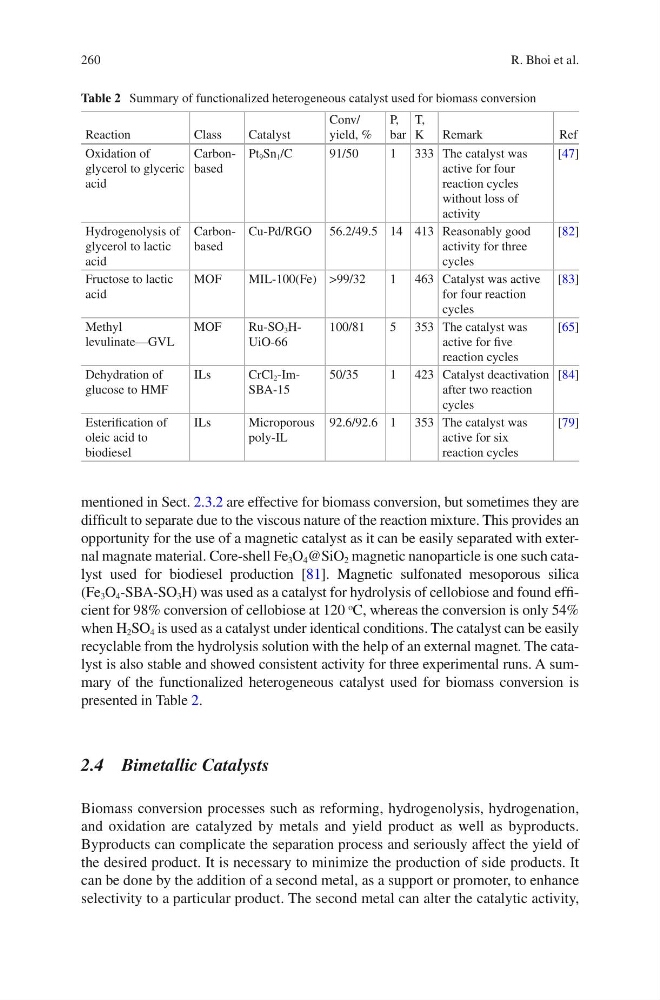
recyclable from the hydrolysis solution with the help of an external magnet. The catalyst is also stable and showed consistent activity for three experimental runs. A summary of the functionalized heterogeneous catalyst used for biomass conversion is
presented in Table 2.
2.4 Bimetallic Catalysts
Biomass conversion processes such as reforming, hydrogenolysis, hydrogenation,
and oxidation are catalyzed by metals and yield product as well as byproducts.
Byproducts can complicate the separation process and seriously affect the yield of
the desired product. It is necessary to minimize the production of side products. It
can be done by the addition of a second metal, as a support or promoter, to enhance
selectivity to a particular product. The second metal can alter the catalytic activity,
Table 2 Summary of functionalized heterogeneous catalyst used for biomass conversion
Reaction
Class
Catalyst
Conv/
yield, %
P,
bar
T,
K Remark
Ref
Oxidation of
glycerol to glyceric
acid
Carbonbased
Pt 9 Sn 1 /C
91/50
1 333 The catalyst was
active for four
reaction cycles
without loss of
activity
[47]
Hydrogenolysis of
glycerol to lactic
acid
Carbonbased
Cu-Pd/RGO 56.2/49.5 14 413 Reasonably good
activity for three
cycles
[82]
Fructose to lactic
acid
MOF
MIL-100(Fe) >99/32
1 463 Catalyst was active
for four reaction
cycles
[83]
Methyl
levulinate—GVL
MOF
Ru-SO 3 HUiO-66
100/81
5 353 The catalyst was
active for five
reaction cycles
[65]
Dehydration of
glucose to HMF
ILs
CrCl 2 -ImSBA-15
50/35
1 423 Catalyst deactivation
after two reaction
cycles
[84]
Esterification of
oleic acid to
biodiesel
ILs
Microporous
poly-IL
92.6/92.6 1 353 The catalyst was
active for six
reaction cycles
[79]
R. Bhoi et al.
mentioned in Sect. 2.3.2 are effective for biomass conversion, but sometimes they are
difficult to separate due to the viscous nature of the reaction mixture. This provides an
opportunity for the use of a magnetic catalyst as it can be easily separated with external magnate material. Core-shell Fe 3 O 4 @SiO 2 magnetic nanoparticle is one such catalyst used for biodiesel production [81]. Magnetic sulfonated mesoporous silica
(Fe 3 O 4 -SBA-SO 3 H) was used as a catalyst for hydrolysis of cellobiose and found efficient for 98% conversion of cellobiose at 120
o
C, whereas the conversion is only 54%
when H 2 SO 4 is used as a catalyst under identical conditions. The catalyst can be easily
recyclable from the hydrolysis solution with the help of an external magnet. The catalyst is also stable and showed consistent activity for three experimental runs. A summary of the functionalized heterogeneous catalyst used for biomass conversion is
presented in Table 2.
2.4 Bimetallic Catalysts
Biomass conversion processes such as reforming, hydrogenolysis, hydrogenation,
and oxidation are catalyzed by metals and yield product as well as byproducts.
Byproducts can complicate the separation process and seriously affect the yield of
the desired product. It is necessary to minimize the production of side products. It
can be done by the addition of a second metal, as a support or promoter, to enhance
selectivity to a particular product. The second metal can alter the catalytic activity,
Table 2 Summary of functionalized heterogeneous catalyst used for biomass conversion
Reaction
Class
Catalyst
Conv/
yield, %
P,
bar
T,
K Remark
Ref
Oxidation of
glycerol to glyceric
acid
Carbonbased
Pt 9 Sn 1 /C
91/50
1 333 The catalyst was
active for four
reaction cycles
without loss of
activity
[47]
Hydrogenolysis of
glycerol to lactic
acid
Carbonbased
Cu-Pd/RGO 56.2/49.5 14 413 Reasonably good
activity for three
cycles
[82]
Fructose to lactic
acid
MOF
MIL-100(Fe) >99/32
1 463 Catalyst was active
for four reaction
cycles
[83]
Methyl
levulinate—GVL
MOF
Ru-SO 3 HUiO-66
100/81
5 353 The catalyst was
active for five
reaction cycles
[65]
Dehydration of
glucose to HMF
ILs
CrCl 2 -ImSBA-15
50/35
1 423 Catalyst deactivation
after two reaction
cycles
[84]
Esterification of
oleic acid to
biodiesel
ILs
Microporous
poly-IL
92.6/92.6 1 353 The catalyst was
active for six
reaction cycles
[79]
R. Bhoi et al.