

164
6 Non-catalytic Microalgae HTL
Wet microalgal biomass can undergo HTL with or without catalyst. Catalyst improves
biocrude oil yield, but without it, yield is highly dependent on temperature and algae
strain species [106]. An investigation on the marine microalgae Nannochloropsis sp.
revealed that the optimum biocrude oil (HHV oil = 39 MJ/kg) yield of 43 wt% was
achieved at 350 °C and 60 min [38]. In a study by [8], Scenedesmus and Spirulina
species subjected on HTL at 300 °C, 10–12 MPa, and 30 min generated 24–45 wt%
biocrude oil having 35–57 MJ/kg HHV [8]. The maximum biocrude oil yield for the
HTL of Dunaliella tertiolecta (HHV oil = 26.62 MJ/kg) performed at 360 °C, 30 min,
and 10 wt% solid feedstock concentration was 36.9 wt% [59]. HTL of Chlorella pyrenoidosa at 280 °C and 120 min reaction time yield 39 wt% biocrude oil [99], and HTL
of Microcystis viridis at 300–340 °C and 30–60 min reaction time yield 33–40 wt%
biocrude oil [25]. Still, caution must be exercised in subjecting these microalgal species to extremely high temperatures because such conditions minimize yield through
recondensation reaction which leads to coke formation [107]. Ideally, non-catalytic
HTL of microalgae must be carried out below the critical point of water (374 °C,
22 MPa) since within this regime the high ionic constant and low dielectric constant
of water brought about by its weak hydrogen bond effectively hydrolyze microalgae’s
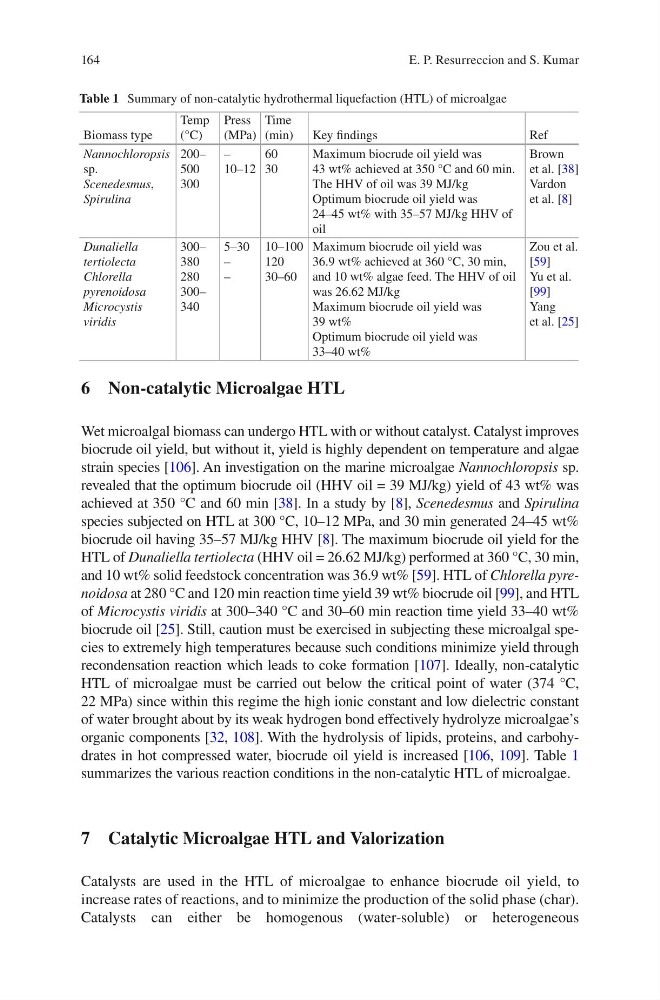
organic components [32, 108]. With the hydrolysis of lipids, proteins, and carbohydrates in hot compressed water, biocrude oil yield is increased [106, 109]. Table 1
summarizes the various reaction conditions in the non-catalytic HTL of microalgae.
7 Catalytic Microalgae HTL and Valorization
Catalysts are used in the HTL of microalgae to enhance biocrude oil yield, to
increase rates of reactions, and to minimize the production of the solid phase (char).
Catalysts can either be homogenous (water-soluble) or heterogeneous
Table 1 Summary of non-catalytic hydrothermal liquefaction (HTL) of microalgae
Biomass type
Temp
(°C)
Press
(MPa)
Time
(min)
Key findings
Ref
Nannochloropsis
sp.
Scenedesmus,
Spirulina
200–
500
300
–
10–12
60
30
Maximum biocrude oil yield was
43 wt% achieved at 350 °C and 60 min.
The HHV of oil was 39 MJ/kg
Optimum biocrude oil yield was
24–45 wt% with 35–57 MJ/kg HHV of
oil
Brown
et al. [38]
Vardon
et al. [8]
Dunaliella
tertiolecta
Chlorella
pyrenoidosa
Microcystis
viridis
300–
380
280
300–
340
5–30
–
–
10–100
120
30–60
Maximum biocrude oil yield was
36.9 wt% achieved at 360 °C, 30 min,
and 10 wt% algae feed. The HHV of oil
was 26.62 MJ/kg
Maximum biocrude oil yield was
39 wt%
Optimum biocrude oil yield was
33–40 wt%
Zou et al.
[59]
Yu et al.
[99]
Yang
et al. [25]
E. P. Resurreccion and S. Kumar
6 Non-catalytic Microalgae HTL
Wet microalgal biomass can undergo HTL with or without catalyst. Catalyst improves
biocrude oil yield, but without it, yield is highly dependent on temperature and algae
strain species [106]. An investigation on the marine microalgae Nannochloropsis sp.
revealed that the optimum biocrude oil (HHV oil = 39 MJ/kg) yield of 43 wt% was
achieved at 350 °C and 60 min [38]. In a study by [8], Scenedesmus and Spirulina
species subjected on HTL at 300 °C, 10–12 MPa, and 30 min generated 24–45 wt%
biocrude oil having 35–57 MJ/kg HHV [8]. The maximum biocrude oil yield for the
HTL of Dunaliella tertiolecta (HHV oil = 26.62 MJ/kg) performed at 360 °C, 30 min,
and 10 wt% solid feedstock concentration was 36.9 wt% [59]. HTL of Chlorella pyrenoidosa at 280 °C and 120 min reaction time yield 39 wt% biocrude oil [99], and HTL
of Microcystis viridis at 300–340 °C and 30–60 min reaction time yield 33–40 wt%
biocrude oil [25]. Still, caution must be exercised in subjecting these microalgal species to extremely high temperatures because such conditions minimize yield through
recondensation reaction which leads to coke formation [107]. Ideally, non-catalytic
HTL of microalgae must be carried out below the critical point of water (374 °C,
22 MPa) since within this regime the high ionic constant and low dielectric constant
of water brought about by its weak hydrogen bond effectively hydrolyze microalgae’s
organic components [32, 108]. With the hydrolysis of lipids, proteins, and carbohydrates in hot compressed water, biocrude oil yield is increased [106, 109]. Table 1
summarizes the various reaction conditions in the non-catalytic HTL of microalgae.
7 Catalytic Microalgae HTL and Valorization
Catalysts are used in the HTL of microalgae to enhance biocrude oil yield, to
increase rates of reactions, and to minimize the production of the solid phase (char).
Catalysts can either be homogenous (water-soluble) or heterogeneous
Table 1 Summary of non-catalytic hydrothermal liquefaction (HTL) of microalgae
Biomass type
Temp
(°C)
Press
(MPa)
Time
(min)
Key findings
Ref
Nannochloropsis
sp.
Scenedesmus,
Spirulina
200–
500
300
–
10–12
60
30
Maximum biocrude oil yield was
43 wt% achieved at 350 °C and 60 min.
The HHV of oil was 39 MJ/kg
Optimum biocrude oil yield was
24–45 wt% with 35–57 MJ/kg HHV of
oil
Brown
et al. [38]
Vardon
et al. [8]
Dunaliella
tertiolecta
Chlorella
pyrenoidosa
Microcystis
viridis
300–
380
280
300–
340
5–30
–
–
10–100
120
30–60
Maximum biocrude oil yield was
36.9 wt% achieved at 360 °C, 30 min,
and 10 wt% algae feed. The HHV of oil
was 26.62 MJ/kg
Maximum biocrude oil yield was
39 wt%
Optimum biocrude oil yield was
33–40 wt%
Zou et al.
[59]
Yu et al.
[99]
Yang
et al. [25]
E. P. Resurreccion and S. Kumar