

125
describes the number of carbon atoms present in the polyamide structure of the
amine and acid, respectively. Various polyamide materials and monomers used are
described in Table 5, and the structures of the monomers used (Fig. 11) for the
syntheses of polyamides are shown in Table 5.
Some of the outstanding characteristics of Nylon™ are given below:
• Excellent durability in the equilibrium moisture content.
– Excellent mechanical properties meaning it has superior strength and elastic
modulus.
– Excellent chemical stability and excellent physical stability.
– Outstanding flame retardant properties, and the flame retardant grades are rated
UL 94VO.
– Wonderful heat resistance properties.
5.1 Degradation of Polyamides
It is seen from the genetic and biochemical studies that microorganisms can degrade
various polyamides. Following is the description of the degradation of polyamides
and different oligomers of Nylon™ [34, 35]. In vivo studies have been reported for
PA 6, particularly for intrauterine devices (IUD) [36, 37]. In 2 years or longer,
breaks were found in the string of the tail. From the prepared samples, PA 66 was
found to be unaffected in the presence of esterase [38] but degrades to a small extent
in the presence of papain, trypsin, and chymotrypsin. Recently, biochemical studies
on the biodegradation of nylon-6,6 by a lignin-degrading fungus were reported [39,
40]. There are many strains selected for submerged cultures of synthetic medium for
degradation using white-rot fungi. Like all natural polymers such as proteins or
peptides, they are prone to biodegradation. Polyamides have the same chemical
moieties like peptides or proteins, but their strong intermolecular hydrogen bonding,
high crystallinity, and less polarity make them non-biodegradable. However,
degradation of low-molecular-weight polyamides or homopolymers into oligomers
can be achieved using microorganisms or enzymatic degradation. Bacteria-degraded
oligomers and monomers are also reported [36, 37, 39, 40]. According to the IUPAC
terminology, biodegradable polymers undergo chain scission, thus resulting in
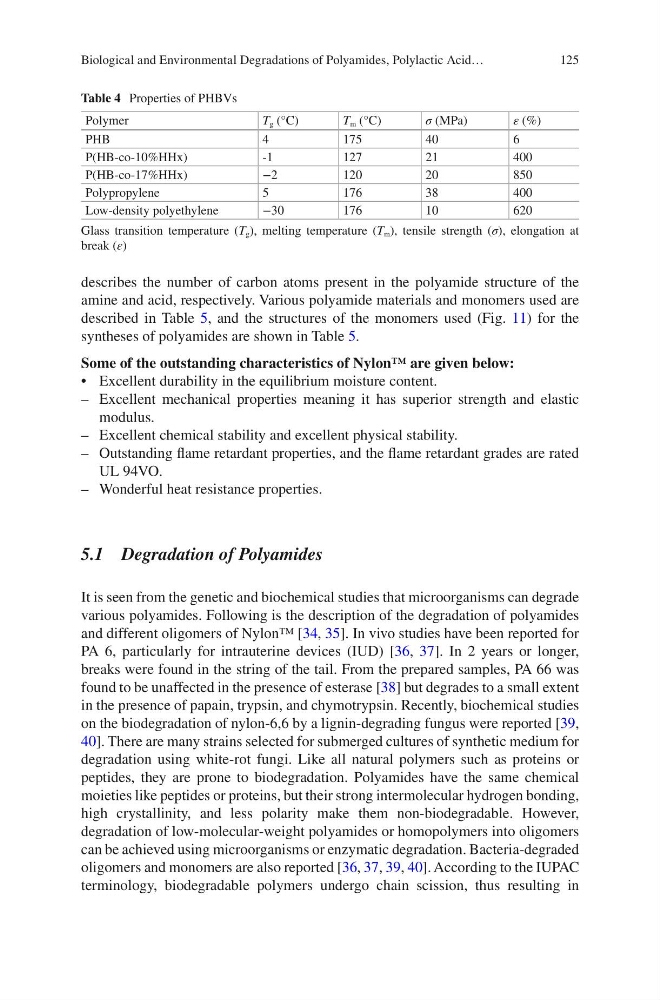
Table 4 Properties of PHBVs
Polymer
T g (°C)
T m (°C)
σ (MPa)
ε (%)
PHB
4
175
40
6
P(HB-co-10%HHx)
-1
127
21
400
P(HB-co-17%HHx)
−2
120
20
850
Polypropylene
5
176
38
400
Low-density polyethylene
−30
176
10
620
Glass transition temperature (T g ), melting temperature (T m ), tensile strength (σ), elongation at
break (ε)
Biological and Environmental Degradations of Polyamides, Polylactic Acid…
describes the number of carbon atoms present in the polyamide structure of the
amine and acid, respectively. Various polyamide materials and monomers used are
described in Table 5, and the structures of the monomers used (Fig. 11) for the
syntheses of polyamides are shown in Table 5.
Some of the outstanding characteristics of Nylon™ are given below:
• Excellent durability in the equilibrium moisture content.
– Excellent mechanical properties meaning it has superior strength and elastic
modulus.
– Excellent chemical stability and excellent physical stability.
– Outstanding flame retardant properties, and the flame retardant grades are rated
UL 94VO.
– Wonderful heat resistance properties.
5.1 Degradation of Polyamides
It is seen from the genetic and biochemical studies that microorganisms can degrade
various polyamides. Following is the description of the degradation of polyamides
and different oligomers of Nylon™ [34, 35]. In vivo studies have been reported for
PA 6, particularly for intrauterine devices (IUD) [36, 37]. In 2 years or longer,
breaks were found in the string of the tail. From the prepared samples, PA 66 was
found to be unaffected in the presence of esterase [38] but degrades to a small extent
in the presence of papain, trypsin, and chymotrypsin. Recently, biochemical studies
on the biodegradation of nylon-6,6 by a lignin-degrading fungus were reported [39,
40]. There are many strains selected for submerged cultures of synthetic medium for
degradation using white-rot fungi. Like all natural polymers such as proteins or
peptides, they are prone to biodegradation. Polyamides have the same chemical
moieties like peptides or proteins, but their strong intermolecular hydrogen bonding,
high crystallinity, and less polarity make them non-biodegradable. However,
degradation of low-molecular-weight polyamides or homopolymers into oligomers
can be achieved using microorganisms or enzymatic degradation. Bacteria-degraded
oligomers and monomers are also reported [36, 37, 39, 40]. According to the IUPAC
terminology, biodegradable polymers undergo chain scission, thus resulting in
Table 4 Properties of PHBVs
Polymer
T g (°C)
T m (°C)
σ (MPa)
ε (%)
PHB
4
175
40
6
P(HB-co-10%HHx)
-1
127
21
400
P(HB-co-17%HHx)
−2
120
20
850
Polypropylene
5
176
38
400
Low-density polyethylene
−30
176
10
620
Glass transition temperature (T g ), melting temperature (T m ), tensile strength (σ), elongation at
break (ε)
Biological and Environmental Degradations of Polyamides, Polylactic Acid…