

119
3.6 Enzymatic Polymerization (EP)
Enzymatic polymerization is a greener approach for the synthesis of PLA and generally applied to the ROP of lactide. For enzymatic polymerization of lactides, several lipases are used, e.g., Candida antarctica lipase B (CAL-B), Pseudomonas
cepacia (lipase PS), porcine pancreatic lipase (PPL), etc. The enzymatic
polymerization can be carried out in bulk, and organic solvents like toluene or ionic
liquids can be used. CAL-B-catalyzed reactions in different solvents led to highmolecular-weight PLA (around M W 40,000) [18].
3.7 Mechanical and Thermal Properties of PLA
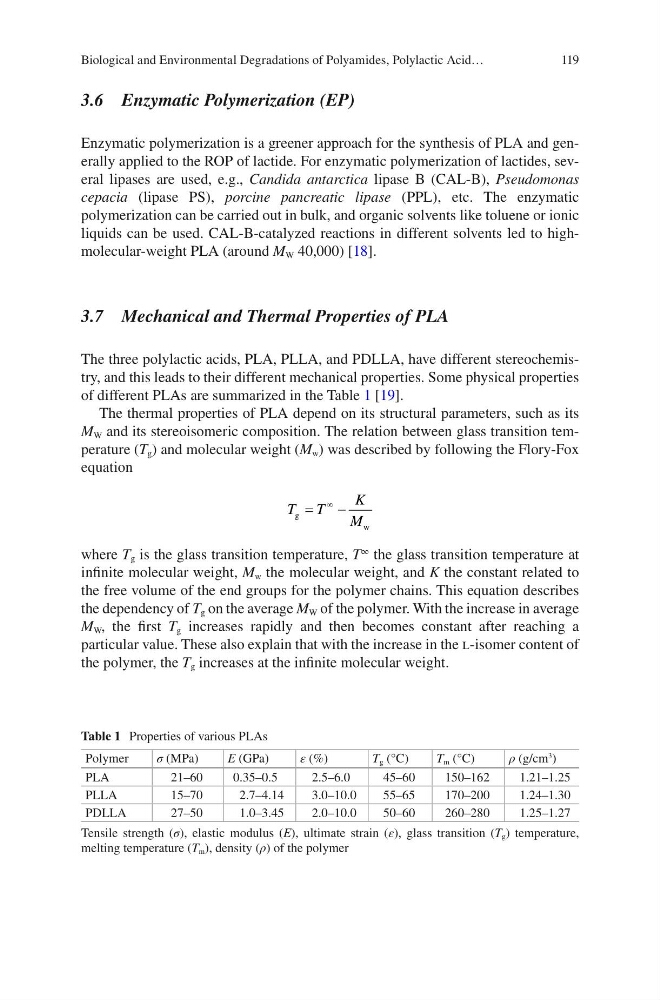
The three polylactic acids, PLA, PLLA, and PDLLA, have different stereochemistry, and this leads to their different mechanical properties. Some physical properties
of different PLAs are summarized in the Table 1 [19].
The thermal properties of PLA depend on its structural parameters, such as its
M W and its stereoisomeric composition. The relation between glass transition temperature (T g ) and molecular weight (M w ) was described by following the Flory-Fox
equation
T T
K
M
g
w
=
−
∞
where T g is the glass transition temperature, T
∞
the glass transition temperature at
infinite molecular weight, M w the molecular weight, and K the constant related to
the free volume of the end groups for the polymer chains. This equation describes
the dependency of T g on the average M W of the polymer. With the increase in average
M W , the first T g increases rapidly and then becomes constant after reaching a
particular value. These also explain that with the increase in the l-isomer content of
the polymer, the T g increases at the infinite molecular weight.
Table 1 Properties of various PLAs
Polymer
σ (MPa)
E (GPa)
ε (%)
T g (°C)
T m (°C)
ρ (g/cm
3
)
PLA
21–60
0.35–0.5
2.5–6.0
45–60
150–162
1.21–1.25
PLLA
15–70
2.7–4.14
3.0–10.0
55–65
170–200
1.24–1.30
PDLLA
27–50
1.0–3.45
2.0–10.0
50–60
260–280
1.25–1.27
Tensile strength (σ), elastic modulus (E), ultimate strain (ε), glass transition (T g ) temperature,
melting temperature (T m ), density (ρ) of the polymer
Biological and Environmental Degradations of Polyamides, Polylactic Acid…
3.6 Enzymatic Polymerization (EP)
Enzymatic polymerization is a greener approach for the synthesis of PLA and generally applied to the ROP of lactide. For enzymatic polymerization of lactides, several lipases are used, e.g., Candida antarctica lipase B (CAL-B), Pseudomonas
cepacia (lipase PS), porcine pancreatic lipase (PPL), etc. The enzymatic
polymerization can be carried out in bulk, and organic solvents like toluene or ionic
liquids can be used. CAL-B-catalyzed reactions in different solvents led to highmolecular-weight PLA (around M W 40,000) [18].
3.7 Mechanical and Thermal Properties of PLA
The three polylactic acids, PLA, PLLA, and PDLLA, have different stereochemistry, and this leads to their different mechanical properties. Some physical properties
of different PLAs are summarized in the Table 1 [19].
The thermal properties of PLA depend on its structural parameters, such as its
M W and its stereoisomeric composition. The relation between glass transition temperature (T g ) and molecular weight (M w ) was described by following the Flory-Fox
equation
T T
K
M
g
w
=
−
∞
where T g is the glass transition temperature, T
∞
the glass transition temperature at
infinite molecular weight, M w the molecular weight, and K the constant related to
the free volume of the end groups for the polymer chains. This equation describes
the dependency of T g on the average M W of the polymer. With the increase in average
M W , the first T g increases rapidly and then becomes constant after reaching a
particular value. These also explain that with the increase in the l-isomer content of
the polymer, the T g increases at the infinite molecular weight.
Table 1 Properties of various PLAs
Polymer
σ (MPa)
E (GPa)
ε (%)
T g (°C)
T m (°C)
ρ (g/cm
3
)
PLA
21–60
0.35–0.5
2.5–6.0
45–60
150–162
1.21–1.25
PLLA
15–70
2.7–4.14
3.0–10.0
55–65
170–200
1.24–1.30
PDLLA
27–50
1.0–3.45
2.0–10.0
50–60
260–280
1.25–1.27
Tensile strength (σ), elastic modulus (E), ultimate strain (ε), glass transition (T g ) temperature,
melting temperature (T m ), density (ρ) of the polymer
Biological and Environmental Degradations of Polyamides, Polylactic Acid…