

93
associated with small-scale production is that the control of pH is very difficult and
sampling from the shake flasks causes oxygen limitations that affect IA production
[16]. In order to avoid the limitation and produce IA under more industrially relevant conditions, Maassen et al. proposed a new method in which cultivation was
performed in a stirred batch where pH can be constantly controlled [33]. The authors
reported an optimum 0.74 g L
−1
h
−1
rate of IA production from glucose (200 g L
−1
)
and ammonium (75 mM). It was found that the yield of IA can be further improved
by reducing the concentration of glucose.
In 2016, Geiser et al. proposed that U. maydis also produces 2- hydroxyparaconate
as a second metabolite along with IA by controlled pulsed fed-batch fermentation
process [34]. It is possible to increase IA production up to 67% after deleting the
enzyme responsible for the degradation of IA into 2-hydroxyparaconate. Such
genetic engineering can be beneficial for improved titer of IA. Wierckx et al.
recently proposed an integrated process by gene knockouts, overexpression of
genes, and replacement of promoter to improve IA yield [35]. This combined
approach yielded 220 g L
−1
IA titer, the highest ever achieved from U. maydis and
A. terreus. A high level of malate was also produced under these conditions. The IA
yield can be further increased by removal/inactivation of the enzyme that promotes
the formation of malate intermediate.
Ustilago cynodontis Ustilago cynodontis (U. cynodontis) is another smut fungus
belonging to the Ustilaginaceae family and commonly known as a natural producer
of IA [36]. It features relatively high pH resistance properties compared to other
smut fungi and is beneficial for the production of IA in batch fermentations.
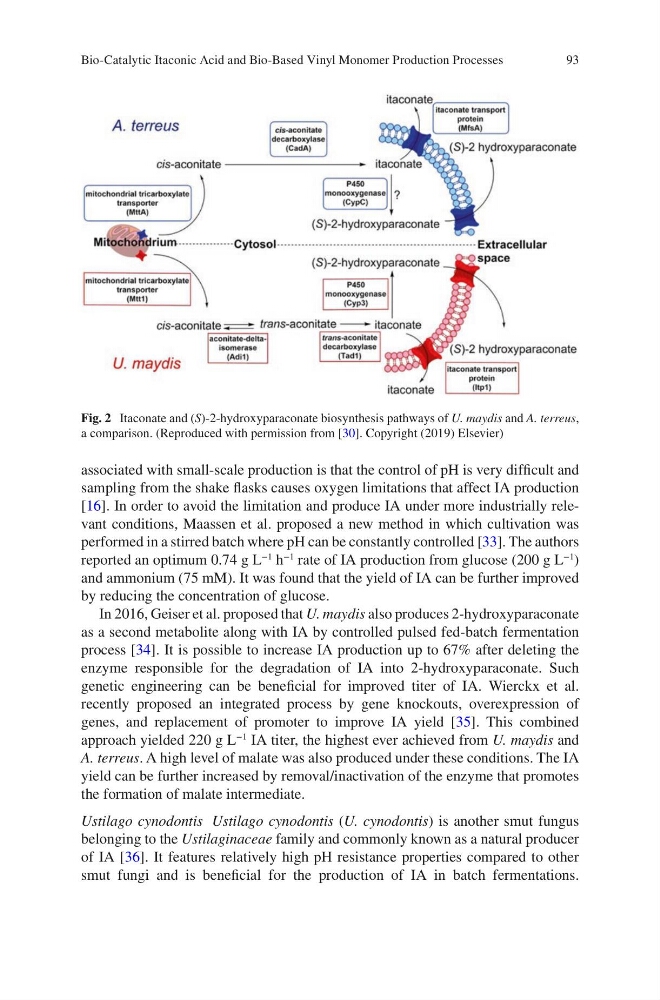
Fig. 2 Itaconate and (S)-2-hydroxyparaconate biosynthesis pathways of U. maydis and A. terreus,
a comparison. (Reproduced with permission from [30]. Copyright (2019) Elsevier)
Bio-Catalytic Itaconic Acid and Bio-Based Vinyl Monomer Production Processes
associated with small-scale production is that the control of pH is very difficult and
sampling from the shake flasks causes oxygen limitations that affect IA production
[16]. In order to avoid the limitation and produce IA under more industrially relevant conditions, Maassen et al. proposed a new method in which cultivation was
performed in a stirred batch where pH can be constantly controlled [33]. The authors
reported an optimum 0.74 g L
−1
h
−1
rate of IA production from glucose (200 g L
−1
)
and ammonium (75 mM). It was found that the yield of IA can be further improved
by reducing the concentration of glucose.
In 2016, Geiser et al. proposed that U. maydis also produces 2- hydroxyparaconate
as a second metabolite along with IA by controlled pulsed fed-batch fermentation
process [34]. It is possible to increase IA production up to 67% after deleting the
enzyme responsible for the degradation of IA into 2-hydroxyparaconate. Such
genetic engineering can be beneficial for improved titer of IA. Wierckx et al.
recently proposed an integrated process by gene knockouts, overexpression of
genes, and replacement of promoter to improve IA yield [35]. This combined
approach yielded 220 g L
−1
IA titer, the highest ever achieved from U. maydis and
A. terreus. A high level of malate was also produced under these conditions. The IA
yield can be further increased by removal/inactivation of the enzyme that promotes
the formation of malate intermediate.
Ustilago cynodontis Ustilago cynodontis (U. cynodontis) is another smut fungus
belonging to the Ustilaginaceae family and commonly known as a natural producer
of IA [36]. It features relatively high pH resistance properties compared to other
smut fungi and is beneficial for the production of IA in batch fermentations.
Fig. 2 Itaconate and (S)-2-hydroxyparaconate biosynthesis pathways of U. maydis and A. terreus,
a comparison. (Reproduced with permission from [30]. Copyright (2019) Elsevier)
Bio-Catalytic Itaconic Acid and Bio-Based Vinyl Monomer Production Processes