

91
It has also been utilized for the synthesis of polyester-based renewable polymers,
synthetic resins, rubbers, and coatings [11]. Owing to its promising applications, the
US Department of Energy has identified IA as the most useful and promising chemical produced from bio-based material, which appealed to the scientific community
towards the development of a scalable technology for IA production and usage [12].
The synthetic route of IA was initially reported in 1837 by the high-temperature
decarboxylation of citric acid [13]. Since the 1960s, industries have been producing
IA by fermentation of glucose using filamentous fungus Aspergillus terreus (A. terreus) with product intensity of 80 g L
−1
and production volume of about one million
tons per year [14]. In 2009, a research group from the University of New Hampshire
developed the homopolymer of IA, which was licensed to Itaconix
®
[15].
The current industrial process faced several challenges like dependence on
selected microorganism strains and the sensitivity of A. terreus to substrate impurities [16]. To overcome these challenges, many studies have been conducted in the
recent past [17]. In particular, they cover genetic modification of the microorganism, morphological engineering of utilization A. terreus of low-cost substrates, and
use of alternative microorganisms. Such technical developments are briefly reviewed
in the following section.
2.1 Global Production and Applications of Bio-Based IA
The global production of IA is around one million tons per year, mostly used for the
production of polymer and copolymer [18]. Commercial-scale production of IA
was started in 1945 by Pfizer Company. Since then, Rhodia (1995, France), Iwata
Chemical (1970, Japan), and Cargill (1996, USA) have also initiated
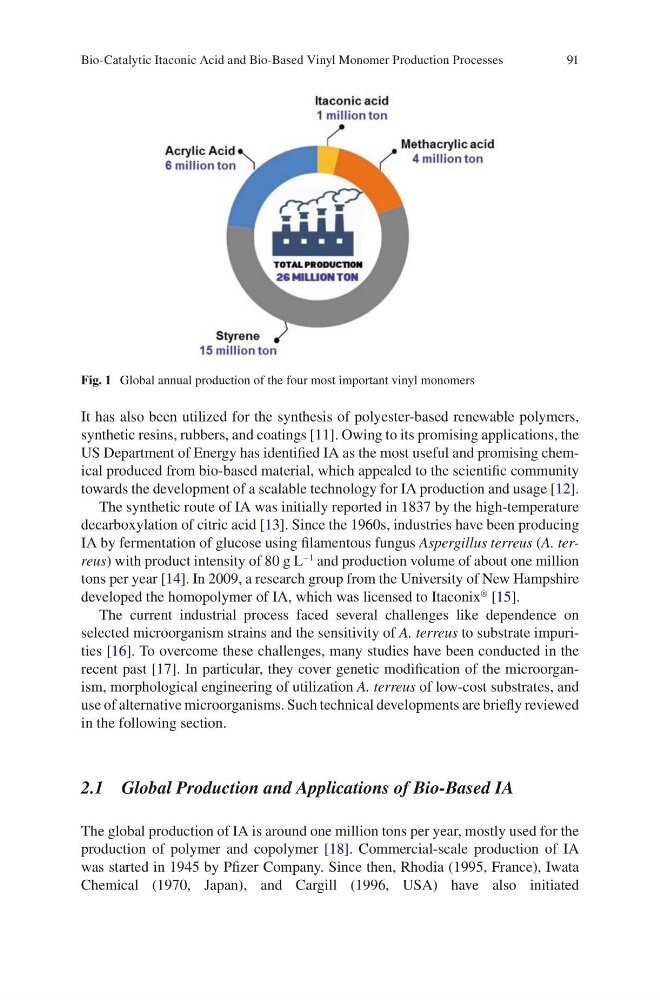
Fig. 1 Global annual production of the four most important vinyl monomers
Bio-Catalytic Itaconic Acid and Bio-Based Vinyl Monomer Production Processes
It has also been utilized for the synthesis of polyester-based renewable polymers,
synthetic resins, rubbers, and coatings [11]. Owing to its promising applications, the
US Department of Energy has identified IA as the most useful and promising chemical produced from bio-based material, which appealed to the scientific community
towards the development of a scalable technology for IA production and usage [12].
The synthetic route of IA was initially reported in 1837 by the high-temperature
decarboxylation of citric acid [13]. Since the 1960s, industries have been producing
IA by fermentation of glucose using filamentous fungus Aspergillus terreus (A. terreus) with product intensity of 80 g L
−1
and production volume of about one million
tons per year [14]. In 2009, a research group from the University of New Hampshire
developed the homopolymer of IA, which was licensed to Itaconix
®
[15].
The current industrial process faced several challenges like dependence on
selected microorganism strains and the sensitivity of A. terreus to substrate impurities [16]. To overcome these challenges, many studies have been conducted in the
recent past [17]. In particular, they cover genetic modification of the microorganism, morphological engineering of utilization A. terreus of low-cost substrates, and
use of alternative microorganisms. Such technical developments are briefly reviewed
in the following section.
2.1 Global Production and Applications of Bio-Based IA
The global production of IA is around one million tons per year, mostly used for the
production of polymer and copolymer [18]. Commercial-scale production of IA
was started in 1945 by Pfizer Company. Since then, Rhodia (1995, France), Iwata
Chemical (1970, Japan), and Cargill (1996, USA) have also initiated
Fig. 1 Global annual production of the four most important vinyl monomers
Bio-Catalytic Itaconic Acid and Bio-Based Vinyl Monomer Production Processes