

61
measurement result could be reported as a subset of values (usually an interval of
values, in the case that the measurand is a quantity), where (for discrete cases) the
greater the number of the values in the subset, the greater the measurement uncertainty, or as a subset of values and a confidence level, i.e., the probability attributed
to the subset. This multiplicity of strategies also reflects the variety of tasks involving measurement results: while single values are the usual choice for uncertainty
propagation and computing functions in indirect measurement, and of course for
daily, nonscientific uses, intervals of values may be more suitable in decisionmaking applications, for example conformity assessment or when investigating the
compatibility of two measurement results.
3.3 The operational context
Measurement is a process designed and performed in a context that is in fact structurally more complex than the one introduced in Chap. 2 and depicted in Fig. 2.8,
for at least the following reasons:
• The quantity unit is defined independently of the specific measurement problem,
and is made available through a metrological system.
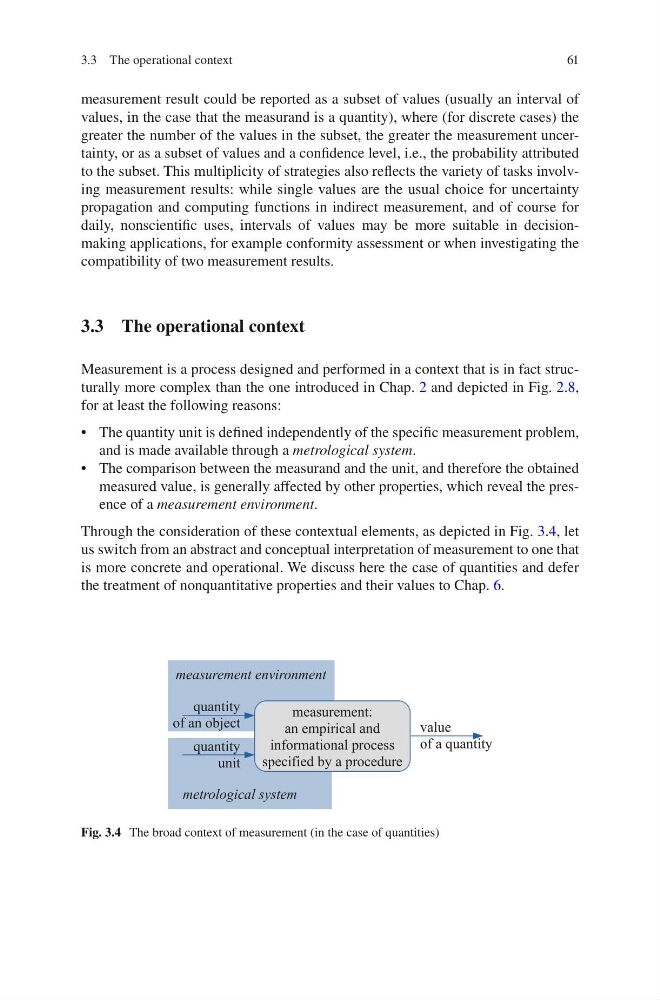
• The comparison between the measurand and the unit, and therefore the obtained
measured value, is generally affected by other properties, which reveal the presence of a measurement environment.
Through the consideration of these contextual elements, as depicted in Fig. 3.4, let
us switch from an abstract and conceptual interpretation of measurement to one that
is more concrete and operational. We discuss here the case of quantities and defer
the treatment of nonquantitative properties and their values to Chap. 6.
Fig. 3.4 The broad context of measurement (in the case of quantities)
3.3 The operational context
measurement result could be reported as a subset of values (usually an interval of
values, in the case that the measurand is a quantity), where (for discrete cases) the
greater the number of the values in the subset, the greater the measurement uncertainty, or as a subset of values and a confidence level, i.e., the probability attributed
to the subset. This multiplicity of strategies also reflects the variety of tasks involving measurement results: while single values are the usual choice for uncertainty
propagation and computing functions in indirect measurement, and of course for
daily, nonscientific uses, intervals of values may be more suitable in decisionmaking applications, for example conformity assessment or when investigating the
compatibility of two measurement results.
3.3 The operational context
Measurement is a process designed and performed in a context that is in fact structurally more complex than the one introduced in Chap. 2 and depicted in Fig. 2.8,
for at least the following reasons:
• The quantity unit is defined independently of the specific measurement problem,
and is made available through a metrological system.
• The comparison between the measurand and the unit, and therefore the obtained
measured value, is generally affected by other properties, which reveal the presence of a measurement environment.
Through the consideration of these contextual elements, as depicted in Fig. 3.4, let
us switch from an abstract and conceptual interpretation of measurement to one that
is more concrete and operational. We discuss here the case of quantities and defer
the treatment of nonquantitative properties and their values to Chap. 6.
Fig. 3.4 The broad context of measurement (in the case of quantities)
3.3 The operational context