

30
able properties, where indistinguishability, designated here as “≈”, is weaker
than equality (two properties could be indistinguishable by the available observational means, and nevertheless could be discovered to be different by adopting
better tools); for example, a 1 and a 2 might be indistinguishable with respect to
their length, L[a 1 ] ≈ L[a 2 ].
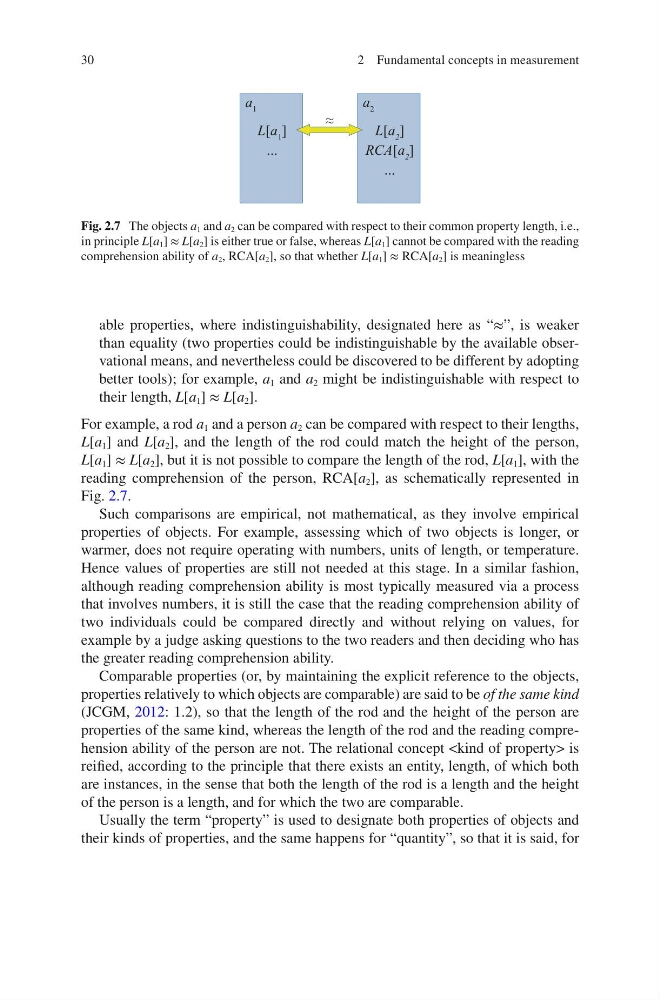
For example, a rod a 1 and a person a 2 can be compared with respect to their lengths,
L[a 1 ] and L[a 2 ], and the length of the rod could match the height of the person,
L[a 1 ] ≈ L[a 2 ], but it is not possible to compare the length of the rod, L[a 1 ], with the
reading comprehension of the person, RCA[a 2 ], as schematically represented in
Fig. 2.7.
Such comparisons are empirical, not mathematical, as they involve empirical
properties of objects. For example, assessing which of two objects is longer, or
warmer, does not require operating with numbers, units of length, or temperature.
Hence values of properties are still not needed at this stage. In a similar fashion,
although reading comprehension ability is most typically measured via a process
that involves numbers, it is still the case that the reading comprehension ability of
two individuals could be compared directly and without relying on values, for
example by a judge asking questions to the two readers and then deciding who has
the greater reading comprehension ability.
Comparable properties (or, by maintaining the explicit reference to the objects,
properties relatively to which objects are comparable) are said to be of the same kind
(JCGM, 2012: 1.2), so that the length of the rod and the height of the person are
properties of the same kind, whereas the length of the rod and the reading comprehension ability of the person are not. The relational concept is
reified, according to the principle that there exists an entity, length, of which both
are instances, in the sense that both the length of the rod is a length and the height
of the person is a length, and for which the two are comparable.
Usually the term “property” is used to designate both properties of objects and
their kinds of properties, and the same happens for “quantity”, so that it is said, for
Fig. 2.7 The objects a 1 and a 2 can be compared with respect to their common property length, i.e.,
in principle L[a 1 ] ≈ L[a 2 ] is either true or false, whereas L[a 1 ] cannot be compared with the reading
comprehension ability of a 2 , RCA[a 2 ], so that whether L[a 1 ] ≈ RCA[a 2 ] is meaningless
2 Fundamental concepts in measurement
able properties, where indistinguishability, designated here as “≈”, is weaker
than equality (two properties could be indistinguishable by the available observational means, and nevertheless could be discovered to be different by adopting
better tools); for example, a 1 and a 2 might be indistinguishable with respect to
their length, L[a 1 ] ≈ L[a 2 ].
For example, a rod a 1 and a person a 2 can be compared with respect to their lengths,
L[a 1 ] and L[a 2 ], and the length of the rod could match the height of the person,
L[a 1 ] ≈ L[a 2 ], but it is not possible to compare the length of the rod, L[a 1 ], with the
reading comprehension of the person, RCA[a 2 ], as schematically represented in
Fig. 2.7.
Such comparisons are empirical, not mathematical, as they involve empirical
properties of objects. For example, assessing which of two objects is longer, or
warmer, does not require operating with numbers, units of length, or temperature.
Hence values of properties are still not needed at this stage. In a similar fashion,
although reading comprehension ability is most typically measured via a process
that involves numbers, it is still the case that the reading comprehension ability of
two individuals could be compared directly and without relying on values, for
example by a judge asking questions to the two readers and then deciding who has
the greater reading comprehension ability.
Comparable properties (or, by maintaining the explicit reference to the objects,
properties relatively to which objects are comparable) are said to be of the same kind
(JCGM, 2012: 1.2), so that the length of the rod and the height of the person are
properties of the same kind, whereas the length of the rod and the reading comprehension ability of the person are not. The relational concept
reified, according to the principle that there exists an entity, length, of which both
are instances, in the sense that both the length of the rod is a length and the height
of the person is a length, and for which the two are comparable.
Usually the term “property” is used to designate both properties of objects and
their kinds of properties, and the same happens for “quantity”, so that it is said, for
Fig. 2.7 The objects a 1 and a 2 can be compared with respect to their common property length, i.e.,
in principle L[a 1 ] ≈ L[a 2 ] is either true or false, whereas L[a 1 ] cannot be compared with the reading
comprehension ability of a 2 , RCA[a 2 ], so that whether L[a 1 ] ≈ RCA[a 2 ] is meaningless
2 Fundamental concepts in measurement