

8
introduced, each corresponding to a different unit, all scales of length share the
same zero length and all scales of mass share the same zero mass.) Accordingly,
ratios of values of (thermometric) temperature are still not meaningful—in the sense
that if the temperatures of two bodies are, e.g., 20 and 40 °C, then the conclusion
that the latter is twice as warm as the former is mistaken (as one can easily check by
converting the two values to °F)—but units of temperature are nevertheless well
defined, and allow us to compare invariantly the ratios of differences of values. A
second scientific development created the conditions for the final step: thermodynamics implies the existence of a minimum, or absolute zero, of temperature, at
−273.15 °C, which led to the Kelvin scale, and which is thus a ratio scale (although,
of course, still nonadditive).
1.2.2 A brief introduction to reading comprehension ability
and its measurement
An important example of measurement in the human science domain is that of a
student’s reading comprehension ability (RCA). The relevance of reading comprehension ability to the modern world can hardly be exaggerated; indeed, you, the
reader, would not have gotten this far without your own reading comprehension! It
is obvious that accurate measurement of RCA is of crucial importance in education,
but it is equally so in many other social domains, such as in the writing of guidebooks, the formulation of tests such as driving tests, and the communication of
public health warnings.
A basic scenario for the measurement of reading comprehension ability might
involve the following:
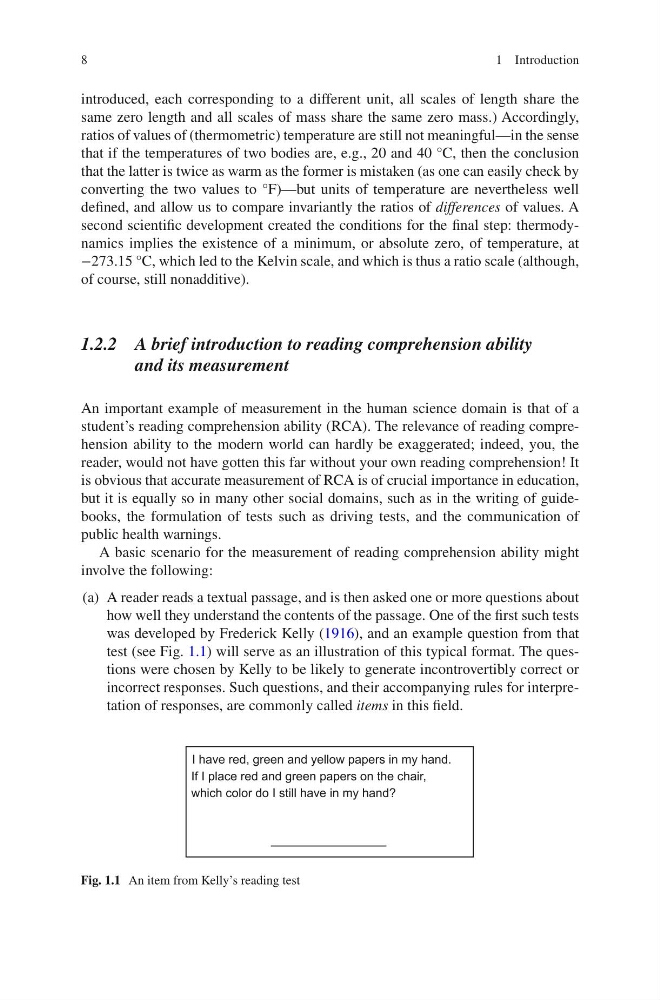
(a) A reader reads a textual passage, and is then asked one or more questions about
how well they understand the contents of the passage. One of the first such tests
was developed by Frederick Kelly (1916), and an example question from that
test (see Fig. 1.1) will serve as an illustration of this typical format. The questions were chosen by Kelly to be likely to generate incontrovertibly correct or
incorrect responses. Such questions, and their accompanying rules for interpretation of responses, are commonly called items in this field.
Fig. 1.1 An item from Kelly’s reading test
1 Introduction
introduced, each corresponding to a different unit, all scales of length share the
same zero length and all scales of mass share the same zero mass.) Accordingly,
ratios of values of (thermometric) temperature are still not meaningful—in the sense
that if the temperatures of two bodies are, e.g., 20 and 40 °C, then the conclusion
that the latter is twice as warm as the former is mistaken (as one can easily check by
converting the two values to °F)—but units of temperature are nevertheless well
defined, and allow us to compare invariantly the ratios of differences of values. A
second scientific development created the conditions for the final step: thermodynamics implies the existence of a minimum, or absolute zero, of temperature, at
−273.15 °C, which led to the Kelvin scale, and which is thus a ratio scale (although,
of course, still nonadditive).
1.2.2 A brief introduction to reading comprehension ability
and its measurement
An important example of measurement in the human science domain is that of a
student’s reading comprehension ability (RCA). The relevance of reading comprehension ability to the modern world can hardly be exaggerated; indeed, you, the
reader, would not have gotten this far without your own reading comprehension! It
is obvious that accurate measurement of RCA is of crucial importance in education,
but it is equally so in many other social domains, such as in the writing of guidebooks, the formulation of tests such as driving tests, and the communication of
public health warnings.
A basic scenario for the measurement of reading comprehension ability might
involve the following:
(a) A reader reads a textual passage, and is then asked one or more questions about
how well they understand the contents of the passage. One of the first such tests
was developed by Frederick Kelly (1916), and an example question from that
test (see Fig. 1.1) will serve as an illustration of this typical format. The questions were chosen by Kelly to be likely to generate incontrovertibly correct or
incorrect responses. Such questions, and their accompanying rules for interpretation of responses, are commonly called items in this field.
Fig. 1.1 An item from Kelly’s reading test
1 Introduction