

264
There are several complementary ways to classify properties. The most important here is between empirical properties and nonempirical (e.g., informational,
and more specifically mathematical) properties, given our hypothesis that only
empirical properties can be measurable. Properties are classified by domain,
i.e., physical properties vs. psychosocial properties. Properties, and more specifically their evaluations, are also classified by their types, where the simplest
distinction is between quantitative and nonquantitative properties and evaluations. We do not emphasize here the traditional distinction between primary and
secondary properties.
Entities such as systems of quantities and scales of properties refer to general
properties.
In formal contexts (e.g., formulas) we write general properties with italic characters. Hence L and length designate the general property length and RCA and
reading comprehension ability designate the general property reading comprehension ability [the VIM does not define this concept; in the specific case of
quantities, it uses “quantity” [1.1] and also “kind of quantity” [1.2]].
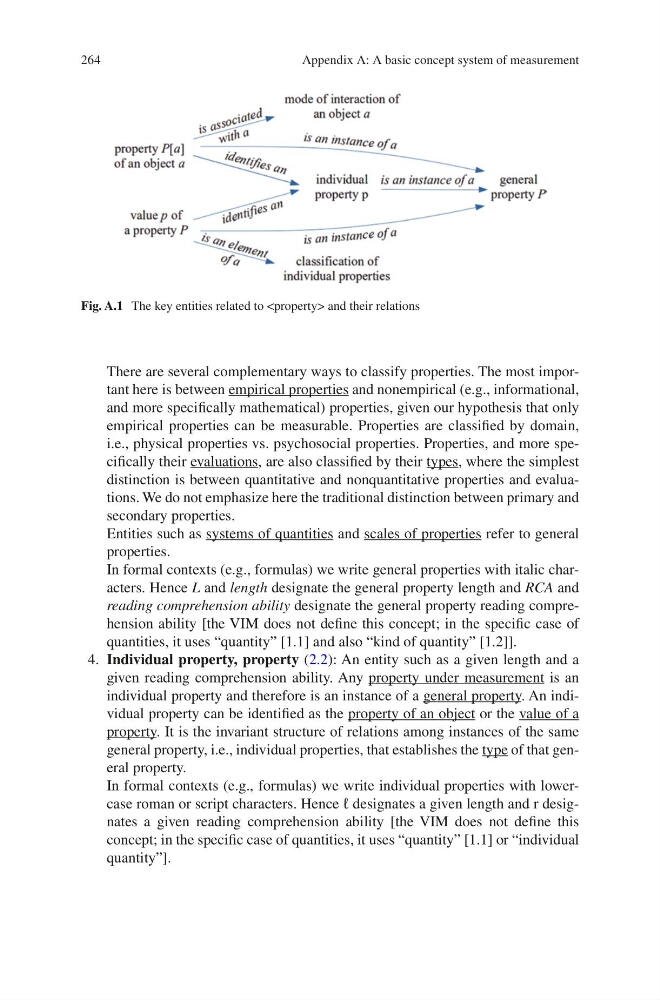
4. Individual property, property (2.2): An entity such as a given length and a
given reading comprehension ability. Any property under measurement is an
individual property and therefore is an instance of a general property. An individual property can be identified as the property of an object or the value of a
property. It is the invariant structure of relations among instances of the same
general property, i.e., individual properties, that establishes the type of that general property.
In formal contexts (e.g., formulas) we write individual properties with lowercase roman or script characters. Hence ℓ designates a given length and r designates a given reading comprehension ability [the VIM does not define this
concept; in the specific case of quantities, it uses “quantity” [1.1] or “individual
quantity”].
Fig. A.1 The key entities related to and their relations
Appendix A: A basic concept system of measurement
There are several complementary ways to classify properties. The most important here is between empirical properties and nonempirical (e.g., informational,
and more specifically mathematical) properties, given our hypothesis that only
empirical properties can be measurable. Properties are classified by domain,
i.e., physical properties vs. psychosocial properties. Properties, and more specifically their evaluations, are also classified by their types, where the simplest
distinction is between quantitative and nonquantitative properties and evaluations. We do not emphasize here the traditional distinction between primary and
secondary properties.
Entities such as systems of quantities and scales of properties refer to general
properties.
In formal contexts (e.g., formulas) we write general properties with italic characters. Hence L and length designate the general property length and RCA and
reading comprehension ability designate the general property reading comprehension ability [the VIM does not define this concept; in the specific case of
quantities, it uses “quantity” [1.1] and also “kind of quantity” [1.2]].
4. Individual property, property (2.2): An entity such as a given length and a
given reading comprehension ability. Any property under measurement is an
individual property and therefore is an instance of a general property. An individual property can be identified as the property of an object or the value of a
property. It is the invariant structure of relations among instances of the same
general property, i.e., individual properties, that establishes the type of that general property.
In formal contexts (e.g., formulas) we write individual properties with lowercase roman or script characters. Hence ℓ designates a given length and r designates a given reading comprehension ability [the VIM does not define this
concept; in the specific case of quantities, it uses “quantity” [1.1] or “individual
quantity”].
Fig. A.1 The key entities related to
Appendix A: A basic concept system of measurement