

240
8.1.1 Syntactic, semantic, and pragmatic information
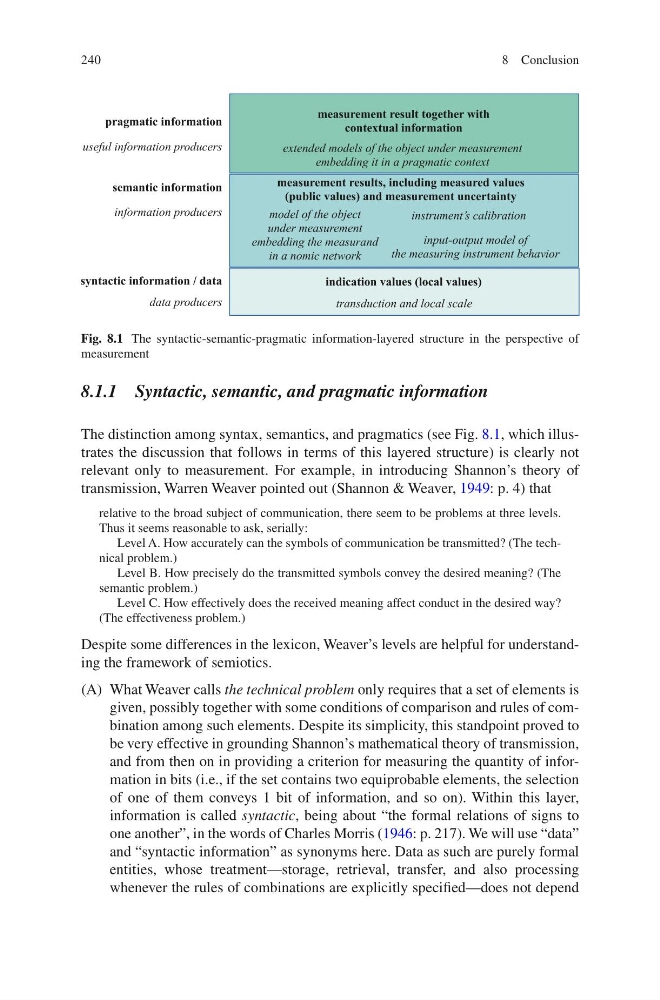
The distinction among syntax, semantics, and pragmatics (see Fig. 8.1, which illustrates the discussion that follows in terms of this layered structure) is clearly not
relevant only to measurement. For example, in introducing Shannon’s theory of
transmission, Warren Weaver pointed out (Shannon & Weaver, 1949: p. 4) that
relative to the broad subject of communication, there seem to be problems at three levels.
Thus it seems reasonable to ask, serially:
Level A. How accurately can the symbols of communication be transmitted? (The technical problem.)
Level B. How precisely do the transmitted symbols convey the desired meaning? (The
semantic problem.)
Level C. How effectively does the received meaning affect conduct in the desired way?
(The effectiveness problem.)
Despite some differences in the lexicon, Weaver’s levels are helpful for understanding the framework of semiotics.
(A) What Weaver calls the technical problem only requires that a set of elements is
given, possibly together with some conditions of comparison and rules of combination among such elements. Despite its simplicity, this standpoint proved to
be very effective in grounding Shannon’s mathematical theory of transmission,
and from then on in providing a criterion for measuring the quantity of information in bits (i.e., if the set contains two equiprobable elements, the selection
of one of them conveys 1 bit of information, and so on). Within this layer,
information is called syntactic, being about “the formal relations of signs to
one another”, in the words of Charles Morris (1946: p. 217). We will use “data”
and “syntactic information” as synonyms here. Data as such are purely formal
entities, whose treatment—storage, retrieval, transfer, and also processing
whenever the rules of combinations are explicitly specified—does not depend
Fig. 8.1 The syntactic-semantic-pragmatic information-layered structure in the perspective of
measurement
8 Conclusion
8.1.1 Syntactic, semantic, and pragmatic information
The distinction among syntax, semantics, and pragmatics (see Fig. 8.1, which illustrates the discussion that follows in terms of this layered structure) is clearly not
relevant only to measurement. For example, in introducing Shannon’s theory of
transmission, Warren Weaver pointed out (Shannon & Weaver, 1949: p. 4) that
relative to the broad subject of communication, there seem to be problems at three levels.
Thus it seems reasonable to ask, serially:
Level A. How accurately can the symbols of communication be transmitted? (The technical problem.)
Level B. How precisely do the transmitted symbols convey the desired meaning? (The
semantic problem.)
Level C. How effectively does the received meaning affect conduct in the desired way?
(The effectiveness problem.)
Despite some differences in the lexicon, Weaver’s levels are helpful for understanding the framework of semiotics.
(A) What Weaver calls the technical problem only requires that a set of elements is
given, possibly together with some conditions of comparison and rules of combination among such elements. Despite its simplicity, this standpoint proved to
be very effective in grounding Shannon’s mathematical theory of transmission,
and from then on in providing a criterion for measuring the quantity of information in bits (i.e., if the set contains two equiprobable elements, the selection
of one of them conveys 1 bit of information, and so on). Within this layer,
information is called syntactic, being about “the formal relations of signs to
one another”, in the words of Charles Morris (1946: p. 217). We will use “data”
and “syntactic information” as synonyms here. Data as such are purely formal
entities, whose treatment—storage, retrieval, transfer, and also processing
whenever the rules of combinations are explicitly specified—does not depend
Fig. 8.1 The syntactic-semantic-pragmatic information-layered structure in the perspective of
measurement
8 Conclusion