

229
7.4.2 Uncertainties in the stages of direct measurement
Our account of measurement uncertainty begins with the background to any actual
measurement: the definition of the measurand and the calibration of the instrument.
7.4.2.1 Regarding the definition of the measurand
Measurement is aimed at acquiring the information required to assert a Basic
Evaluation Equation Θ[a] = θ, i.e., the equality of the property Θ of the object a and
the value θ (see the analysis in particular in Sects. 5.1.1 and 6.4). In the simplest
condition, the measurand is defined as the property which interacts with the instrument and triggers the transduction: in a (tautological) sense, we measure what the
instrument measures. This might be acceptable when the information acquired by
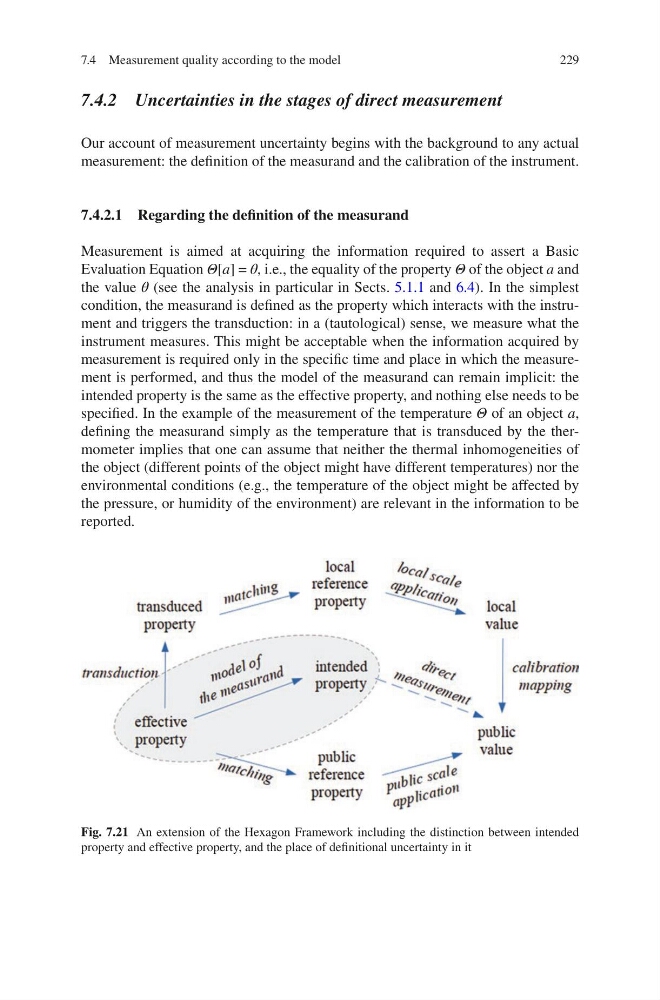
measurement is required only in the specific time and place in which the measurement is performed, and thus the model of the measurand can remain implicit: the
intended property is the same as the effective property, and nothing else needs to be
specified. In the example of the measurement of the temperature Θ of an object a,
defining the measurand simply as the temperature that is transduced by the thermometer implies that one can assume that neither the thermal inhomogeneities of
the object (different points of the object might have different temperatures) nor the
environmental conditions (e.g., the temperature of the object might be affected by
the pressure, or humidity of the environment) are relevant in the information to be
reported.
Fig. 7.21 An extension of the Hexagon Framework including the distinction between intended
property and effective property, and the place of definitional uncertainty in it
7.4 Measurement quality according to the model
7.4.2 Uncertainties in the stages of direct measurement
Our account of measurement uncertainty begins with the background to any actual
measurement: the definition of the measurand and the calibration of the instrument.
7.4.2.1 Regarding the definition of the measurand
Measurement is aimed at acquiring the information required to assert a Basic
Evaluation Equation Θ[a] = θ, i.e., the equality of the property Θ of the object a and
the value θ (see the analysis in particular in Sects. 5.1.1 and 6.4). In the simplest
condition, the measurand is defined as the property which interacts with the instrument and triggers the transduction: in a (tautological) sense, we measure what the
instrument measures. This might be acceptable when the information acquired by
measurement is required only in the specific time and place in which the measurement is performed, and thus the model of the measurand can remain implicit: the
intended property is the same as the effective property, and nothing else needs to be
specified. In the example of the measurement of the temperature Θ of an object a,
defining the measurand simply as the temperature that is transduced by the thermometer implies that one can assume that neither the thermal inhomogeneities of
the object (different points of the object might have different temperatures) nor the
environmental conditions (e.g., the temperature of the object might be affected by
the pressure, or humidity of the environment) are relevant in the information to be
reported.
Fig. 7.21 An extension of the Hexagon Framework including the distinction between intended
property and effective property, and the place of definitional uncertainty in it
7.4 Measurement quality according to the model