

224
First is a norm-referenced approach (see also Sect. 6.3.4). In this method, a representative sample of individuals from a specified population (e.g., 5-year-olds in a
given country) take a test, which generates a sample of results in the form of local
values (“sum scores”) on the test. Then, relevant statistics are computed on the sum
scores, such as the mean and the standard deviation (or the median and the interquartile range, or the percentiles), and the public reference properties are taken to be
the RCAs of readers at specified values of the sum scores. For example, a scale
could be set by mapping the mean to, say, 500, and the standard deviation to, say,
100. A somewhat different way to use a norm-referenced approach is to choose two
different reference populations and set up a scale between them, similar to the way
that the Celsius scale is set using the freezing point and the boiling point of water
for temperature. For example, one might choose 5-year-olds and 15-year-olds, and
then assign the medians, or means, of each to convenient numbers, such as 10 and
100, respectively. The intermediate reference properties are either chosen arbitrarily,
as in the case of Mohs’ scale of hardness, or inferred by assuming that the property
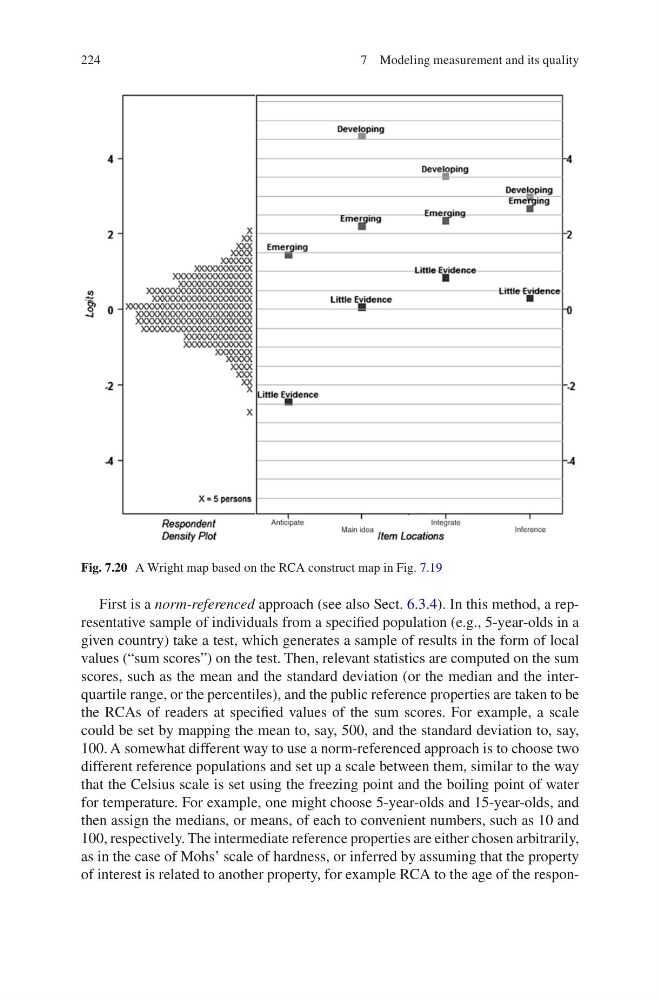
of interest is related to another property, for example RCA to the age of the responFig. 7.20 A Wright map based on the RCA construct map in Fig. 7.19
7 Modeling measurement and its quality
First is a norm-referenced approach (see also Sect. 6.3.4). In this method, a representative sample of individuals from a specified population (e.g., 5-year-olds in a
given country) take a test, which generates a sample of results in the form of local
values (“sum scores”) on the test. Then, relevant statistics are computed on the sum
scores, such as the mean and the standard deviation (or the median and the interquartile range, or the percentiles), and the public reference properties are taken to be
the RCAs of readers at specified values of the sum scores. For example, a scale
could be set by mapping the mean to, say, 500, and the standard deviation to, say,
100. A somewhat different way to use a norm-referenced approach is to choose two
different reference populations and set up a scale between them, similar to the way
that the Celsius scale is set using the freezing point and the boiling point of water
for temperature. For example, one might choose 5-year-olds and 15-year-olds, and
then assign the medians, or means, of each to convenient numbers, such as 10 and
100, respectively. The intermediate reference properties are either chosen arbitrarily,
as in the case of Mohs’ scale of hardness, or inferred by assuming that the property
of interest is related to another property, for example RCA to the age of the responFig. 7.20 A Wright map based on the RCA construct map in Fig. 7.19
7 Modeling measurement and its quality