

209
property of an object
value of a property
→
from a set of comparable and distinguishable properties of objects (i.e., all are
instances of the same general property) to a set of distinct values of that general
property, where the mapping is constrained by the conditions of scale transformation (see Sects. 6.3.2 and 6.5.1), so that, for example, for ordinal evaluations a scale
is identified up to a monotonic transformation, and for ratio evaluations a scale is
identified up to a change of the unit. While syntactically equivalent to a Basic
Evaluation Equation, a Basic Evaluation Scale differs in that it is not, in principle,
true or false, depending on which value is chosen for each given property. Rather, it
is a specification, which is instead required to be consistent: that is, if the property
P[a] is greater than the property P[b] then the value specified for P[a] must be
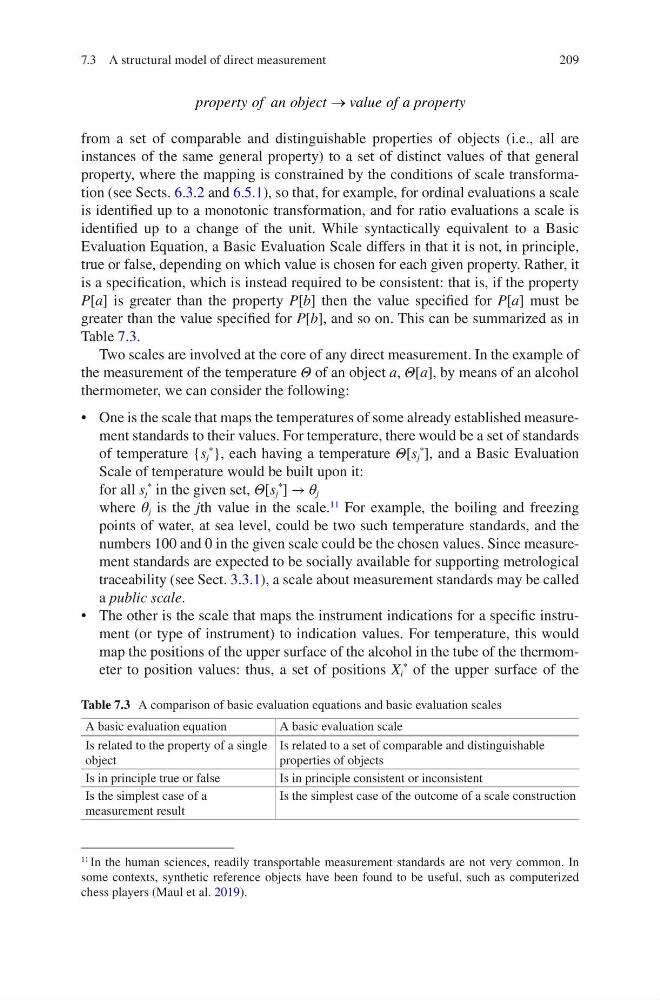
greater than the value specified for P[b], and so on. This can be summarized as in
Table 7.3.
Two scales are involved at the core of any direct measurement. In the example of
the measurement of the temperature Θ of an object a, Θ[a], by means of an alcohol
thermometer, we can consider the following:
• One is the scale that maps the temperatures of some already established measurement standards to their values. For temperature, there would be a set of standards
of temperature {s j
*
}, each having a temperature Θ[s j
*
], and a Basic Evaluation
Scale of temperature would be built upon it:
for all s j
*
in the given set, Θ[s j
*
] → θ j
where θ j is the jth value in the scale.
11
For example, the boiling and freezing
points of water, at sea level, could be two such temperature standards, and the
numbers 100 and 0 in the given scale could be the chosen values. Since measurement standards are expected to be socially available for supporting metrological
traceability (see Sect. 3.3.1), a scale about measurement standards may be called
a public scale.
• The other is the scale that maps the instrument indications for a specific instrument (or type of instrument) to indication values. For temperature, this would
map the positions of the upper surface of the alcohol in the tube of the thermometer to position values: thus, a set of positions X i
*
of the upper surface of the
11 In the human sciences, readily transportable measurement standards are not very common. In
some contexts, synthetic reference objects have been found to be useful, such as computerized
chess players (Maul et al. 2019).
Table 7.3 A comparison of basic evaluation equations and basic evaluation scales
A basic evaluation equation
A basic evaluation scale
Is related to the property of a single
object
Is related to a set of comparable and distinguishable
properties of objects
Is in principle true or false
Is in principle consistent or inconsistent
Is the simplest case of a
measurement result
Is the simplest case of the outcome of a scale construction
7.3 A structural model of direct measurement
property of an object
value of a property
→
from a set of comparable and distinguishable properties of objects (i.e., all are
instances of the same general property) to a set of distinct values of that general
property, where the mapping is constrained by the conditions of scale transformation (see Sects. 6.3.2 and 6.5.1), so that, for example, for ordinal evaluations a scale
is identified up to a monotonic transformation, and for ratio evaluations a scale is
identified up to a change of the unit. While syntactically equivalent to a Basic
Evaluation Equation, a Basic Evaluation Scale differs in that it is not, in principle,
true or false, depending on which value is chosen for each given property. Rather, it
is a specification, which is instead required to be consistent: that is, if the property
P[a] is greater than the property P[b] then the value specified for P[a] must be
greater than the value specified for P[b], and so on. This can be summarized as in
Table 7.3.
Two scales are involved at the core of any direct measurement. In the example of
the measurement of the temperature Θ of an object a, Θ[a], by means of an alcohol
thermometer, we can consider the following:
• One is the scale that maps the temperatures of some already established measurement standards to their values. For temperature, there would be a set of standards
of temperature {s j
*
}, each having a temperature Θ[s j
*
], and a Basic Evaluation
Scale of temperature would be built upon it:
for all s j
*
in the given set, Θ[s j
*
] → θ j
where θ j is the jth value in the scale.
11
For example, the boiling and freezing
points of water, at sea level, could be two such temperature standards, and the
numbers 100 and 0 in the given scale could be the chosen values. Since measurement standards are expected to be socially available for supporting metrological
traceability (see Sect. 3.3.1), a scale about measurement standards may be called
a public scale.
• The other is the scale that maps the instrument indications for a specific instrument (or type of instrument) to indication values. For temperature, this would
map the positions of the upper surface of the alcohol in the tube of the thermometer to position values: thus, a set of positions X i
*
of the upper surface of the
11 In the human sciences, readily transportable measurement standards are not very common. In
some contexts, synthetic reference objects have been found to be useful, such as computerized
chess players (Maul et al. 2019).
Table 7.3 A comparison of basic evaluation equations and basic evaluation scales
A basic evaluation equation
A basic evaluation scale
Is related to the property of a single
object
Is related to a set of comparable and distinguishable
properties of objects
Is in principle true or false
Is in principle consistent or inconsistent
Is the simplest case of a
measurement result
Is the simplest case of the outcome of a scale construction
7.3 A structural model of direct measurement