

207
a measurement is based on an indirect method (as in the right column of Table 7.2) when(i)
instruments are used that are not necessarily coupled with objects that carry the measurand
or designed to interact with instances of the general property of the measurand, and(ii) the
model of the measurand is used in measurement for identifying the measurand and its
dependence on the properties from which the measurement result can be computed
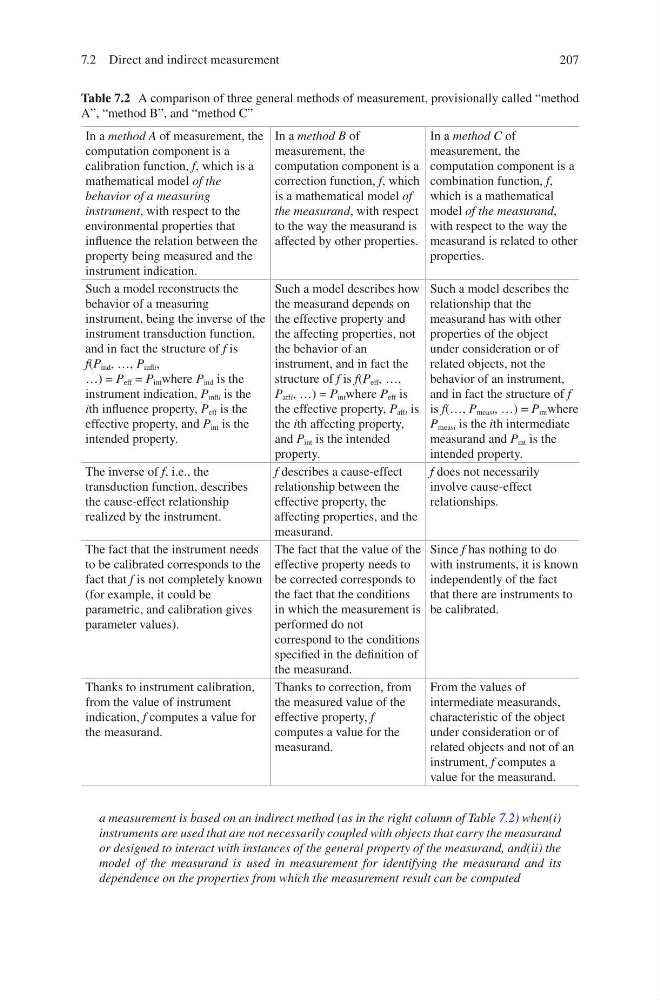
Table 7.2 A comparison of three general methods of measurement, provisionally called “method
A”, “method B”, and “method C”
In a method A of measurement, the
computation component is a
calibration function, f, which is a
mathematical model of the
behavior of a measuring
instrument, with respect to the
environmental properties that
influence the relation between the
property being measured and the
instrument indication.
In a method B of
measurement, the
computation component is a
correction function, f, which
is a mathematical model of
the measurand, with respect
to the way the measurand is
affected by other properties.
In a method C of
measurement, the
computation component is a
combination function, f,
which is a mathematical
model of the measurand,
with respect to the way the
measurand is related to other
properties.
Such a model reconstructs the
behavior of a measuring
instrument, being the inverse of the
instrument transduction function,
and in fact the structure of f is
f(P ind , …, P infli ,
…) = P eff = P int where P ind is the
instrument indication, P infli is the
ith influence property, P eff is the
effective property, and P int is the
intended property.
Such a model describes how
the measurand depends on
the effective property and
the affecting properties, not
the behavior of an
instrument, and in fact the
structure of f is f(P eff , …,
P affi , …) = P int where P eff is
the effective property, P affi is
the ith affecting property,
and P int is the intended
property.
Such a model describes the
relationship that the
measurand has with other
properties of the object
under consideration or of
related objects, not the
behavior of an instrument,
and in fact the structure of f
is f(…, P measi , …) = P int where
P measi is the ith intermediate
measurand and P int is the
intended property.
The inverse of f, i.e., the
transduction function, describes
the cause-effect relationship
realized by the instrument.
f describes a cause-effect
relationship between the
effective property, the
affecting properties, and the
measurand.
f does not necessarily
involve cause-effect
relationships.
The fact that the instrument needs
to be calibrated corresponds to the
fact that f is not completely known
(for example, it could be
parametric, and calibration gives
parameter values).
The fact that the value of the
effective property needs to
be corrected corresponds to
the fact that the conditions
in which the measurement is
performed do not
correspond to the conditions
specified in the definition of
the measurand.
Since f has nothing to do
with instruments, it is known
independently of the fact
that there are instruments to
be calibrated.
Thanks to instrument calibration,
from the value of instrument
indication, f computes a value for
the measurand.
Thanks to correction, from
the measured value of the
effective property, f
computes a value for the
measurand.
From the values of
intermediate measurands,
characteristic of the object
under consideration or of
related objects and not of an
instrument, f computes a
value for the measurand.
7.2 Direct and indirect measurement
a measurement is based on an indirect method (as in the right column of Table 7.2) when(i)
instruments are used that are not necessarily coupled with objects that carry the measurand
or designed to interact with instances of the general property of the measurand, and(ii) the
model of the measurand is used in measurement for identifying the measurand and its
dependence on the properties from which the measurement result can be computed
Table 7.2 A comparison of three general methods of measurement, provisionally called “method
A”, “method B”, and “method C”
In a method A of measurement, the
computation component is a
calibration function, f, which is a
mathematical model of the
behavior of a measuring
instrument, with respect to the
environmental properties that
influence the relation between the
property being measured and the
instrument indication.
In a method B of
measurement, the
computation component is a
correction function, f, which
is a mathematical model of
the measurand, with respect
to the way the measurand is
affected by other properties.
In a method C of
measurement, the
computation component is a
combination function, f,
which is a mathematical
model of the measurand,
with respect to the way the
measurand is related to other
properties.
Such a model reconstructs the
behavior of a measuring
instrument, being the inverse of the
instrument transduction function,
and in fact the structure of f is
f(P ind , …, P infli ,
…) = P eff = P int where P ind is the
instrument indication, P infli is the
ith influence property, P eff is the
effective property, and P int is the
intended property.
Such a model describes how
the measurand depends on
the effective property and
the affecting properties, not
the behavior of an
instrument, and in fact the
structure of f is f(P eff , …,
P affi , …) = P int where P eff is
the effective property, P affi is
the ith affecting property,
and P int is the intended
property.
Such a model describes the
relationship that the
measurand has with other
properties of the object
under consideration or of
related objects, not the
behavior of an instrument,
and in fact the structure of f
is f(…, P measi , …) = P int where
P measi is the ith intermediate
measurand and P int is the
intended property.
The inverse of f, i.e., the
transduction function, describes
the cause-effect relationship
realized by the instrument.
f describes a cause-effect
relationship between the
effective property, the
affecting properties, and the
measurand.
f does not necessarily
involve cause-effect
relationships.
The fact that the instrument needs
to be calibrated corresponds to the
fact that f is not completely known
(for example, it could be
parametric, and calibration gives
parameter values).
The fact that the value of the
effective property needs to
be corrected corresponds to
the fact that the conditions
in which the measurement is
performed do not
correspond to the conditions
specified in the definition of
the measurand.
Since f has nothing to do
with instruments, it is known
independently of the fact
that there are instruments to
be calibrated.
Thanks to instrument calibration,
from the value of instrument
indication, f computes a value for
the measurand.
Thanks to correction, from
the measured value of the
effective property, f
computes a value for the
measurand.
From the values of
intermediate measurands,
characteristic of the object
under consideration or of
related objects and not of an
instrument, f computes a
value for the measurand.
7.2 Direct and indirect measurement