

xxii
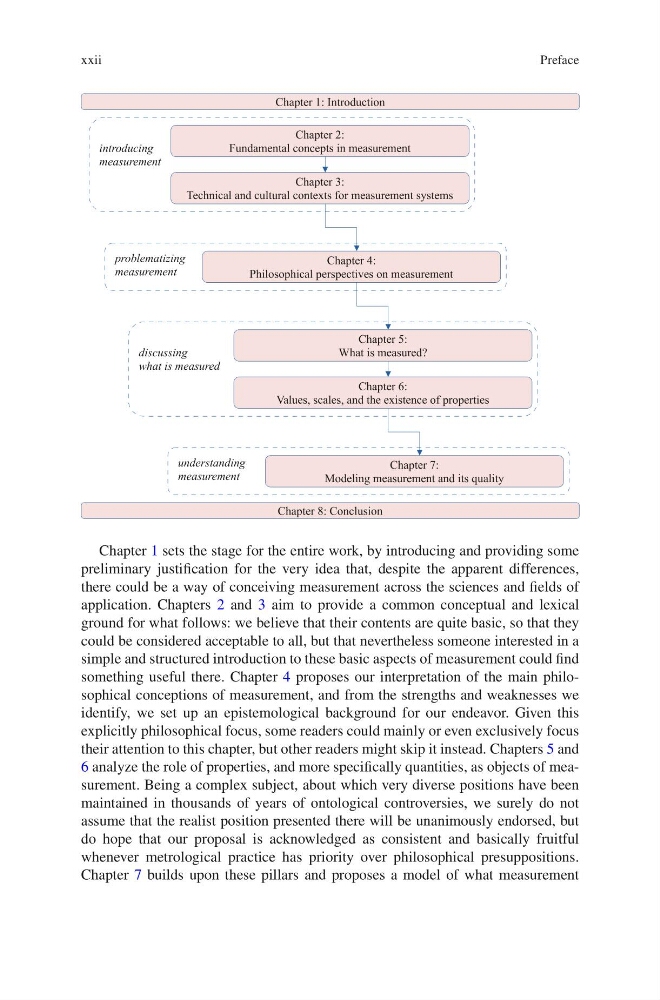
Chapter 1 sets the stage for the entire work, by introducing and providing some
preliminary justification for the very idea that, despite the apparent differences,
there could be a way of conceiving measurement across the sciences and fields of
application. Chapters 2 and 3 aim to provide a common conceptual and lexical
ground for what follows: we believe that their contents are quite basic, so that they
could be considered acceptable to all, but that nevertheless someone interested in a
simple and structured introduction to these basic aspects of measurement could find
something useful there. Chapter 4 proposes our interpretation of the main philosophical conceptions of measurement, and from the strengths and weaknesses we
identify, we set up an epistemological background for our endeavor. Given this
explicitly philosophical focus, some readers could mainly or even exclusively focus
their attention to this chapter, but other readers might skip it instead. Chapters 5 and
6 analyze the role of properties, and more specifically quantities, as objects of measurement. Being a complex subject, about which very diverse positions have been
maintained in thousands of years of ontological controversies, we surely do not
assume that the realist position presented there will be unanimously endorsed, but
do hope that our proposal is acknowledged as consistent and basically fruitful
whenever metrological practice has priority over philosophical presuppositions.
Chapter 7 builds upon these pillars and proposes a model of what measurement
Preface
Chapter 1 sets the stage for the entire work, by introducing and providing some
preliminary justification for the very idea that, despite the apparent differences,
there could be a way of conceiving measurement across the sciences and fields of
application. Chapters 2 and 3 aim to provide a common conceptual and lexical
ground for what follows: we believe that their contents are quite basic, so that they
could be considered acceptable to all, but that nevertheless someone interested in a
simple and structured introduction to these basic aspects of measurement could find
something useful there. Chapter 4 proposes our interpretation of the main philosophical conceptions of measurement, and from the strengths and weaknesses we
identify, we set up an epistemological background for our endeavor. Given this
explicitly philosophical focus, some readers could mainly or even exclusively focus
their attention to this chapter, but other readers might skip it instead. Chapters 5 and
6 analyze the role of properties, and more specifically quantities, as objects of measurement. Being a complex subject, about which very diverse positions have been
maintained in thousands of years of ontological controversies, we surely do not
assume that the realist position presented there will be unanimously endorsed, but
do hope that our proposal is acknowledged as consistent and basically fruitful
whenever metrological practice has priority over philosophical presuppositions.
Chapter 7 builds upon these pillars and proposes a model of what measurement
Preface