

170
value transmitted along the channel by the agent via the encoded quantity is in principle perfectly knowable. No such agent exists in the case of measurement, which
requires a radically different description, in which values of quantities are the output, and not the input, of the process.
29
6.5 Generalizing the framework to nonquantitative
properties
The ontological and epistemological analysis proposed so far has been focused on
quantities, although, as we have exemplified, much can also be done with nonadditive quantities. In consistency with the VIM, we have assumed that quantities are
specific kinds of properties (JCGM, 2012: 1.1), and therefore we need to work on
the relation between quantities and properties in order to explore whether and how
the ontology and epistemology introduced so far can be applied to properties in
general. Concretely, the issue is whether Basic Evaluation Equations can involve
nonquantitative properties, and if so, what are the key differences between quantitative and nonquantitative Basic Evaluation Equations.
According to a standard view in philosophy of science, developed in particular
within the neopositivist tradition by Rudolf Carnap (1966) and Carl Gustav Hempel
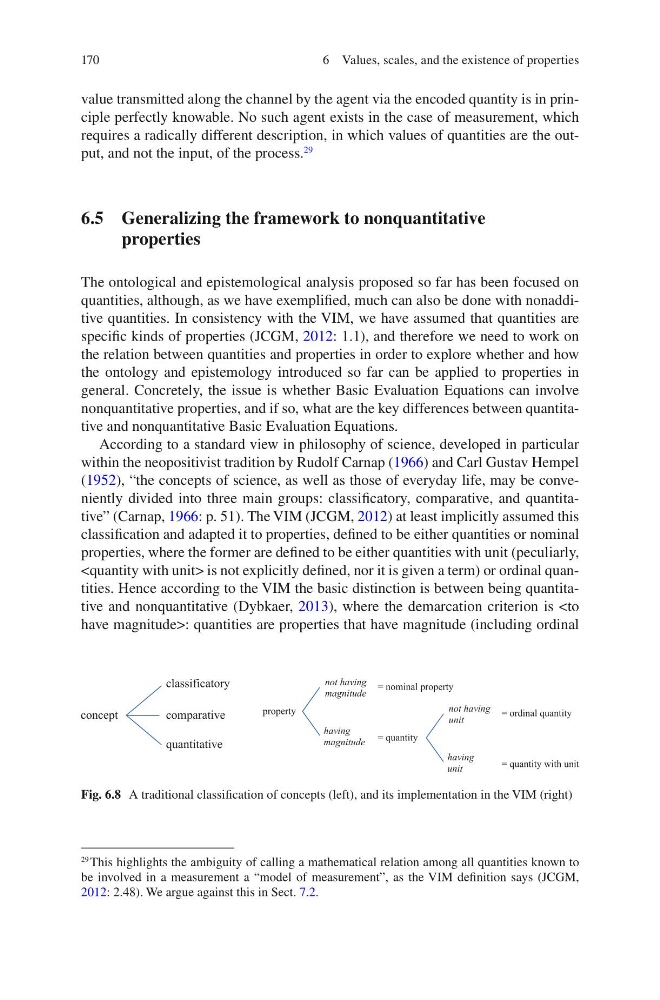
(1952), “the concepts of science, as well as those of everyday life, may be conveniently divided into three main groups: classificatory, comparative, and quantitative” (Carnap, 1966: p. 51). The VIM (JCGM, 2012) at least implicitly assumed this
classification and adapted it to properties, defined to be either quantities or nominal
properties, where the former are defined to be either quantities with unit (peculiarly,
is not explicitly defined, nor it is given a term) or ordinal quantities. Hence according to the VIM the basic distinction is between being quantitative and nonquantitative (Dybkaer, 2013), where the demarcation criterion is
29 This highlights the ambiguity of calling a mathematical relation among all quantities known to
be involved in a measurement a “model of measurement”, as the VIM definition says (JCGM,
2012: 2.48). We argue against this in Sect. 7.2.
Fig. 6.8 A traditional classification of concepts (left), and its implementation in the VIM (right)
6 Values, scales, and the existence of properties
value transmitted along the channel by the agent via the encoded quantity is in principle perfectly knowable. No such agent exists in the case of measurement, which
requires a radically different description, in which values of quantities are the output, and not the input, of the process.
29
6.5 Generalizing the framework to nonquantitative
properties
The ontological and epistemological analysis proposed so far has been focused on
quantities, although, as we have exemplified, much can also be done with nonadditive quantities. In consistency with the VIM, we have assumed that quantities are
specific kinds of properties (JCGM, 2012: 1.1), and therefore we need to work on
the relation between quantities and properties in order to explore whether and how
the ontology and epistemology introduced so far can be applied to properties in
general. Concretely, the issue is whether Basic Evaluation Equations can involve
nonquantitative properties, and if so, what are the key differences between quantitative and nonquantitative Basic Evaluation Equations.
According to a standard view in philosophy of science, developed in particular
within the neopositivist tradition by Rudolf Carnap (1966) and Carl Gustav Hempel
(1952), “the concepts of science, as well as those of everyday life, may be conveniently divided into three main groups: classificatory, comparative, and quantitative” (Carnap, 1966: p. 51). The VIM (JCGM, 2012) at least implicitly assumed this
classification and adapted it to properties, defined to be either quantities or nominal
properties, where the former are defined to be either quantities with unit (peculiarly,
29 This highlights the ambiguity of calling a mathematical relation among all quantities known to
be involved in a measurement a “model of measurement”, as the VIM definition says (JCGM,
2012: 2.48). We argue against this in Sect. 7.2.
Fig. 6.8 A traditional classification of concepts (left), and its implementation in the VIM (right)
6 Values, scales, and the existence of properties