

167
rates of m and n) can be compared by comparing s m /D with s n /D, where (s m /D)/
(s n /D) is the observed proportion of reader n answering an item incorrectly and
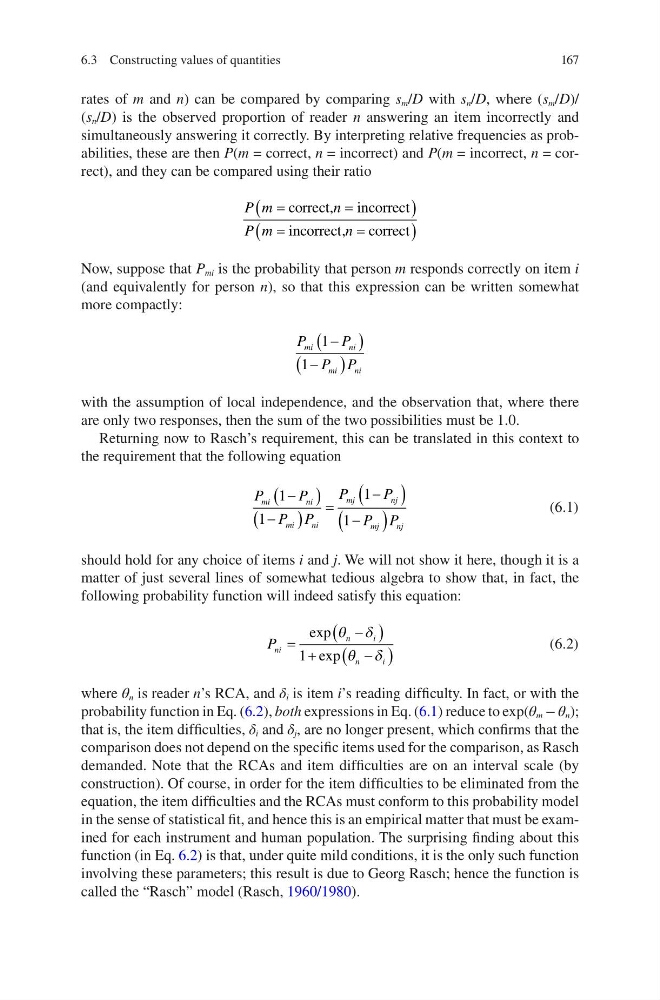
simultaneously answering it correctly. By interpreting relative frequencies as probabilities, these are then P(m = correct, n = incorrect) and P(m = incorrect, n = correct), and they can be compared using their ratio
P m
n
P m
n
=
=
(
)
=
=
(
)
correct,
incorrect
incorrect,
correct
Now, suppose that P mi is the probability that person m responds correctly on item i
(and equivalently for person n), so that this expression can be written somewhat
more compactly:
P
P
P P
mi
ni
mi
ni
1
1
−
(
)
−
(
)
with the assumption of local independence, and the observation that, where there
are only two responses, then the sum of the two possibilities must be 1.0.
Returning now to Rasch’s requirement, this can be translated in this context to
the requirement that the following equation
P
P
P P
P
P
P P
mi
ni
mi
ni
mj
nj
mj
nj
1
1
1
1
−
(
)
−
(
)
=
−
(
)
−
(
)
(6.1)
should hold for any choice of items i and j. We will not show it here, though it is a
matter of just several lines of somewhat tedious algebra to show that, in fact, the
following probability function will indeed satisfy this equation:
P ni
n
i
n
i
=
−
(
)
+
−
(
)
exp
exp
θ δ
θ δ
1
(6.2)
where θ n is reader n’s RCA, and δ i is item i’s reading difficulty. In fact, or with the
probability function in Eq. (6.2), both expressions in Eq. (6.1) reduce to exp(θ m − θ n );
that is, the item difficulties, δ i and δ j , are no longer present, which confirms that the
comparison does not depend on the specific items used for the comparison, as Rasch
demanded. Note that the RCAs and item difficulties are on an interval scale (by
construction). Of course, in order for the item difficulties to be eliminated from the
equation, the item difficulties and the RCAs must conform to this probability model
in the sense of statistical fit, and hence this is an empirical matter that must be examined for each instrument and human population. The surprising finding about this
function (in Eq. 6.2) is that, under quite mild conditions, it is the only such function
involving these parameters; this result is due to Georg Rasch; hence the function is
called the “Rasch” model (Rasch, 1960/1980).
6.3 Constructing values of quantities
rates of m and n) can be compared by comparing s m /D with s n /D, where (s m /D)/
(s n /D) is the observed proportion of reader n answering an item incorrectly and
simultaneously answering it correctly. By interpreting relative frequencies as probabilities, these are then P(m = correct, n = incorrect) and P(m = incorrect, n = correct), and they can be compared using their ratio
P m
n
P m
n
=
=
(
)
=
=
(
)
correct,
incorrect
incorrect,
correct
Now, suppose that P mi is the probability that person m responds correctly on item i
(and equivalently for person n), so that this expression can be written somewhat
more compactly:
P
P
P P
mi
ni
mi
ni
1
1
−
(
)
−
(
)
with the assumption of local independence, and the observation that, where there
are only two responses, then the sum of the two possibilities must be 1.0.
Returning now to Rasch’s requirement, this can be translated in this context to
the requirement that the following equation
P
P
P P
P
P
P P
mi
ni
mi
ni
mj
nj
mj
nj
1
1
1
1
−
(
)
−
(
)
=
−
(
)
−
(
)
(6.1)
should hold for any choice of items i and j. We will not show it here, though it is a
matter of just several lines of somewhat tedious algebra to show that, in fact, the
following probability function will indeed satisfy this equation:
P ni
n
i
n
i
=
−
(
)
+
−
(
)
exp
exp
θ δ
θ δ
1
(6.2)
where θ n is reader n’s RCA, and δ i is item i’s reading difficulty. In fact, or with the
probability function in Eq. (6.2), both expressions in Eq. (6.1) reduce to exp(θ m − θ n );
that is, the item difficulties, δ i and δ j , are no longer present, which confirms that the
comparison does not depend on the specific items used for the comparison, as Rasch
demanded. Note that the RCAs and item difficulties are on an interval scale (by
construction). Of course, in order for the item difficulties to be eliminated from the
equation, the item difficulties and the RCAs must conform to this probability model
in the sense of statistical fit, and hence this is an empirical matter that must be examined for each instrument and human population. The surprising finding about this
function (in Eq. 6.2) is that, under quite mild conditions, it is the only such function
involving these parameters; this result is due to Georg Rasch; hence the function is
called the “Rasch” model (Rasch, 1960/1980).
6.3 Constructing values of quantities