

162
• If θ i < θ j < θ k and m j ≤ m k then θ i,j < θ i,k , i.e., thermal composition is monotonic
for monotonically increasing mass.
• If θ i < θ j < θ k and m j > m k then all cases, θ i,j < θ i,k , θ i,j = θ i,k , and θ i,j > θ i,k , can
happen.
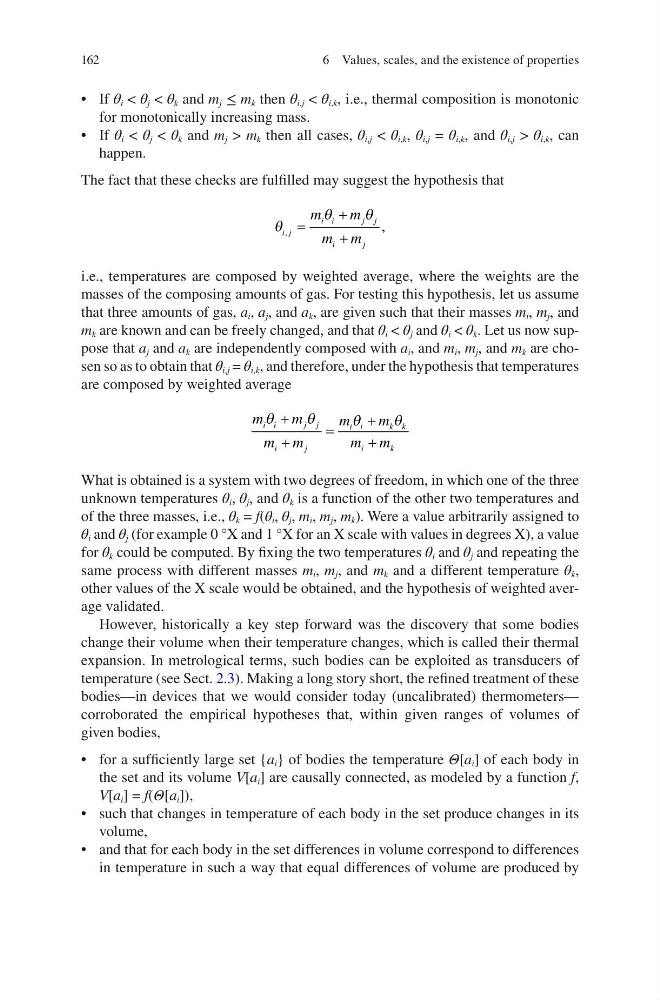
The fact that these checks are fulfilled may suggest the hypothesis that
θ
θ
θ
i j
i i
j j
i
j
m
m
m m
,
,
=
+
+
i.e., temperatures are composed by weighted average, where the weights are the
masses of the composing amounts of gas. For testing this hypothesis, let us assume
that three amounts of gas, a i , a j , and a k , are given such that their masses m i , m j , and
m k are known and can be freely changed, and that θ i < θ j and θ i < θ k . Let us now suppose that a j and a k are independently composed with a i , and m i , m j , and m k are chosen so as to obtain that θ i,j = θ i,k , and therefore, under the hypothesis that temperatures
are composed by weighted average
m
m
m m
m
m
m m
i i
j j
i
j
i i
k k
i
k
θ
θ
θ
θ
+
+
=
+
+
What is obtained is a system with two degrees of freedom, in which one of the three
unknown temperatures θ i , θ j , and θ k is a function of the other two temperatures and
of the three masses, i.e., θ k = f(θ i , θ j , m i , m j , m k ). Were a value arbitrarily assigned to
θ i and θ j (for example 0 °X and 1 °X for an X scale with values in degrees X), a value
for θ k could be computed. By fixing the two temperatures θ i and θ j and repeating the
same process with different masses m i , m j , and m k and a different temperature θ k ,
other values of the X scale would be obtained, and the hypothesis of weighted average validated.
However, historically a key step forward was the discovery that some bodies
change their volume when their temperature changes, which is called their thermal
expansion. In metrological terms, such bodies can be exploited as transducers of
temperature (see Sect. 2.3). Making a long story short, the refined treatment of these
bodies—in devices that we would consider today (uncalibrated) thermometers—
corroborated the empirical hypotheses that, within given ranges of volumes of
given bodies,
• for a sufficiently large set {a i } of bodies the temperature Θ[a i ] of each body in
the set and its volume V[a i ] are causally connected, as modeled by a function f,
V[a i ] = f(Θ[a i ]),
• such that changes in temperature of each body in the set produce changes in its
volume,
• and that for each body in the set differences in volume correspond to differences
in temperature in such a way that equal differences of volume are produced by
6 Values, scales, and the existence of properties
• If θ i < θ j < θ k and m j ≤ m k then θ i,j < θ i,k , i.e., thermal composition is monotonic
for monotonically increasing mass.
• If θ i < θ j < θ k and m j > m k then all cases, θ i,j < θ i,k , θ i,j = θ i,k , and θ i,j > θ i,k , can
happen.
The fact that these checks are fulfilled may suggest the hypothesis that
θ
θ
θ
i j
i i
j j
i
j
m
m
m m
,
,
=
+
+
i.e., temperatures are composed by weighted average, where the weights are the
masses of the composing amounts of gas. For testing this hypothesis, let us assume
that three amounts of gas, a i , a j , and a k , are given such that their masses m i , m j , and
m k are known and can be freely changed, and that θ i < θ j and θ i < θ k . Let us now suppose that a j and a k are independently composed with a i , and m i , m j , and m k are chosen so as to obtain that θ i,j = θ i,k , and therefore, under the hypothesis that temperatures
are composed by weighted average
m
m
m m
m
m
m m
i i
j j
i
j
i i
k k
i
k
θ
θ
θ
θ
+
+
=
+
+
What is obtained is a system with two degrees of freedom, in which one of the three
unknown temperatures θ i , θ j , and θ k is a function of the other two temperatures and
of the three masses, i.e., θ k = f(θ i , θ j , m i , m j , m k ). Were a value arbitrarily assigned to
θ i and θ j (for example 0 °X and 1 °X for an X scale with values in degrees X), a value
for θ k could be computed. By fixing the two temperatures θ i and θ j and repeating the
same process with different masses m i , m j , and m k and a different temperature θ k ,
other values of the X scale would be obtained, and the hypothesis of weighted average validated.
However, historically a key step forward was the discovery that some bodies
change their volume when their temperature changes, which is called their thermal
expansion. In metrological terms, such bodies can be exploited as transducers of
temperature (see Sect. 2.3). Making a long story short, the refined treatment of these
bodies—in devices that we would consider today (uncalibrated) thermometers—
corroborated the empirical hypotheses that, within given ranges of volumes of
given bodies,
• for a sufficiently large set {a i } of bodies the temperature Θ[a i ] of each body in
the set and its volume V[a i ] are causally connected, as modeled by a function f,
V[a i ] = f(Θ[a i ]),
• such that changes in temperature of each body in the set produce changes in its
volume,
• and that for each body in the set differences in volume correspond to differences
in temperature in such a way that equal differences of volume are produced by
6 Values, scales, and the existence of properties