

158
and this is in fact what became the definition of the metre in 2019 as a result of the
26th General Conference of Weights and Measures: “The metre (…) is defined by
taking the fixed numerical value of the speed of light in vacuum c to be 299 792 458
when expressed in the unit m s
–1
, where the second is defined in terms of the caesium frequency ∆ν Cs ” (BIPM, 2019: 2.3.1).
Given the condition of the correctness of the theory that assumes invariance in
the relevant class, this generalization produces three important benefits, by making
the unit:
• Independent of the conditions of stability of a single object
• More widely accessible (in principle, everyone with the access to one object of
the class can realize the definition of the unit, and therefore operate as the root of
a traceability chain)
• Definable in terms of quantities of kinds other than that of the unit, given the
condition that all relevant quantities are related in a system of quantities
6.3.5 Values of quantities: what they are
Let us summarize the main features of the construction proposed in the previous
sections. In the special case of an empirically additive general quantity Q, the quantities Q[a i ] of objects a i can be concatenated so that the concatenation Q[a i ] ⊕ Q[a j ]
can be empirically indistinguishable from a quantity Q[a k ], that is,
Q[a i ] ⊕ Q[a j ] ≈ Q[a k ].
18
On this basis an object r having the quantity Q can be singled out with the conditions that it is sufficiently Q-stable and that Q-related copies
of it are available. This allows for the identification of the individual quantity Q[r]
not only as “Q[r]”—i.e., the quantity Q of the object r—but also through a timeindependent identifier “q ref ” (“ℓ ref ” in the example above). This also allows for
reporting of the information on a quantity Q[a i ] in terms of its indistinguishability
from a multiple x of q ref , Q[a i ] ≈ x q ref . Furthermore, other such reference objects r*
can be chosen, and the scale transformation q ref = k q ref* can be experimentally tested,
for a given k that depends on q ref and q ref* .
While everything that has been done in this construction is related to quantities
of objects, the conclusions apply to what are commonly acknowledged to be values
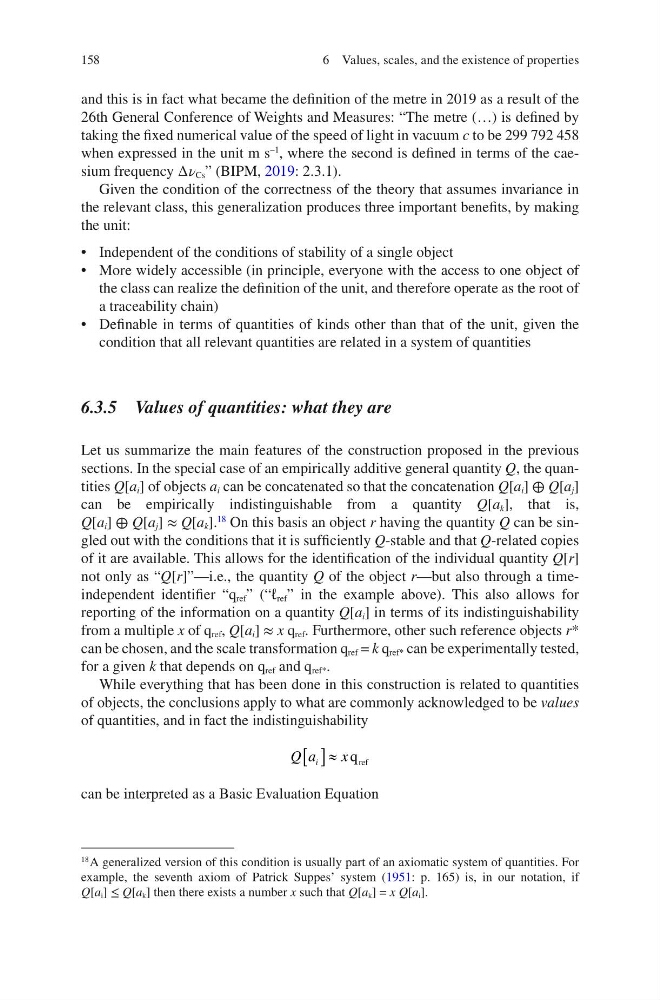
of quantities, and in fact the indistinguishability
Q a
x
i
[ ]≈ q ref
can be interpreted as a Basic Evaluation Equation
18 A generalized version of this condition is usually part of an axiomatic system of quantities. For
example, the seventh axiom of Patrick Suppes’ system (1951: p. 165) is, in our notation, if
Q[a i ] ≤ Q[a k ] then there exists a number x such that Q[a k ] = x Q[a i ].
6 Values, scales, and the existence of properties
and this is in fact what became the definition of the metre in 2019 as a result of the
26th General Conference of Weights and Measures: “The metre (…) is defined by
taking the fixed numerical value of the speed of light in vacuum c to be 299 792 458
when expressed in the unit m s
–1
, where the second is defined in terms of the caesium frequency ∆ν Cs ” (BIPM, 2019: 2.3.1).
Given the condition of the correctness of the theory that assumes invariance in
the relevant class, this generalization produces three important benefits, by making
the unit:
• Independent of the conditions of stability of a single object
• More widely accessible (in principle, everyone with the access to one object of
the class can realize the definition of the unit, and therefore operate as the root of
a traceability chain)
• Definable in terms of quantities of kinds other than that of the unit, given the
condition that all relevant quantities are related in a system of quantities
6.3.5 Values of quantities: what they are
Let us summarize the main features of the construction proposed in the previous
sections. In the special case of an empirically additive general quantity Q, the quantities Q[a i ] of objects a i can be concatenated so that the concatenation Q[a i ] ⊕ Q[a j ]
can be empirically indistinguishable from a quantity Q[a k ], that is,
Q[a i ] ⊕ Q[a j ] ≈ Q[a k ].
18
On this basis an object r having the quantity Q can be singled out with the conditions that it is sufficiently Q-stable and that Q-related copies
of it are available. This allows for the identification of the individual quantity Q[r]
not only as “Q[r]”—i.e., the quantity Q of the object r—but also through a timeindependent identifier “q ref ” (“ℓ ref ” in the example above). This also allows for
reporting of the information on a quantity Q[a i ] in terms of its indistinguishability
from a multiple x of q ref , Q[a i ] ≈ x q ref . Furthermore, other such reference objects r*
can be chosen, and the scale transformation q ref = k q ref* can be experimentally tested,
for a given k that depends on q ref and q ref* .
While everything that has been done in this construction is related to quantities
of objects, the conclusions apply to what are commonly acknowledged to be values
of quantities, and in fact the indistinguishability
Q a
x
i
[ ]≈ q ref
can be interpreted as a Basic Evaluation Equation
18 A generalized version of this condition is usually part of an axiomatic system of quantities. For
example, the seventh axiom of Patrick Suppes’ system (1951: p. 165) is, in our notation, if
Q[a i ] ≤ Q[a k ] then there exists a number x such that Q[a k ] = x Q[a i ].
6 Values, scales, and the existence of properties