

155
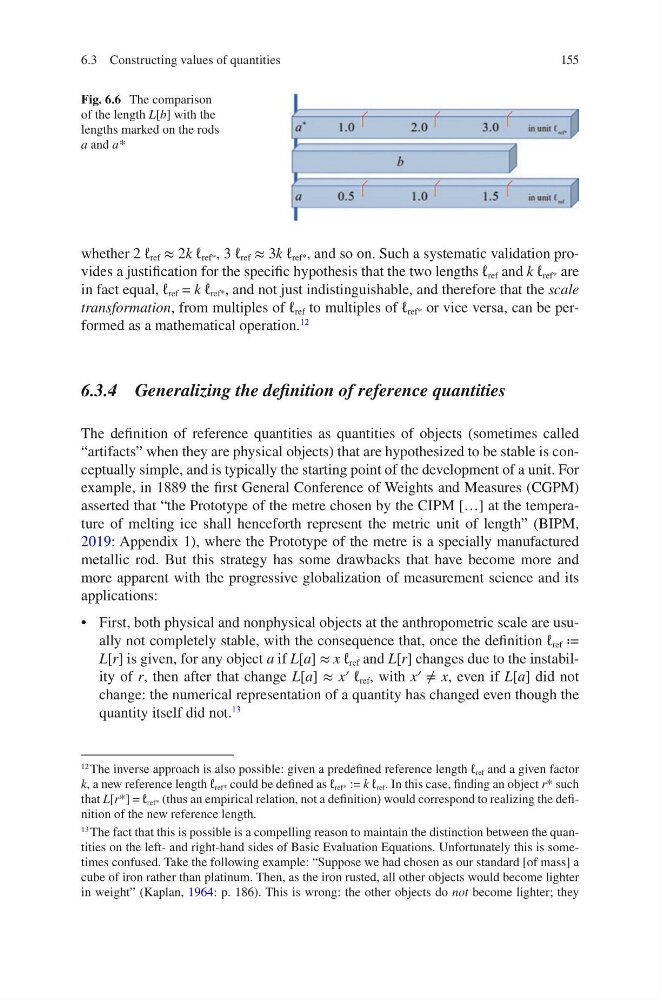
whether 2 ℓ ref ≈ 2k ℓ ref* , 3 ℓ ref ≈ 3k ℓ ref* , and so on. Such a systematic validation provides a justification for the specific hypothesis that the two lengths ℓ ref and k ℓ ref* are
in fact equal, ℓ ref = k ℓ ref* , and not just indistinguishable, and therefore that the scale
transformation, from multiples of ℓ ref to multiples of ℓ ref* or vice versa, can be performed as a mathematical operation.
12
6.3.4 Generalizing the definition of reference quantities
The definition of reference quantities as quantities of objects (sometimes called
“artifacts” when they are physical objects) that are hypothesized to be stable is conceptually simple, and is typically the starting point of the development of a unit. For
example, in 1889 the first General Conference of Weights and Measures (CGPM)
asserted that “the Prototype of the metre chosen by the CIPM […] at the temperature of melting ice shall henceforth represent the metric unit of length” (BIPM,
2019: Appendix 1), where the Prototype of the metre is a specially manufactured
metallic rod. But this strategy has some drawbacks that have become more and
more apparent with the progressive globalization of measurement science and its
applications:
• First, both physical and nonphysical objects at the anthropometric scale are usually not completely stable, with the consequence that, once the definition ℓ ref ≔
L[r] is given, for any object a if L[a] ≈ x ℓ ref and L[r] changes due to the instability of r, then after that change L[a] ≈ x′ ℓ ref , with x′ ≠ x, even if L[a] did not
change: the numerical representation of a quantity has changed even though the
quantity itself did not.
13
12 The inverse approach is also possible: given a predefined reference length ℓ ref and a given factor
k, a new reference length ℓ ref* could be defined as ℓ ref* := k ℓ ref . In this case, finding an object r* such
that L[r*] = ℓ ref* (thus an empirical relation, not a definition) would correspond to realizing the definition of the new reference length.
13 The fact that this is possible is a compelling reason to maintain the distinction between the quantities on the left- and right-hand sides of Basic Evaluation Equations. Unfortunately this is sometimes confused. Take the following example: “Suppose we had chosen as our standard [of mass] a
cube of iron rather than platinum. Then, as the iron rusted, all other objects would become lighter
in weight” (Kaplan, 1964: p. 186). This is wrong: the other objects do not become lighter; they
Fig. 6.6 The comparison
of the length L[b] with the
lengths marked on the rods
a and a*
6.3 Constructing values of quantities
whether 2 ℓ ref ≈ 2k ℓ ref* , 3 ℓ ref ≈ 3k ℓ ref* , and so on. Such a systematic validation provides a justification for the specific hypothesis that the two lengths ℓ ref and k ℓ ref* are
in fact equal, ℓ ref = k ℓ ref* , and not just indistinguishable, and therefore that the scale
transformation, from multiples of ℓ ref to multiples of ℓ ref* or vice versa, can be performed as a mathematical operation.
12
6.3.4 Generalizing the definition of reference quantities
The definition of reference quantities as quantities of objects (sometimes called
“artifacts” when they are physical objects) that are hypothesized to be stable is conceptually simple, and is typically the starting point of the development of a unit. For
example, in 1889 the first General Conference of Weights and Measures (CGPM)
asserted that “the Prototype of the metre chosen by the CIPM […] at the temperature of melting ice shall henceforth represent the metric unit of length” (BIPM,
2019: Appendix 1), where the Prototype of the metre is a specially manufactured
metallic rod. But this strategy has some drawbacks that have become more and
more apparent with the progressive globalization of measurement science and its
applications:
• First, both physical and nonphysical objects at the anthropometric scale are usually not completely stable, with the consequence that, once the definition ℓ ref ≔
L[r] is given, for any object a if L[a] ≈ x ℓ ref and L[r] changes due to the instability of r, then after that change L[a] ≈ x′ ℓ ref , with x′ ≠ x, even if L[a] did not
change: the numerical representation of a quantity has changed even though the
quantity itself did not.
13
12 The inverse approach is also possible: given a predefined reference length ℓ ref and a given factor
k, a new reference length ℓ ref* could be defined as ℓ ref* := k ℓ ref . In this case, finding an object r* such
that L[r*] = ℓ ref* (thus an empirical relation, not a definition) would correspond to realizing the definition of the new reference length.
13 The fact that this is possible is a compelling reason to maintain the distinction between the quantities on the left- and right-hand sides of Basic Evaluation Equations. Unfortunately this is sometimes confused. Take the following example: “Suppose we had chosen as our standard [of mass] a
cube of iron rather than platinum. Then, as the iron rusted, all other objects would become lighter
in weight” (Kaplan, 1964: p. 186). This is wrong: the other objects do not become lighter; they
Fig. 6.6 The comparison
of the length L[b] with the
lengths marked on the rods
a and a*
6.3 Constructing values of quantities