

153
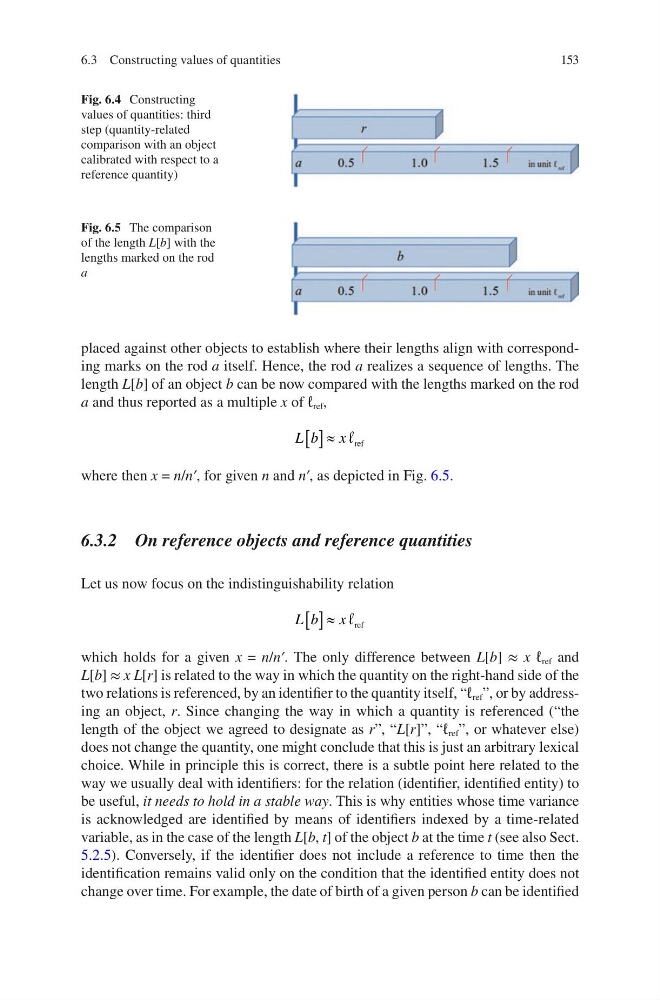
placed against other objects to establish where their lengths align with corresponding marks on the rod a itself. Hence, the rod a realizes a sequence of lengths. The
length L[b] of an object b can be now compared with the lengths marked on the rod
a and thus reported as a multiple x of ℓ ref ,
L b x
[ ] ≈ l ref
where then x = n/n′, for given n and n′, as depicted in Fig. 6.5.
6.3.2 On reference objects and reference quantities
Let us now focus on the indistinguishability relation
L b x
[ ] ≈ l ref
which holds for a given x = n/n′. The only difference between L[b] ≈ x ℓ ref and
L[b] ≈ x L[r] is related to the way in which the quantity on the right-hand side of the
two relations is referenced, by an identifier to the quantity itself, “ℓ ref ”, or by addressing an object, r. Since changing the way in which a quantity is referenced (“the
length of the object we agreed to designate as r”, “L[r]”, “ℓ ref ”, or whatever else)
does not change the quantity, one might conclude that this is just an arbitrary lexical
choice. While in principle this is correct, there is a subtle point here related to the
way we usually deal with identifiers: for the relation (identifier, identified entity) to
be useful, it needs to hold in a stable way. This is why entities whose time variance
is acknowledged are identified by means of identifiers indexed by a time-related
variable, as in the case of the length L[b, t] of the object b at the time t (see also Sect.
5.2.5). Conversely, if the identifier does not include a reference to time then the
identification remains valid only on the condition that the identified entity does not
change over time. For example, the date of birth of a given person b can be identified
Fig. 6.4 Constructing
values of quantities: third
step (quantity-related
comparison with an object
calibrated with respect to a
reference quantity)
Fig. 6.5 The comparison
of the length L[b] with the
lengths marked on the rod
a
6.3 Constructing values of quantities
placed against other objects to establish where their lengths align with corresponding marks on the rod a itself. Hence, the rod a realizes a sequence of lengths. The
length L[b] of an object b can be now compared with the lengths marked on the rod
a and thus reported as a multiple x of ℓ ref ,
L b x
[ ] ≈ l ref
where then x = n/n′, for given n and n′, as depicted in Fig. 6.5.
6.3.2 On reference objects and reference quantities
Let us now focus on the indistinguishability relation
L b x
[ ] ≈ l ref
which holds for a given x = n/n′. The only difference between L[b] ≈ x ℓ ref and
L[b] ≈ x L[r] is related to the way in which the quantity on the right-hand side of the
two relations is referenced, by an identifier to the quantity itself, “ℓ ref ”, or by addressing an object, r. Since changing the way in which a quantity is referenced (“the
length of the object we agreed to designate as r”, “L[r]”, “ℓ ref ”, or whatever else)
does not change the quantity, one might conclude that this is just an arbitrary lexical
choice. While in principle this is correct, there is a subtle point here related to the
way we usually deal with identifiers: for the relation (identifier, identified entity) to
be useful, it needs to hold in a stable way. This is why entities whose time variance
is acknowledged are identified by means of identifiers indexed by a time-related
variable, as in the case of the length L[b, t] of the object b at the time t (see also Sect.
5.2.5). Conversely, if the identifier does not include a reference to time then the
identification remains valid only on the condition that the identified entity does not
change over time. For example, the date of birth of a given person b can be identified
Fig. 6.4 Constructing
values of quantities: third
step (quantity-related
comparison with an object
calibrated with respect to a
reference quantity)
Fig. 6.5 The comparison
of the length L[b] with the
lengths marked on the rod
a
6.3 Constructing values of quantities