

132
in particular its being long has not changed,
29
while, plausibly among other properties, its being heavy has changed.
A complementary basic assumption is that property-related comparability is
applicable not only to the same object in different time instants, but also to different
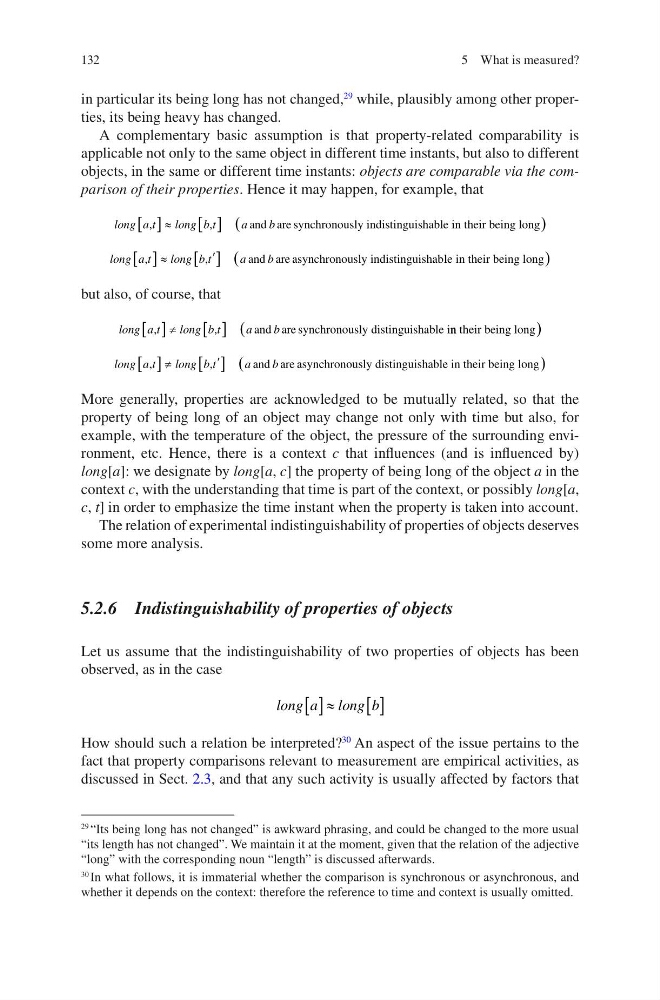
objects, in the same or different time instants: objects are comparable via the comparison of their properties. Hence it may happen, for example, that
long a t
long b t
a
b
,
,
and are synchronously indistinguishable
> @
> @
|
in their being long
long a t
long b t
a
b
,
,
and are asynchronously indistinguishab
> @
> @
|
c
l le in their being long
but also, of course, that
long a t
long b t
a
b
,
,
and are synchronously distinguishable i
> @
> @
z
n n their being long
long a t
long b t
a
b
,
,
and are asynchronously distinguishable
> @
> @
z
c
in their being long
More generally, properties are acknowledged to be mutually related, so that the
property of being long of an object may change not only with time but also, for
example, with the temperature of the object, the pressure of the surrounding environment, etc. Hence, there is a context c that influences (and is influenced by)
long[a]: we designate by long[a, c] the property of being long of the object a in the
context c, with the understanding that time is part of the context, or possibly long[a,
c, t] in order to emphasize the time instant when the property is taken into account.
The relation of experimental indistinguishability of properties of objects deserves
some more analysis.
5.2.6 Indistinguishability of properties of objects
Let us assume that the indistinguishability of two properties of objects has been
observed, as in the case
long a long b
> @ |
> @
How should such a relation be interpreted?
30
An aspect of the issue pertains to the
fact that property comparisons relevant to measurement are empirical activities, as
discussed in Sect. 2.3, and that any such activity is usually affected by factors that
29 “Its being long has not changed” is awkward phrasing, and could be changed to the more usual
“its length has not changed”. We maintain it at the moment, given that the relation of the adjective
“long” with the corresponding noun “length” is discussed afterwards.
30 In what follows, it is immaterial whether the comparison is synchronous or asynchronous, and
whether it depends on the context: therefore the reference to time and context is usually omitted.
5 What is measured?
in particular its being long has not changed,
29
while, plausibly among other properties, its being heavy has changed.
A complementary basic assumption is that property-related comparability is
applicable not only to the same object in different time instants, but also to different
objects, in the same or different time instants: objects are comparable via the comparison of their properties. Hence it may happen, for example, that
long a t
long b t
a
b
,
,
and are synchronously indistinguishable
> @
> @
|
in their being long
long a t
long b t
a
b
,
,
and are asynchronously indistinguishab
> @
> @
|
c
l le in their being long
but also, of course, that
long a t
long b t
a
b
,
,
and are synchronously distinguishable i
> @
> @
z
n n their being long
long a t
long b t
a
b
,
,
and are asynchronously distinguishable
> @
> @
z
c
in their being long
More generally, properties are acknowledged to be mutually related, so that the
property of being long of an object may change not only with time but also, for
example, with the temperature of the object, the pressure of the surrounding environment, etc. Hence, there is a context c that influences (and is influenced by)
long[a]: we designate by long[a, c] the property of being long of the object a in the
context c, with the understanding that time is part of the context, or possibly long[a,
c, t] in order to emphasize the time instant when the property is taken into account.
The relation of experimental indistinguishability of properties of objects deserves
some more analysis.
5.2.6 Indistinguishability of properties of objects
Let us assume that the indistinguishability of two properties of objects has been
observed, as in the case
long a long b
> @ |
> @
How should such a relation be interpreted?
30
An aspect of the issue pertains to the
fact that property comparisons relevant to measurement are empirical activities, as
discussed in Sect. 2.3, and that any such activity is usually affected by factors that
29 “Its being long has not changed” is awkward phrasing, and could be changed to the more usual
“its length has not changed”. We maintain it at the moment, given that the relation of the adjective
“long” with the corresponding noun “length” is discussed afterwards.
30 In what follows, it is immaterial whether the comparison is synchronous or asynchronous, and
whether it depends on the context: therefore the reference to time and context is usually omitted.
5 What is measured?