

114
formalized as
8
P a p
> @
for example
length rod a
>
@ 1 2345
.
m
or
reading comprehension ability student b
logits on a speci
>
@ 1 23
.
f fic RCA scale
or
blood type patient c A in the ABOsystem
>
@
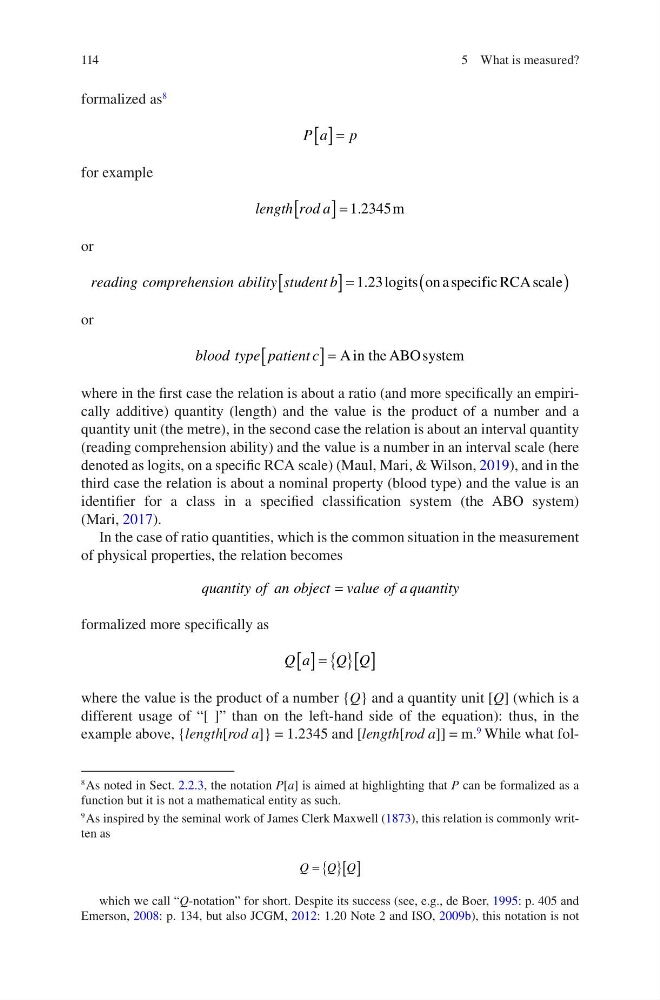
where in the first case the relation is about a ratio (and more specifically an empirically additive) quantity (length) and the value is the product of a number and a
quantity unit (the metre), in the second case the relation is about an interval quantity
(reading comprehension ability) and the value is a number in an interval scale (here
denoted as logits, on a specific RCA scale) (Maul, Mari, & Wilson, 2019), and in the
third case the relation is about a nominal property (blood type) and the value is an
identifier for a class in a specified classification system (the ABO system)
(Mari, 2017).
In the case of ratio quantities, which is the common situation in the measurement
of physical properties, the relation becomes
quantity of an object value of a quantity
=
formalized more specifically as
Q a
Q Q
> @ ^ `> @
where the value is the product of a number {Q} and a quantity unit [Q] (which is a
different usage of “[ ]” than on the left-hand side of the equation): thus, in the
example above, {length[rod a]} = 1.2345 and [length[rod a]] = m.
9
While what fol8 As noted in Sect. 2.2.3, the notation P[a] is aimed at highlighting that P can be formalized as a
function but it is not a mathematical entity as such.
9 As inspired by the seminal work of James Clerk Maxwell (1873), this relation is commonly written as
Q Q Q
^ `> @
which we call “Q-notation” for short. Despite its success (see, e.g., de Boer, 1995: p. 405 and
Emerson, 2008: p. 134, but also JCGM, 2012: 1.20 Note 2 and ISO, 2009b), this notation is not
5 What is measured?
formalized as
8
P a p
> @
for example
length rod a
>
@ 1 2345
.
m
or
reading comprehension ability student b
logits on a speci
>
@ 1 23
.
f fic RCA scale
or
blood type patient c A in the ABOsystem
>
@
where in the first case the relation is about a ratio (and more specifically an empirically additive) quantity (length) and the value is the product of a number and a
quantity unit (the metre), in the second case the relation is about an interval quantity
(reading comprehension ability) and the value is a number in an interval scale (here
denoted as logits, on a specific RCA scale) (Maul, Mari, & Wilson, 2019), and in the
third case the relation is about a nominal property (blood type) and the value is an
identifier for a class in a specified classification system (the ABO system)
(Mari, 2017).
In the case of ratio quantities, which is the common situation in the measurement
of physical properties, the relation becomes
quantity of an object value of a quantity
=
formalized more specifically as
Q a
Q Q
> @ ^ `> @
where the value is the product of a number {Q} and a quantity unit [Q] (which is a
different usage of “[ ]” than on the left-hand side of the equation): thus, in the
example above, {length[rod a]} = 1.2345 and [length[rod a]] = m.
9
While what fol8 As noted in Sect. 2.2.3, the notation P[a] is aimed at highlighting that P can be formalized as a
function but it is not a mathematical entity as such.
9 As inspired by the seminal work of James Clerk Maxwell (1873), this relation is commonly written as
Q Q Q
^ `> @
which we call “Q-notation” for short. Despite its success (see, e.g., de Boer, 1995: p. 405 and
Emerson, 2008: p. 134, but also JCGM, 2012: 1.20 Note 2 and ISO, 2009b), this notation is not
5 What is measured?