

68
3 In-Tether Chiral Center Induced Helical Peptide Modulators …
from the native p53-MDM2/MDMX complex to a suitably stable, potent, and specific
therapeutic agent. Verdine et al. reported a helical stabilized SAH-P53-8 peptide
which reactivated p53 in vitro with limited biological potency in cellular assays
[15]. Lane et al. reported a phage-derived sMTide02-02A peptide which displayed
greater activity than SAH-8 and nutlin-3a [25]. Sawyer et al. reported on the stapled
peptide ATSP-7041, a highly potent dual inhibitor of both MDM2 and MDMX with
both in vitro and in vivo activity [26]. Although great successes in the modulation of
p53-MDM2/X interaction by peptide-based ligands have been achieved, only limited
in vivo studies were reported and more research is required to tackle this important
PPI.
The resistance of cancer stem/progenitor cells (CSPCs) to chemotherapy leads
to cancer relapse. Ovarian teratocarcinoma (OVTC) arises from germ cells and
comprises pluripotent cells [27–29]. The PA-1 cell line, derived from human ovarian
teratocarcinoma cells, is a well-accepted model for studying cancer cell stemness
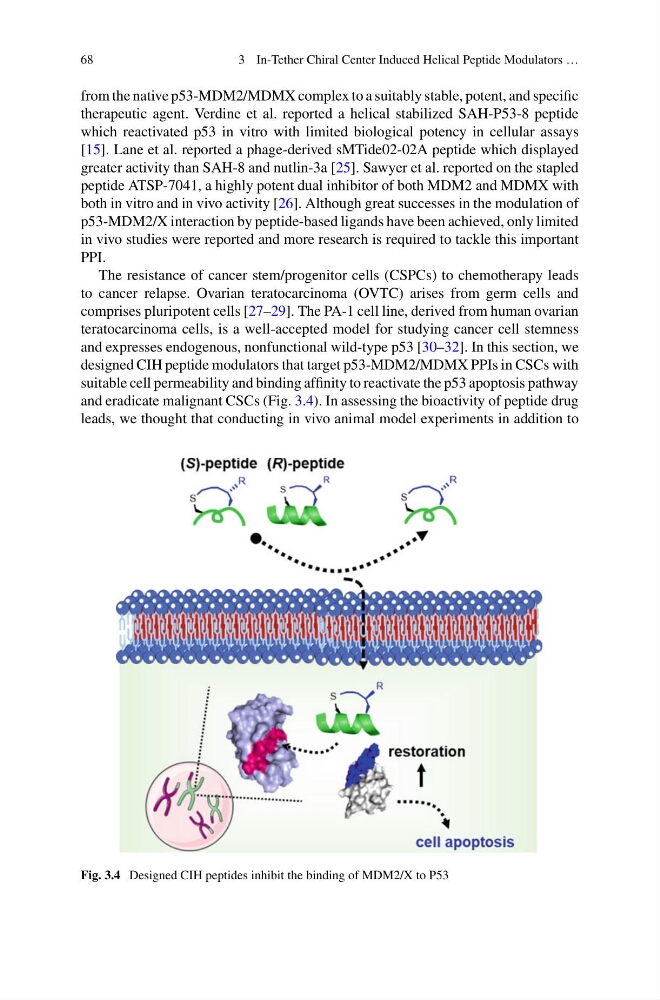
and expresses endogenous, nonfunctional wild-type p53 [30–32]. In this section, we
designed CIH peptide modulators that target p53-MDM2/MDMX PPIs in CSCs with
suitable cell permeability and binding affinity to reactivate the p53 apoptosis pathway
and eradicate malignant CSCs (Fig. 3.4). In assessing the bioactivity of peptide drug
leads, we thought that conducting in vivo animal model experiments in addition to
Fig. 3.4 Designed CIH peptides inhibit the binding of MDM2/X to P53
3 In-Tether Chiral Center Induced Helical Peptide Modulators …
from the native p53-MDM2/MDMX complex to a suitably stable, potent, and specific
therapeutic agent. Verdine et al. reported a helical stabilized SAH-P53-8 peptide
which reactivated p53 in vitro with limited biological potency in cellular assays
[15]. Lane et al. reported a phage-derived sMTide02-02A peptide which displayed
greater activity than SAH-8 and nutlin-3a [25]. Sawyer et al. reported on the stapled
peptide ATSP-7041, a highly potent dual inhibitor of both MDM2 and MDMX with
both in vitro and in vivo activity [26]. Although great successes in the modulation of
p53-MDM2/X interaction by peptide-based ligands have been achieved, only limited
in vivo studies were reported and more research is required to tackle this important
PPI.
The resistance of cancer stem/progenitor cells (CSPCs) to chemotherapy leads
to cancer relapse. Ovarian teratocarcinoma (OVTC) arises from germ cells and
comprises pluripotent cells [27–29]. The PA-1 cell line, derived from human ovarian
teratocarcinoma cells, is a well-accepted model for studying cancer cell stemness
and expresses endogenous, nonfunctional wild-type p53 [30–32]. In this section, we
designed CIH peptide modulators that target p53-MDM2/MDMX PPIs in CSCs with
suitable cell permeability and binding affinity to reactivate the p53 apoptosis pathway
and eradicate malignant CSCs (Fig. 3.4). In assessing the bioactivity of peptide drug
leads, we thought that conducting in vivo animal model experiments in addition to
Fig. 3.4 Designed CIH peptides inhibit the binding of MDM2/X to P53