

12
1 Introduction
S
S
S
H
N
N
O
N
N
3
thiol-ether
bis-thioether
lactam
triazole
all hydrocarbon
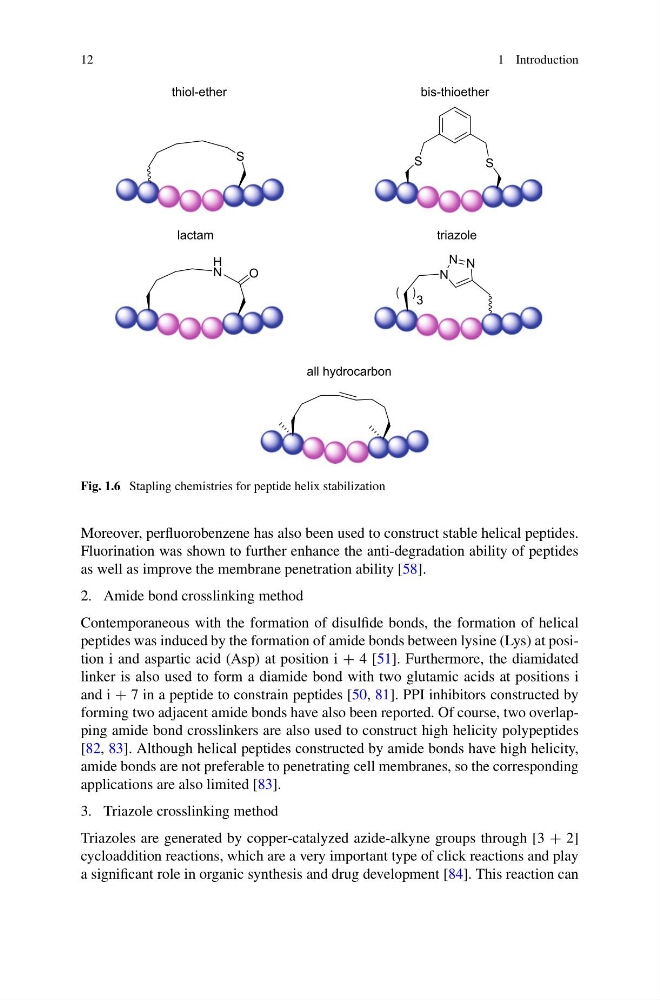
Fig. 1.6 Stapling chemistries for peptide helix stabilization
Moreover, perfluorobenzene has also been used to construct stable helical peptides.
Fluorination was shown to further enhance the anti-degradation ability of peptides
as well as improve the membrane penetration ability [58].
2. Amide bond crosslinking method
Contemporaneous with the formation of disulfide bonds, the formation of helical
peptides was induced by the formation of amide bonds between lysine (Lys) at position i and aspartic acid (Asp) at position i + 4 [51]. Furthermore, the diamidated
linker is also used to form a diamide bond with two glutamic acids at positions i
and i + 7 in a peptide to constrain peptides [50, 81]. PPI inhibitors constructed by
forming two adjacent amide bonds have also been reported. Of course, two overlapping amide bond crosslinkers are also used to construct high helicity polypeptides
[82, 83]. Although helical peptides constructed by amide bonds have high helicity,
amide bonds are not preferable to penetrating cell membranes, so the corresponding
applications are also limited [83].
3. Triazole crosslinking method
Triazoles are generated by copper-catalyzed azide-alkyne groups through [3 + 2]
cycloaddition reactions, which are a very important type of click reactions and play
a significant role in organic synthesis and drug development [84]. This reaction can
1 Introduction
S
S
S
H
N
N
O
N
N
3
thiol-ether
bis-thioether
lactam
triazole
all hydrocarbon
Fig. 1.6 Stapling chemistries for peptide helix stabilization
Moreover, perfluorobenzene has also been used to construct stable helical peptides.
Fluorination was shown to further enhance the anti-degradation ability of peptides
as well as improve the membrane penetration ability [58].
2. Amide bond crosslinking method
Contemporaneous with the formation of disulfide bonds, the formation of helical
peptides was induced by the formation of amide bonds between lysine (Lys) at position i and aspartic acid (Asp) at position i + 4 [51]. Furthermore, the diamidated
linker is also used to form a diamide bond with two glutamic acids at positions i
and i + 7 in a peptide to constrain peptides [50, 81]. PPI inhibitors constructed by
forming two adjacent amide bonds have also been reported. Of course, two overlapping amide bond crosslinkers are also used to construct high helicity polypeptides
[82, 83]. Although helical peptides constructed by amide bonds have high helicity,
amide bonds are not preferable to penetrating cell membranes, so the corresponding
applications are also limited [83].
3. Triazole crosslinking method
Triazoles are generated by copper-catalyzed azide-alkyne groups through [3 + 2]
cycloaddition reactions, which are a very important type of click reactions and play
a significant role in organic synthesis and drug development [84]. This reaction can