

(R) during the Holocene (Kennett et al. 2002) to be quantified. While the modern value of R varies from 540 years to
970 years depending of the intensity of the Peruvian
upwelling (the rise to the surface of
14 C-depleted intermediate and deep waters), it was slightly lower at 430 years
between 5000 and 5300 cal BP and much lower at only
30 years between 5600 and 5900 cal BP. The much lower
value of R is very unlikely, as charcoals and associated
mollusk shells would have the same
14 C ages. This may be
due to two phenomena: the charcoals originate from the
burning of old trees at the time of burial (living over some
hundred years) or the small charcoals migrated downwards
in the archaeological layers. Only statistical analyses of the
14 C ages of charcoals and shells would enable a conclusion
to be reached. This Peruvian study clearly emphasizes that
charcoals are not always the best candidates in radiocarbon
dating.
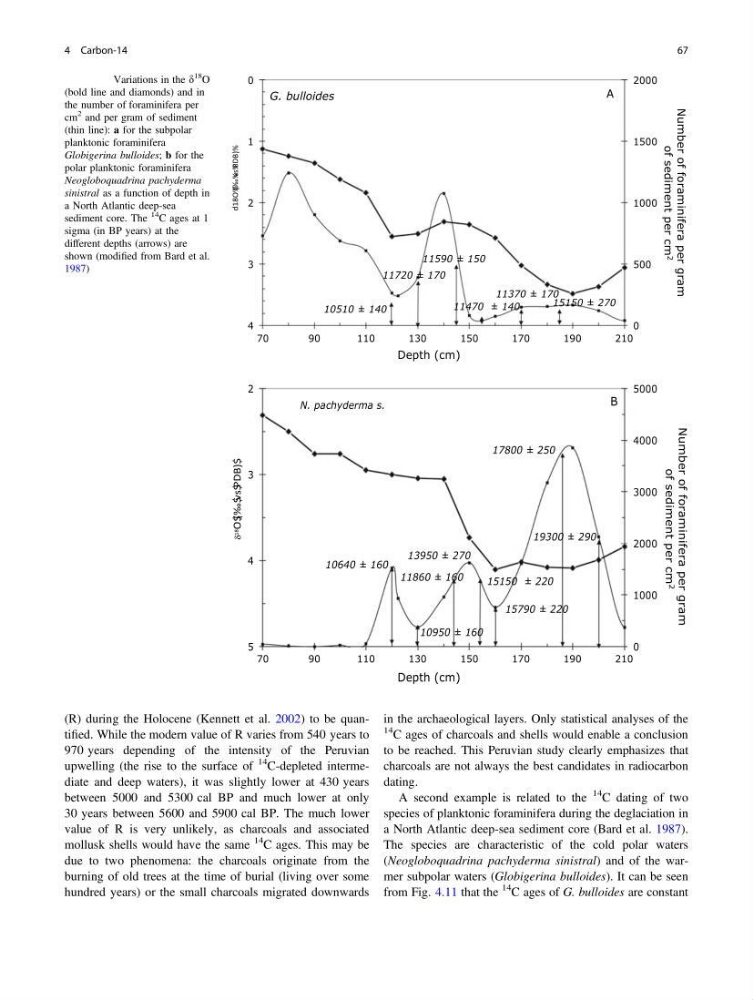
A second example is related to the
14 C dating of two
species of planktonic foraminifera during the deglaciation in
a North Atlantic deep-sea sediment core (Bard et al. 1987).
The species are characteristic of the cold polar waters
(Neogloboquadrina pachyderma sinistral) and of the warmer subpolar waters (Globigerina bulloides). It can be seen
from Fig. 4.11 that the
14 C ages of G. bulloides are constant
0
500
1000
1500
2000
0
1
2
3
4
70
90
110
130
150
170
190
210
70
90
110
130
150
170
190
210
d18O% (‰% vs% PDB)%
Depth (cm)
10510 ± 140
11720 ± 170
11590 ± 150
11470 ± 140
11370 ± 170
G. bulloides
15150 ± 270
A
Number of foraminifera per gram
of sediment per cm 2
0
1000
2000
3000
4000
5000
2
3
4
5
δ 18
O$ (‰$vs$PDB)$
Depth (cm)
10640 ± 160
11860 ± 160
13950 ± 270
15150 ± 220
15790 ± 220
N. pachyderma s.
17800 ± 250
19300 ± 290
B
Number of foraminifera per gram
of sediment per cm 2
10950 ± 160
Fig. 4.11 Variations in the d
18
O
(bold line and diamonds) and in
the number of foraminifera per
cm
2 and per gram of sediment
(thin line): a for the subpolar
planktonic foraminifera
Globigerina bulloides; b for the
polar planktonic foraminifera
Neogloboquadrina pachyderma
sinistral as a function of depth in
a North Atlantic deep-sea
sediment core. The
14 C ages at 1
sigma (in BP years) at the
different depths (arrows) are
shown (modified from Bard et al.
1987)
4 Carbon-14
67
970 years depending of the intensity of the Peruvian
upwelling (the rise to the surface of
14 C-depleted intermediate and deep waters), it was slightly lower at 430 years
between 5000 and 5300 cal BP and much lower at only
30 years between 5600 and 5900 cal BP. The much lower
value of R is very unlikely, as charcoals and associated
mollusk shells would have the same
14 C ages. This may be
due to two phenomena: the charcoals originate from the
burning of old trees at the time of burial (living over some
hundred years) or the small charcoals migrated downwards
in the archaeological layers. Only statistical analyses of the
14 C ages of charcoals and shells would enable a conclusion
to be reached. This Peruvian study clearly emphasizes that
charcoals are not always the best candidates in radiocarbon
dating.
A second example is related to the
14 C dating of two
species of planktonic foraminifera during the deglaciation in
a North Atlantic deep-sea sediment core (Bard et al. 1987).
The species are characteristic of the cold polar waters
(Neogloboquadrina pachyderma sinistral) and of the warmer subpolar waters (Globigerina bulloides). It can be seen
from Fig. 4.11 that the
14 C ages of G. bulloides are constant
0
500
1000
1500
2000
0
1
2
3
4
70
90
110
130
150
170
190
210
70
90
110
130
150
170
190
210
d18O% (‰% vs% PDB)%
Depth (cm)
10510 ± 140
11720 ± 170
11590 ± 150
11470 ± 140
11370 ± 170
G. bulloides
15150 ± 270
A
Number of foraminifera per gram
of sediment per cm 2
0
1000
2000
3000
4000
5000
2
3
4
5
δ 18
O$ (‰$vs$PDB)$
Depth (cm)
10640 ± 160
11860 ± 160
13950 ± 270
15150 ± 220
15790 ± 220
N. pachyderma s.
17800 ± 250
19300 ± 290
B
Number of foraminifera per gram
of sediment per cm 2
10950 ± 160
Fig. 4.11 Variations in the d
18
O
(bold line and diamonds) and in
the number of foraminifera per
cm
2 and per gram of sediment
(thin line): a for the subpolar
planktonic foraminifera
Globigerina bulloides; b for the
polar planktonic foraminifera
Neogloboquadrina pachyderma
sinistral as a function of depth in
a North Atlantic deep-sea
sediment core. The
14 C ages at 1
sigma (in BP years) at the
different depths (arrows) are
shown (modified from Bard et al.
1987)
4 Carbon-14
67