

organic matter in the soil. Instrumented monitoring of the
13 C content in experimental soil plots can be used to estimate
the mean residence time from a few years to some decades.
Many studies have been conducted since the beginning of
the
14 C method (Balesdent and Guillet 1982; Gaudinsky
et al. 2000). At first, they were carried out by radioactive
counting measurements (a few grams of carbon), and then by
mass spectrometry coupled to an accelerator (AMS), which
did not allow the targeted molecular level to be reached,
because a few milligrams of carbon were still required.
Nevertheless, their scope was large, and they identified
kinetic pools among the various elements of the soil’s
organic matter, in other words, compartments that can be
defined by a specific carbon residence time. It has been
shown that the residence time of different carbon compartments in soil can range from one to several decades or even
to a few thousand years for the stable fraction.
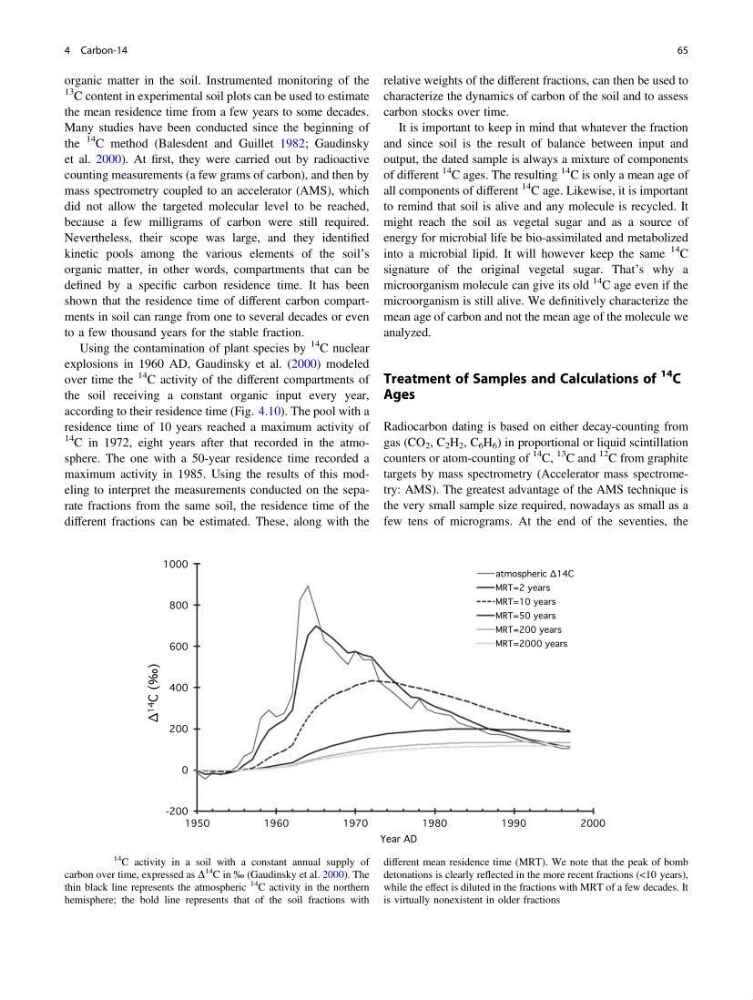
Using the contamination of plant species by
14 C nuclear
explosions in 1960 AD, Gaudinsky et al. (2000) modeled
over time the
14 C activity of the different compartments of
the soil receiving a constant organic input every year,
according to their residence time (Fig. 4.10). The pool with a
residence time of 10 years reached a maximum activity of
14 C in 1972, eight years after that recorded in the atmosphere. The one with a 50-year residence time recorded a
maximum activity in 1985. Using the results of this modeling to interpret the measurements conducted on the separate fractions from the same soil, the residence time of the
different fractions can be estimated. These, along with the
relative weights of the different fractions, can then be used to
characterize the dynamics of carbon of the soil and to assess
carbon stocks over time.
It is important to keep in mind that whatever the fraction
and since soil is the result of balance between input and
output, the dated sample is always a mixture of components
of different
14 C ages. The resulting
14 C is only a mean age of
all components of different
14 C age. Likewise, it is important
to remind that soil is alive and any molecule is recycled. It
might reach the soil as vegetal sugar and as a source of
energy for microbial life be bio-assimilated and metabolized
into a microbial lipid. It will however keep the same
14 C
signature of the original vegetal sugar. That’s why a
microorganism molecule can give its old
14 C age even if the
microorganism is still alive. We definitively characterize the
mean age of carbon and not the mean age of the molecule we
analyzed.
Treatment of Samples and Calculations of
14
C
Ages
Radiocarbon dating is based on either decay-counting from
gas (CO 2 , C 2 H 2 , C 6 H 6 ) in proportional or liquid scintillation
counters or atom-counting of
14
C,
13 C and
12 C from graphite
targets by mass spectrometry (Accelerator mass spectrometry: AMS). The greatest advantage of the AMS technique is
the very small sample size required, nowadays as small as a
few tens of micrograms. At the end of the seventies, the
Fig. 4.10
14
C activity in a soil with a constant annual supply of
carbon over time, expressed as D
14
C in ‰ (Gaudinsky et al. 2000). The
thin black line represents the atmospheric
14
C activity in the northern
hemisphere; the bold line represents that of the soil fractions with
different mean residence time (MRT). We note that the peak of bomb
detonations is clearly reflected in the more recent fractions (<10 years),
while the effect is diluted in the fractions with MRT of a few decades. It
is virtually nonexistent in older fractions
4 Carbon-14
65
13 C content in experimental soil plots can be used to estimate
the mean residence time from a few years to some decades.
Many studies have been conducted since the beginning of
the
14 C method (Balesdent and Guillet 1982; Gaudinsky
et al. 2000). At first, they were carried out by radioactive
counting measurements (a few grams of carbon), and then by
mass spectrometry coupled to an accelerator (AMS), which
did not allow the targeted molecular level to be reached,
because a few milligrams of carbon were still required.
Nevertheless, their scope was large, and they identified
kinetic pools among the various elements of the soil’s
organic matter, in other words, compartments that can be
defined by a specific carbon residence time. It has been
shown that the residence time of different carbon compartments in soil can range from one to several decades or even
to a few thousand years for the stable fraction.
Using the contamination of plant species by
14 C nuclear
explosions in 1960 AD, Gaudinsky et al. (2000) modeled
over time the
14 C activity of the different compartments of
the soil receiving a constant organic input every year,
according to their residence time (Fig. 4.10). The pool with a
residence time of 10 years reached a maximum activity of
14 C in 1972, eight years after that recorded in the atmosphere. The one with a 50-year residence time recorded a
maximum activity in 1985. Using the results of this modeling to interpret the measurements conducted on the separate fractions from the same soil, the residence time of the
different fractions can be estimated. These, along with the
relative weights of the different fractions, can then be used to
characterize the dynamics of carbon of the soil and to assess
carbon stocks over time.
It is important to keep in mind that whatever the fraction
and since soil is the result of balance between input and
output, the dated sample is always a mixture of components
of different
14 C ages. The resulting
14 C is only a mean age of
all components of different
14 C age. Likewise, it is important
to remind that soil is alive and any molecule is recycled. It
might reach the soil as vegetal sugar and as a source of
energy for microbial life be bio-assimilated and metabolized
into a microbial lipid. It will however keep the same
14 C
signature of the original vegetal sugar. That’s why a
microorganism molecule can give its old
14 C age even if the
microorganism is still alive. We definitively characterize the
mean age of carbon and not the mean age of the molecule we
analyzed.
Treatment of Samples and Calculations of
14
C
Ages
Radiocarbon dating is based on either decay-counting from
gas (CO 2 , C 2 H 2 , C 6 H 6 ) in proportional or liquid scintillation
counters or atom-counting of
14
C,
13 C and
12 C from graphite
targets by mass spectrometry (Accelerator mass spectrometry: AMS). The greatest advantage of the AMS technique is
the very small sample size required, nowadays as small as a
few tens of micrograms. At the end of the seventies, the
Fig. 4.10
14
C activity in a soil with a constant annual supply of
carbon over time, expressed as D
14
C in ‰ (Gaudinsky et al. 2000). The
thin black line represents the atmospheric
14
C activity in the northern
hemisphere; the bold line represents that of the soil fractions with
different mean residence time (MRT). We note that the peak of bomb
detonations is clearly reflected in the more recent fractions (<10 years),
while the effect is diluted in the fractions with MRT of a few decades. It
is virtually nonexistent in older fractions
4 Carbon-14
65