

in the ash-bed (Friedrich et al. 2006). The discovery of an
olive branch with leaves buried in the ash bed enabled a very
precise dating of the eruption. Friedrich et al. (2006) dated
the annual tree-rings of a piece of branch (Fig. 4.5). The
variation (wiggle) of the
14 C ages in the tree-ring matched
precisely that of the calibration record, the number of calendar years being equal to that of the tree-rings.
The calendar age of the eruption of Santorini was thus
estimated to be between 1627 and 1600 BC, with a confidence level of 95%. The apogee of the Minoan civilization
would then be earlier than that of the New Kingdom, and
would be contemporary to the time when foreign kings—
Hyksos—occupied the country (Friedrich et al. 2006).
The Bipolar Seesaw or the North-South Heat
Transfer
Rapid fluctuations of climate, referred to as Heinrich events,
Younger Dryas, and Dansgard-Oeschger events, punctuated
the last glacial period and the deglaciation.
They were attributed to variations in the thermohaline
oceanic circulation (see Chap. 21). The mechanisms of these
rapid fluctuations were clarified by the analysis of the
14 C
variations in the varved deposits in the Cariaco Basin
(Hughen et al. 1998; Reimer et al. 2013). The atmospheric
14 CO 2 concentration is very sensitive to the rate of formation
of deep water, because the CO 2 in the atmosphere is transferred to the deeper layers of the ocean via the oceanic circulation. This rate also regulates the heat transfer to the
northern high latitudes. During the cold event of the
Younger Dryas, which lasted approximately 1200 calendar
years, the atmospheric Δ
14 C increased (younger
14 C ages)
during the first 200 years and then decreased during the
following 1000 years (Fig. 4.6a). The increase of Δ
14 C is in
agreement with a reduction in the deepwater formation in the
northern North Atlantic, contributing to a cold climate, but
how may the further Δ
14
C decrease be explained when the
climate is still cold in the northern latitudes?
Glaciologists have shown that the abrupt cooling
observed in the northern hemisphere was accompanied by a
warming in Antarctica, and vice versa (Blunier et al. 1998).
Comparing these two results, Broecker (1998) proposed a
seesaw pattern of the north-south heat transfer via the ocean
or the “thermal bipolar seesaw” (Fig. 4.6b): a reduction in
deep water formation in the North Atlantic Ocean led to the
installation of a cold climate in the northern hemisphere and
an increase in the atmospheric
14 C. Deep waters further form
in the Southern Ocean contributing to the atmospheric Δ
14 C
decrease.
0
5000
10000
15000
20000
25000
30000
35000
0
5000
10000
15000
20000
25000
30000
35000
Radiocarbon ages (years BP)
Calendar Ages (years BP)
Dendrochronology
Barbados
Mururoa
8000
8500
9000
9500
10000
10500
11000
9000
11000
Radiocarbon ages (years BP)
Calendar Ages (years BP)
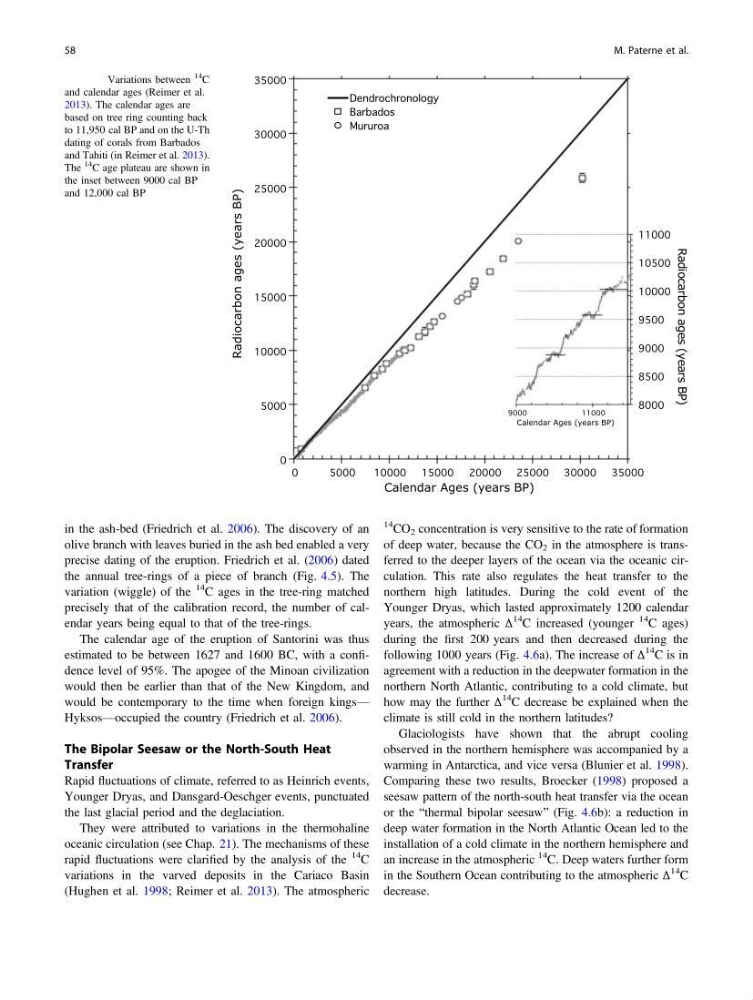
Fig. 4.3 Variations between
14
C
and calendar ages (Reimer et al.
2013). The calendar ages are
based on tree ring counting back
to 11,950 cal BP and on the U-Th
dating of corals from Barbados
and Tahiti (in Reimer et al. 2013).
The
14
C age plateau are shown in
the inset between 9000 cal BP
and 12,000 cal BP
58
M. Paterne et al.
olive branch with leaves buried in the ash bed enabled a very
precise dating of the eruption. Friedrich et al. (2006) dated
the annual tree-rings of a piece of branch (Fig. 4.5). The
variation (wiggle) of the
14 C ages in the tree-ring matched
precisely that of the calibration record, the number of calendar years being equal to that of the tree-rings.
The calendar age of the eruption of Santorini was thus
estimated to be between 1627 and 1600 BC, with a confidence level of 95%. The apogee of the Minoan civilization
would then be earlier than that of the New Kingdom, and
would be contemporary to the time when foreign kings—
Hyksos—occupied the country (Friedrich et al. 2006).
The Bipolar Seesaw or the North-South Heat
Transfer
Rapid fluctuations of climate, referred to as Heinrich events,
Younger Dryas, and Dansgard-Oeschger events, punctuated
the last glacial period and the deglaciation.
They were attributed to variations in the thermohaline
oceanic circulation (see Chap. 21). The mechanisms of these
rapid fluctuations were clarified by the analysis of the
14 C
variations in the varved deposits in the Cariaco Basin
(Hughen et al. 1998; Reimer et al. 2013). The atmospheric
14 CO 2 concentration is very sensitive to the rate of formation
of deep water, because the CO 2 in the atmosphere is transferred to the deeper layers of the ocean via the oceanic circulation. This rate also regulates the heat transfer to the
northern high latitudes. During the cold event of the
Younger Dryas, which lasted approximately 1200 calendar
years, the atmospheric Δ
14 C increased (younger
14 C ages)
during the first 200 years and then decreased during the
following 1000 years (Fig. 4.6a). The increase of Δ
14 C is in
agreement with a reduction in the deepwater formation in the
northern North Atlantic, contributing to a cold climate, but
how may the further Δ
14
C decrease be explained when the
climate is still cold in the northern latitudes?
Glaciologists have shown that the abrupt cooling
observed in the northern hemisphere was accompanied by a
warming in Antarctica, and vice versa (Blunier et al. 1998).
Comparing these two results, Broecker (1998) proposed a
seesaw pattern of the north-south heat transfer via the ocean
or the “thermal bipolar seesaw” (Fig. 4.6b): a reduction in
deep water formation in the North Atlantic Ocean led to the
installation of a cold climate in the northern hemisphere and
an increase in the atmospheric
14 C. Deep waters further form
in the Southern Ocean contributing to the atmospheric Δ
14 C
decrease.
0
5000
10000
15000
20000
25000
30000
35000
0
5000
10000
15000
20000
25000
30000
35000
Radiocarbon ages (years BP)
Calendar Ages (years BP)
Dendrochronology
Barbados
Mururoa
8000
8500
9000
9500
10000
10500
11000
9000
11000
Radiocarbon ages (years BP)
Calendar Ages (years BP)
Fig. 4.3 Variations between
14
C
and calendar ages (Reimer et al.
2013). The calendar ages are
based on tree ring counting back
to 11,950 cal BP and on the U-Th
dating of corals from Barbados
and Tahiti (in Reimer et al. 2013).
The
14
C age plateau are shown in
the inset between 9000 cal BP
and 12,000 cal BP
58
M. Paterne et al.